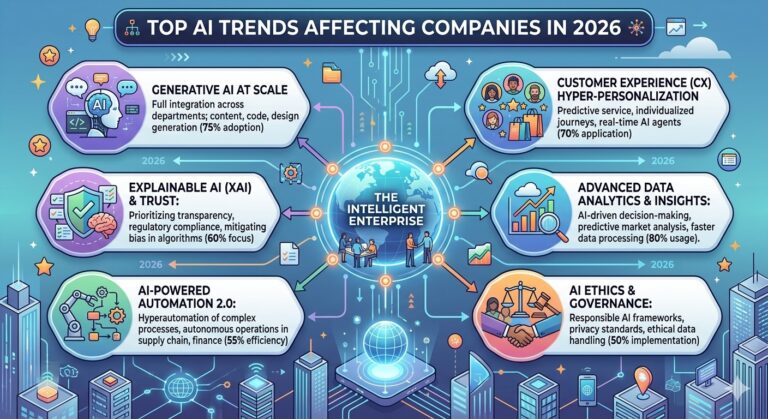
Top AI Trends Affecting Companies in 2026
Industries are still changing at a rate never seen before thanks to artificial intelligence. In order to boost productivity, enhance decision-making, and open up new development prospects, companies in a variety of industries are incorporating AI into their operations in 2026.
What started off as experimental technology is now an essential part of initiatives for digital transformation. To remain competitive in a world that is becoming more and more data-driven, many businesses are making significant investments in AI tools, infrastructure, and automation systems. In reality, as businesses prioritize AI-related technology in their budgets, global expenditure and usage of AI continue to climb. Coursera
Growth of Self-governing AI Agents
The rise of agentic AI, or autonomous systems that can carry out activities with little human supervision, is one of the most important developments of 2026.
Unlike traditional AI tools that simply respond to commands, AI agents can:
- Analyze data
- Make decisions
- Execute multi-step workflows
- Continuously optimize processes
For example, an AI agent in marketing could analyze customer data, design campaign strategies, launch advertisements, and adjust budgets automatically based on performance. These intelligent systems help businesses automate complex processes and reduce manual workload. (TechTarget)
Generative AI Becoming a Business Standard
Generative AI has evolved from a novelty to a mainstream business tool. In 2026, companies are using generative AI to create content, design products, generate code, and automate customer interactions.
Common generative AI applications include:
- Writing marketing content
- Creating product descriptions
- Generating images and videos
- Developing software code
Businesses that adopt generative AI can produce high-quality content faster while reducing operational costs.
Multimodal AI Enhancing Human Interaction
Multimodal AI systems are capable of understanding and generating multiple types of data, including text, images, video, and audio.
This technology enables more natural interactions between humans and machines. For example:
- Voice assistants that understand visual context
- AI tools that analyze videos and written reports together
- Customer service systems that interpret both voice and text inputs
As multimodal AI advances, businesses will be able to provide richer and more interactive digital experiences for their customers. (Coursera)
AI-Powered Automation Across Business Operations
Automation has always been a major benefit of AI, but in 2026 automation is becoming more intelligent and adaptable.
AI-driven automation can now handle tasks such as:
- Customer support
- Inventory management
- Financial analysis
- HR recruitment processes
These systems continuously learn from new data, allowing businesses to improve efficiency while reducing operational errors.
Increased Investment in AI Infrastructure
Another major trend is the growing investment in AI infrastructure, including data centers, custom AI chips, and advanced computing systems.
Large technology companies are investing heavily in AI hardware and infrastructure to support the increasing demand for AI-powered services. This shift highlights how AI is becoming a foundational technology for modern digital platforms and enterprise systems. (Reuters)
For businesses, this means faster and more powerful AI tools will become widely available.
AI-Driven Decision Making
Businesses are increasingly using AI analytics tools to make strategic decisions based on real-time data.
AI can analyze vast amounts of information from:
- Customer behavior
- Market trends
- Sales performance
- Operational data
By transforming raw data into actionable insights, AI helps organizations make smarter decisions and reduce risks.
Industry-Specific AI Solutions
In 2026, AI tools are becoming more specialized for specific industries. Rather than using generic AI systems, businesses are adopting solutions tailored to their unique needs.
Examples include:
- AI-powered diagnostics in healthcare
- Predictive maintenance in manufacturing
- Fraud detection in financial services
- Personalized recommendations in e-commerce
Industry-specific AI solutions provide higher accuracy and more relevant insights.
Ethical and Responsible AI Adoption
As AI becomes more powerful, businesses must address ethical concerns related to privacy, bias, and transparency.
Governments and regulatory bodies are introducing new guidelines to ensure responsible AI usage. Organizations must now implement practices such as:
- Transparent AI decision-making
- Responsible data handling
- Bias detection and mitigation
Responsible AI adoption will play a key role in building trust with customers and stakeholders.
AI Becoming a Collaborative Business Partner
Instead of replacing human workers, AI is increasingly functioning as a collaborative partner that enhances human productivity.
Employees are using AI tools to:
- Improve creativity
- Analyze complex data
- Automate repetitive work
- Generate ideas and solutions
This shift allows businesses to combine human expertise with AI capabilities, leading to better outcomes and innovation. (Source)
Conclusion
Artificial intelligence is rapidly reshaping the way businesses operate in 2026. From autonomous AI agents and generative AI to multimodal systems and intelligent automation, these trends are driving a new era of digital transformation.
Organizations that embrace these technologies will gain significant advantages in efficiency, innovation, and customer engagement.
By understanding and adopting the latest AI trends, businesses can stay competitive and unlock new opportunities in the evolving digital economy.