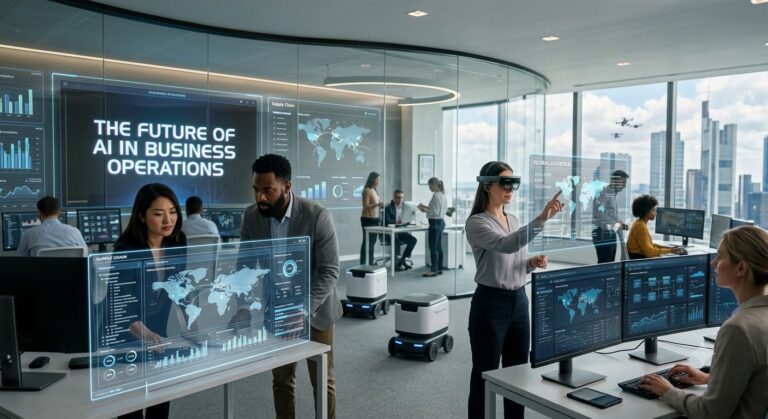
The Future of AI in Business Operations
Introduction
Artificial intelligence (AI) is rapidly changing the way businesses operate. What was once considered an emerging technology has become an essential tool for improving efficiency, reducing costs, and enhancing customer experiences. From automating repetitive tasks to providing real-time business insights, AI is helping organizations work smarter and adapt to an increasingly competitive marketplace.
As AI technology continues to evolve, its impact on business operations will become even greater. Companies across industries are investing in AI-powered solutions to streamline workflows, optimize decision-making, improve communication, and support long-term growth.
In this article, we’ll explore the future of AI in business operations, the trends shaping the next generation of business technology, and how organizations can prepare for an AI-driven future.
Why AI Is Transforming Business Operations
Modern businesses generate enormous amounts of data while managing increasingly complex workflows. Traditional processes often struggle to keep pace with growing customer expectations and operational demands.
AI helps businesses overcome these challenges by:
- Automating repetitive tasks
- Improving operational efficiency
- Enhancing customer service
- Supporting data-driven decisions
- Reducing human error
- Increasing productivity
These capabilities allow organizations to focus on innovation and strategic growth rather than manual administration.
Smarter Business Automation
One of the biggest trends shaping the future is intelligent automation.
Unlike traditional automation, AI can analyze information, learn from patterns, and continuously improve performance.
Future AI automation will help businesses:
- Automate end-to-end workflows
- Process documents intelligently
- Manage routine approvals
- Optimize inventory management
- Coordinate operational processes
As AI becomes more sophisticated, businesses will automate increasingly complex tasks while maintaining high levels of accuracy.
AI-Powered Decision Making
Business leaders rely on accurate information to make informed decisions.
Future AI systems will analyze massive datasets in real time to provide actionable recommendations.
AI-powered decision support can help businesses:
- Forecast demand
- Predict market trends
- Optimize pricing strategies
- Identify operational risks
- Improve financial planning
Rather than replacing leadership, AI will provide deeper insights that support better strategic decisions.
Predictive Business Operations
Predictive AI is expected to become a core part of future business operations.
By analyzing historical data and identifying patterns, AI can anticipate future events before they occur.
Examples include:
- Predicting equipment maintenance needs
- Forecasting customer demand
- Anticipating supply chain disruptions
- Identifying potential customer churn
- Detecting business risks
Predictive capabilities allow organizations to solve problems before they impact operations.
Enhanced Customer Service Through AI
Customer expectations continue to evolve, and AI will play an increasingly important role in meeting those expectations.
Future AI-powered customer service will include:
- More natural conversations
- Real-time language translation
- Emotion-aware interactions
- Personalized recommendations
- Predictive customer support
Businesses will be able to provide faster, more personalized, and more consistent customer experiences.
AI and Workforce Collaboration
Contrary to common misconceptions, the future of AI is not about replacing employees.
Instead, AI will become a collaborative partner that supports workers in their daily responsibilities.
AI will assist employees by:
- Automating repetitive work
- Organizing information
- Generating reports
- Providing recommendations
- Simplifying workflows
This collaboration allows employees to focus on creativity, innovation, and relationship-building.
Hyper-Personalized Customer Experiences
Future AI systems will create highly personalized interactions based on customer behavior, preferences, and real-time activity.
Businesses will use AI to:
- Customize marketing campaigns
- Personalize product recommendations
- Deliver tailored customer support
- Improve customer journeys
Personalization will become a key competitive advantage for organizations across industries.
AI-Driven Operational Efficiency
Operational efficiency will continue to improve as AI becomes integrated across business departments.
AI will help optimize:
- Human resources
- Finance
- Customer service
- Sales
- Marketing
- Supply chain management
- Inventory control
By connecting these functions through intelligent automation, businesses can operate more efficiently and respond faster to changing conditions.
Advanced Data Analytics
Data is one of the most valuable business assets, but its value depends on how effectively it is analyzed.
Future AI analytics platforms will:
- Process data in real time
- Identify hidden patterns
- Generate predictive insights
- Recommend business improvements
- Support faster decision-making
Organizations that leverage AI analytics will gain a stronger competitive advantage.
Improved Cybersecurity and Risk Management
As businesses become increasingly digital, cybersecurity will remain a top priority.
AI will strengthen security by:
- Detecting unusual activity
- Identifying potential cyber threats
- Monitoring network behavior
- Preventing fraud
- Responding to incidents automatically
Intelligent security systems will help organizations protect sensitive business and customer information.
AI for Remote and Hybrid Work
The future workplace will continue to embrace remote and hybrid work models.
AI will support distributed teams by:
- Automating meeting summaries
- Scheduling tasks
- Managing projects
- Translating conversations
- Improving team collaboration
These tools help businesses maintain productivity regardless of employee location.
Ethical and Responsible AI
As AI becomes more influential, businesses must ensure it is used responsibly.
Future AI strategies should include:
- Transparent decision-making
- Data privacy protection
- Human oversight
- Fair and unbiased algorithms
- Compliance with regulations
Responsible AI practices build trust with customers, employees, and stakeholders.
Preparing Your Business for the Future of AI
Businesses can prepare for the future by:
- Identifying processes suitable for automation
- Investing in scalable AI platforms
- Training employees to work alongside AI
- Strengthening data management practices
- Continuously evaluating AI performance
- Prioritizing customer experience
Organizations that begin their AI journey today will be better positioned for tomorrow’s opportunities.
How SmileLineAI Supports Modern Business Operations
AI-powered platforms like SmileLineAI help businesses improve communication, automate customer interactions, and streamline operational processes.
SmileLineAI enables organizations to:
- Automate customer conversations
- Improve response times
- Personalize customer engagement
- Enhance team productivity
- Reduce repetitive workloads
- Support scalable business growth
By integrating intelligent AI solutions into daily operations, businesses can improve efficiency while delivering exceptional customer experiences.
The Road Ahead
Artificial intelligence will continue to shape every aspect of business operations in the coming years. Companies that embrace AI will benefit from greater efficiency, smarter decision-making, enhanced customer experiences, and increased agility.
Rather than replacing human expertise, AI will serve as a powerful business partner that enables employees and leaders to work more effectively.
Final Thoughts
The future of AI in business operations is filled with opportunity. From intelligent automation and predictive analytics to personalized customer experiences and enhanced productivity, AI is redefining how organizations operate and compete.
Businesses that adopt AI strategically, invest in responsible implementation, and empower employees to work alongside intelligent technology will be well-positioned for long-term success.
As AI continues to evolve, organizations that embrace innovation today will become the industry leaders of tomorrow.