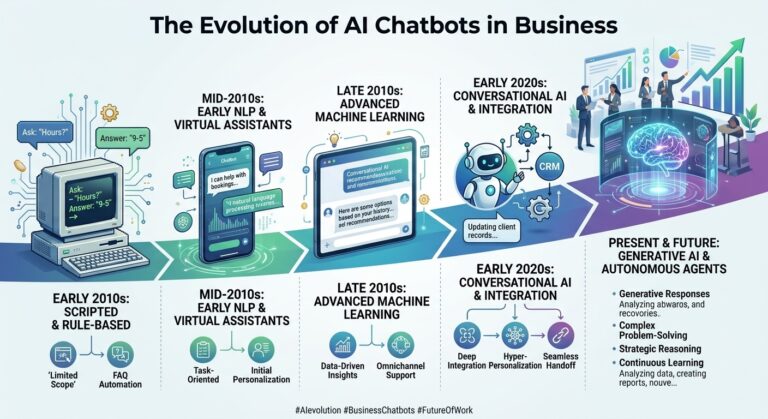
The Evolution of AI Chatbots in Business
Introduction
AI chatbots have changed significantly over the past several decades. What began as relatively simple computer programs designed to respond to predefined inputs has evolved into sophisticated conversational systems capable of understanding natural language, maintaining context, assisting customers, supporting sales teams, and helping businesses automate a growing range of communication tasks.
Today, AI chatbots are becoming an important part of digital business strategies. Companies use them to answer customer questions, generate leads, provide product recommendations, assist employees, support online transactions, and improve customer experiences.
But modern AI chatbots did not appear overnight.
Their development represents a long progression from basic rule-based programs to machine-learning systems and, more recently, generative AI and context-aware conversational assistants.
Understanding the evolution of AI chatbots helps businesses see where the technology came from, how it has changed, and how organizations can use modern chatbot capabilities effectively.
What Is an AI Chatbot?
An AI chatbot is a software system designed to communicate with people through conversational interfaces.
Depending on the technology, a chatbot may communicate through:
- Websites
- Mobile applications
- Messaging platforms
- Customer support portals
- Voice interfaces
- Social platforms
- Internal business systems
Modern AI chatbots can process natural-language requests and generate responses based on their training, available information, instructions, and business context.
Their capabilities can range from answering simple questions to supporting complex customer journeys.
The Early Beginnings of Chatbots
The history of chatbots goes back much further than today’s generative AI systems.
Early chatbot experiments demonstrated that computers could simulate aspects of human conversation.
These early systems generally relied on patterns and predefined responses rather than understanding language in the modern sense.
When users entered particular words or phrases, the system searched for patterns and returned an appropriate programmed response.
Although limited, these systems introduced an important idea:
People could interact with computers using conversational language.
This concept would eventually become central to modern conversational AI.
The Rise of Rule-Based Chatbots
As businesses began exploring automated customer communication, rule-based chatbots became more common.
These systems followed predefined decision trees.
For example:
Customer: “I need help with an order.”
Chatbot: “Choose an option:”
- Track an order
- Change an order
- Cancel an order
- Speak with support
This approach could work well when customers followed predictable paths.
Rule-based chatbots offered businesses several advantages:
- Predictable responses
- Simple implementation
- Easy control
- Consistent information
- Straightforward workflows
However, they also had significant limitations.
If a customer asked something outside the predefined flow, the chatbot might not know how to respond.
The Limitations of Traditional Chatbots
Early business chatbots were often criticized for feeling robotic.
Customers had to use specific words or select predetermined options.
For example, a chatbot might understand:
“Track order”
but fail to understand:
“Where is the package I ordered yesterday?”
This created a major limitation.
Customers had to adapt to the chatbot rather than the chatbot adapting to the customer.
Businesses began looking for better ways to understand natural language.
The Introduction of Natural Language Processing
Natural Language Processing, commonly known as NLP, became an important part of chatbot development.
NLP allows computer systems to process and interpret human language.
Instead of simply matching exact words, NLP-based systems can analyze the meaning and intent behind a customer’s message.
For example, the following requests may communicate a similar intent:
- “Where is my order?”
- “Can you track my package?”
- “Has my order shipped?”
- “I want to know where my delivery is.”
Understanding intent made chatbots more flexible.
This represented an important step in the evolution of AI chatbots in business.
The Growth of Machine Learning
Machine learning introduced another major change.
Instead of relying entirely on manually programmed rules, machine-learning systems could use data to improve their ability to recognize patterns.
This allowed businesses to build chatbots capable of handling a wider range of customer requests.
Machine learning helped improve areas such as:
- Intent recognition
- Customer classification
- Language understanding
- Recommendation systems
- Conversation analysis
The chatbot was becoming less dependent on rigid scripts.
AI Chatbots Enter Customer Service
Customer support became one of the most important business applications for chatbots.
Businesses receive large numbers of repetitive questions every day.
Common examples include:
- Business hours
- Pricing
- Product information
- Shipping
- Returns
- Account questions
- Appointment information
- Basic troubleshooting
AI chatbots could automate many of these interactions.
This helped businesses provide faster responses while allowing human support teams to concentrate on more complex cases.
Chatbots Move Into Sales and Marketing
As chatbot capabilities improved, businesses began using them for more than customer service.
AI chatbots became useful in sales and marketing.
A chatbot could engage website visitors, ask questions about their needs, recommend products, and collect contact information.
For example, a visitor might ask:
“Which plan is best for a small company?”
The chatbot could ask about the customer’s requirements and provide relevant information.
This transformed chatbots from simple support tools into customer engagement systems.
The Rise of Conversational Commerce
Another important development was the use of chatbots throughout the buying journey.
Instead of simply answering questions, chatbots could help customers:
- Discover products
- Compare options
- Understand features
- Find pricing information
- Receive recommendations
- Start purchasing processes
- Get post-purchase support
This created new opportunities for conversational commerce.
The conversation itself became part of the customer journey.
Chatbots Become More Context-Aware
Earlier chatbots often treated each message independently.
Modern AI systems can increasingly use conversation context.
For example:
Customer: “Do you have a monthly plan?”
Chatbot: “Yes, we offer monthly plans.”
Customer: “How much does it cost?”
A context-aware system understands that “it” refers to the monthly plan.
Context makes conversations feel more natural because customers do not need to repeat information constantly.
The Emergence of Generative AI
Generative AI represents another major stage in chatbot development.
Traditional chatbots generally selected or generated responses within relatively constrained systems.
Generative AI can produce new responses based on the conversation and available information.
This can make interactions more flexible.
Instead of requiring businesses to write a response for every possible question, generative AI can produce responses dynamically.
This capability has expanded the potential applications of business chatbots considerably.
From Chatbots to AI Assistants
Modern systems increasingly go beyond the traditional definition of a chatbot.
Rather than simply answering questions, AI assistants can help users complete tasks.
Depending on the system and integrations available, an AI assistant may help with:
- Finding information
- Summarizing content
- Scheduling activities
- Supporting customer service
- Assisting employees
- Recommending products
- Processing requests
- Guiding workflows
This represents a shift from conversation automation toward task assistance.
AI Chatbots and Customer Personalization
Personalization has become another important part of modern chatbot technology.
Businesses can potentially use customer context to make conversations more relevant.
For example, a chatbot may distinguish between:
- New visitors
- Existing customers
- Returning buyers
- Prospective customers
- Support customers
When appropriate and properly authorized, customer context can help businesses provide more relevant assistance.
However, personalization must be balanced with privacy and transparency.
AI Chatbots and Human Support
The evolution of chatbots does not necessarily mean the elimination of human customer service.
Instead, many businesses are moving toward hybrid models.
AI can handle:
- Repetitive questions
- Basic information requests
- Initial customer interactions
- Simple troubleshooting
- Information retrieval
Human employees can handle:
- Complex problems
- Sensitive situations
- Complaints
- Exceptions
- High-value customer relationships
- Cases requiring judgment
This division allows businesses to combine automation with human expertise.
AI Chatbots Become Available Around the Clock
One of the practical advantages of modern AI chatbots is continuous availability.
Human support teams usually operate according to schedules.
AI systems can potentially provide automated assistance at any time.
This means customers can receive answers outside normal operating hours.
For international businesses, this can also help provide support across different time zones.
The Expansion of Chatbots Across Business Departments
AI chatbots are no longer limited to customer service departments.
Businesses can use conversational AI across multiple functions.
Customer Service
Answer questions and provide basic assistance.
Sales
Qualify leads and support product discovery.
Marketing
Engage website visitors and provide campaign information.
Human Resources
Help employees find internal information.
IT Support
Guide employees through common technical problems.
E-Commerce
Help shoppers find products and complete purchases.
Operations
Assist with repetitive information requests and workflows.
The technology is becoming part of broader business automation strategies.
Chatbots and Business Data
Modern AI systems can potentially work with information from business knowledge bases and connected systems.
This allows a chatbot to provide more relevant answers than a generic conversational system.
For example, a business chatbot may be connected to appropriate sources containing:
- Product information
- Help documentation
- Company policies
- Frequently asked questions
- Service details
- Customer support resources
The quality of these information sources remains critical.
A sophisticated AI system can still produce poor results if it has access to inaccurate or outdated information.
The Importance of AI Chatbot Training
As chatbots have evolved, the focus has shifted from simply programming responses to managing knowledge, instructions, context, and performance.
Businesses need to ensure that chatbot systems receive accurate information and appropriate instructions.
Continuous improvement can involve:
- Reviewing failed conversations
- Updating knowledge
- Testing common questions
- Monitoring customer feedback
- Improving escalation procedures
- Adjusting conversation flows
AI chatbot deployment should therefore be treated as an ongoing process.
The Importance of Responsible AI
As AI chatbots become more capable, businesses must also consider responsible implementation.
Important areas include:
- Customer privacy
- Data security
- Transparency
- Accuracy
- Human oversight
- Appropriate automation
- Access control
Businesses should understand what their chatbot can and cannot do and establish appropriate safeguards.
The goal should be to create useful AI experiences while maintaining customer trust.
How AI Chatbots Are Changing Customer Expectations
The evolution of chatbots has also influenced what customers expect from businesses.
Customers increasingly encounter automated assistance across websites, applications, and digital services.
This can create expectations for:
- Faster responses
- Easier communication
- More convenient self-service
- Personalized assistance
- 24/7 availability
Businesses therefore need to think about chatbot technology as part of the broader customer experience rather than as an isolated software feature.
The Future of AI Chatbots in Business
The future of business chatbots is likely to involve increasingly sophisticated AI assistants.
Future systems may become better at:
- Understanding conversation context
- Working across multiple business systems
- Assisting with complex tasks
- Supporting employees
- Personalizing interactions
- Understanding different forms of communication
- Automating multi-step workflows
The distinction between chatbot, virtual assistant, and AI agent may also become less clear as systems become capable of completing more tasks.
However, businesses will still need to determine which activities should be automated and where human involvement remains important.
What Businesses Can Learn From the Evolution of Chatbots
The history of AI chatbots provides several important lessons.
Start With Customer Needs
Technology should solve genuine customer problems rather than exist simply because it is available.
Build Around Useful Information
A chatbot needs accurate, relevant knowledge to provide meaningful assistance.
Combine AI With Human Expertise
Automation and human support can work together rather than being treated as competing approaches.
Keep Improving
Customer questions and business requirements change over time. Chatbots need continuous monitoring and updates.
Focus on Experience
A technically advanced chatbot is not necessarily a useful chatbot. The customer experience should remain central.
How SmileLineAI Fits Into the Evolution of AI Customer Communication
SmileLineAI reflects the broader movement toward AI-powered customer communication.
As businesses move from basic automated responses toward intelligent customer interaction systems, AI can support more parts of the customer journey.
Modern AI customer platforms can help businesses provide faster responses, automate repetitive conversations, support customer service teams, and create more consistent digital communication.
The evolution is not simply about making chatbots more intelligent.
It is about making business communication more useful.
When AI understands customer questions, provides relevant information, remembers appropriate context, and connects customers with human employees when necessary, businesses can create more effective customer experiences.
Conclusion
The evolution of AI chatbots in business has been a journey from simple rule-based programs to increasingly sophisticated conversational AI systems.
Early chatbots depended heavily on predefined scripts. Natural language processing made them better at understanding customer intent. Machine learning expanded their ability to recognize patterns. Generative AI has now enabled more flexible and context-aware conversations.
Today, AI chatbots can support customer service, sales, marketing, e-commerce, employee assistance, and business automation.
Yet technology is only part of the equation.
Successful businesses must combine AI capabilities with accurate information, thoughtful conversation design, privacy protections, human oversight, and continuous improvement.
The future of AI chatbots is likely to move beyond answering questions toward helping customers and employees complete meaningful tasks.
For businesses, the opportunity is not simply to deploy another automated tool. It is to build smarter communication experiences that make interactions faster, easier, and more useful while preserving the value of human expertise.
If you’d like, I can continue the SmileLineAI SEO series with “How AI Chatbots Are Transforming the Modern Customer Experience.”