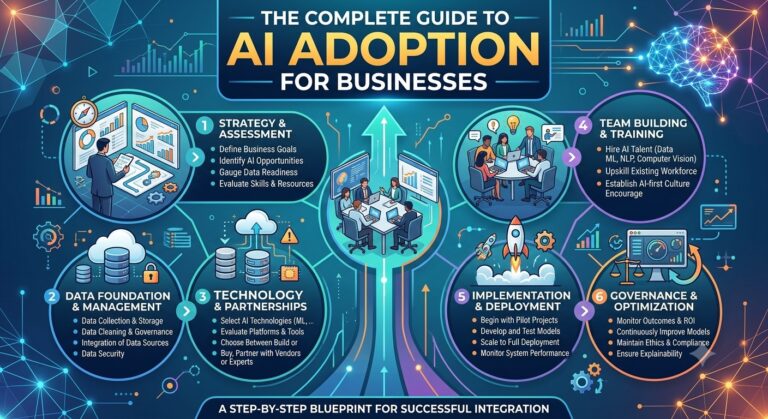
The Complete Guide to AI Adoption for Businesses
Introduction
Artificial intelligence (AI) is no longer a technology reserved for large corporations. Businesses of all sizes are adopting AI to automate repetitive tasks, improve customer service, analyze data, and make smarter decisions. As AI tools become more accessible and affordable, organizations across industries are finding new ways to improve efficiency and remain competitive.
However, adopting AI is about more than purchasing software. A successful AI strategy requires clear goals, the right technology, employee training, and ongoing optimization. Businesses that approach AI strategically are more likely to achieve measurable improvements in productivity, customer satisfaction, and long-term growth.
This complete guide explains how businesses can successfully adopt AI, avoid common mistakes, and maximize the value of their AI investments.
What Is AI Adoption?
AI adoption is the process of integrating artificial intelligence into business operations to improve efficiency, automate tasks, support decision-making, and enhance customer experiences.
AI technologies can be used across nearly every department, including:
- Customer service
- Marketing
- Sales
- Human resources
- Finance
- Operations
- IT support
- Data analytics
Rather than replacing employees, AI helps teams work more efficiently by handling repetitive work and providing valuable insights.
Why Businesses Are Investing in AI
Organizations adopt AI because it delivers measurable business benefits.
Some of the most common advantages include:
- Increased productivity
- Faster customer support
- Lower operational costs
- Better business insights
- Improved decision-making
- Enhanced customer experiences
- Scalable business operations
- Higher employee efficiency
As competition increases, AI has become an important tool for maintaining growth and delivering consistent service.
Step 1: Identify Business Goals
Every successful AI implementation begins with a clear understanding of business objectives.
Ask questions such as:
- Which processes consume the most time?
- Where are customers experiencing delays?
- Which repetitive tasks could be automated?
- What operational challenges need improvement?
Defining measurable goals helps ensure AI projects deliver real business value.
Step 2: Evaluate Existing Business Processes
Before introducing AI, businesses should review their current workflows.
Look for processes that are:
- Repetitive
- Time-consuming
- Data-intensive
- Rule-based
- Prone to human error
These areas often provide the fastest return on investment when automated with AI.
Step 3: Choose the Right AI Solutions
Not every AI platform offers the same capabilities. Selecting the right solution depends on your business needs.
Common AI solutions include:
- AI chatbots
- Customer communication platforms
- Marketing automation tools
- Predictive analytics software
- Workflow automation platforms
- Document processing systems
- Business intelligence tools
Choose AI software that integrates well with your existing systems and can grow alongside your business.
Step 4: Prepare High-Quality Data
AI systems perform best when trained on accurate, organized, and relevant information.
Businesses should:
- Clean outdated records
- Organize customer data
- Standardize information
- Remove duplicate entries
- Maintain secure databases
Quality data improves AI accuracy and helps generate more reliable insights.
Step 5: Train Employees
AI adoption is most successful when employees understand how to use the technology effectively.
Training should cover:
- AI capabilities
- Workflow changes
- Best practices
- Data security
- Human oversight
- Responsible AI use
When employees view AI as a productivity tool rather than a replacement, adoption becomes much smoother.
Step 6: Start With Small AI Projects
Instead of transforming the entire business at once, begin with manageable projects.
Examples include:
- Automating customer FAQs
- AI-powered appointment scheduling
- Email response automation
- Marketing campaign optimization
- Workflow automation
Small successes build confidence and provide valuable learning opportunities before expanding AI across the organization.
Step 7: Monitor Performance and Optimize
AI implementation is an ongoing process.
Businesses should regularly monitor metrics such as:
- Customer satisfaction
- Response times
- Employee productivity
- Operational efficiency
- Cost savings
- Conversion rates
Continuous optimization ensures AI continues delivering measurable business value.
Common Business Applications of AI
AI is transforming nearly every area of business operations.
Customer Service
AI-powered chatbots and virtual assistants provide:
- Instant responses
- 24/7 support
- Personalized conversations
- Faster issue resolution
This improves customer satisfaction while reducing support workloads.
Marketing
AI helps marketers:
- Personalize campaigns
- Analyze customer behavior
- Optimize advertising
- Generate content ideas
- Improve campaign performance
Smarter marketing leads to better engagement and higher return on investment.
Sales
AI supports sales teams by:
- Identifying qualified leads
- Predicting customer behavior
- Recommending follow-up actions
- Automating routine communication
Sales teams can spend more time building relationships and closing deals.
Operations
AI streamlines business operations through:
- Workflow automation
- Inventory optimization
- Scheduling
- Resource planning
- Document management
Automation reduces manual work and improves efficiency.
Overcoming Common AI Adoption Challenges
Businesses often encounter obstacles when implementing AI.
Common challenges include:
- Lack of employee training
- Poor data quality
- Unclear business objectives
- Resistance to change
- Choosing the wrong AI platform
- Unrealistic expectations
Addressing these challenges early increases the likelihood of successful implementation.
Responsible AI Adoption
Responsible AI should be part of every business strategy.
Best practices include:
- Protect customer privacy
- Ensure transparency
- Monitor AI decisions
- Maintain human oversight
- Comply with industry regulations
- Continuously evaluate AI performance
Responsible implementation builds trust with customers, employees, and stakeholders.
How SmileLineAI Supports AI Adoption
Businesses looking to modernize customer communication can benefit from AI-powered platforms like SmileLineAI.
SmileLineAI helps organizations:
- Automate customer conversations
- Deliver instant support
- Improve response times
- Personalize customer interactions
- Increase customer engagement
- Reduce repetitive workloads
By simplifying AI implementation, SmileLineAI enables businesses to improve operational efficiency while delivering exceptional customer experiences.
The Future of AI Adoption
Artificial intelligence continues to evolve rapidly, offering new opportunities for businesses.
Future AI capabilities are expected to include:
- Advanced predictive analytics
- Autonomous workflow automation
- Hyper-personalized customer engagement
- Smarter business intelligence
- Real-time operational optimization
- More natural conversational AI
Businesses that adopt AI today will be better prepared to take advantage of tomorrow’s innovations.
Best Practices for Long-Term AI Success
To maximize the benefits of AI, businesses should:
- Develop a long-term AI strategy.
- Start with high-impact use cases.
- Invest in employee training.
- Maintain high-quality data.
- Measure results using clear KPIs.
- Continuously refine AI processes.
- Balance automation with human expertise.
These practices help ensure AI remains a valuable asset as the business grows.
Conclusion
Artificial intelligence is transforming how businesses operate, compete, and grow. From improving customer service and automating workflows to enhancing marketing and supporting smarter decision-making, AI provides powerful opportunities for organizations of every size.
Successful AI adoption requires thoughtful planning, the right technology, quality data, and a commitment to continuous improvement. Businesses that implement AI strategically can reduce operational costs, improve productivity, strengthen customer relationships, and create a foundation for sustainable growth.
As AI continues to evolve, organizations that embrace innovation today will be well-positioned to lead in tomorrow’s increasingly digital economy.