How to Use AI Chatbots to Increase Customer Satisfaction
Introduction
Customer satisfaction plays a major role in the success of every business. Satisfied customers are more likely to return, make repeat purchases, recommend a company to others, and develop long-term relationships with a brand.
Today, however, customers expect more than quality products and services. They also expect fast responses, convenient support, accurate information, and personalized interactions.
Meeting these expectations can be difficult, especially for businesses handling a large number of customer inquiries.
This is where AI chatbots can help.
AI chatbots can automate routine conversations, answer common questions, provide assistance around the clock, and guide customers toward relevant information. When used strategically, they can reduce waiting times and create smoother customer experiences.
However, simply adding a chatbot to a website does not automatically increase customer satisfaction. Businesses must design and manage AI chatbot experiences around real customer needs.
This article explains how to use AI chatbots to increase customer satisfaction, including practical strategies, common mistakes to avoid, and the importance of balancing AI automation with human support.
Why Customer Satisfaction Matters
Customer satisfaction measures how well a business meets or exceeds customer expectations.
A positive customer experience can contribute to:
- Customer loyalty
- Repeat purchases
- Positive reviews
- Word-of-mouth referrals
- Higher customer retention
- Stronger brand reputation
- Increased customer lifetime value
On the other hand, slow responses, confusing communication, and unresolved problems can create frustration.
AI chatbots can help businesses improve several important parts of the customer experience when they are implemented correctly.
Provide Faster Responses With AI Chatbots
One of the most important factors in customer satisfaction is response time.
Customers often do not want to wait hours for answers to simple questions.
AI chatbots can provide immediate responses to common requests such as:
- What are your business hours?
- What products or services do you offer?
- How much does this cost?
- How do I schedule an appointment?
- Where can I find your pricing?
- How can I contact support?
Instant responses can make customers feel that their time is valued.
For many routine questions, speed and convenience can significantly improve the customer experience.
Offer 24/7 Customer Assistance
Customers may need information outside normal business hours.
This is especially common for online businesses that receive visitors from different locations and time zones.
AI chatbots can remain available throughout the day and night to provide basic assistance.
They can help customers during:
- Evenings
- Weekends
- Holidays
- Outside regular office hours
A business may not have the resources to maintain a large 24/7 support team, but an AI chatbot can provide an initial level of assistance whenever customers need it.
For complex issues, the chatbot can collect information and arrange for follow-up from a human representative.
Answer Common Questions Accurately
Customers become frustrated when they have to search through multiple pages to find simple information.
A well-designed AI chatbot can provide quick answers based on accurate business information.
Businesses should identify their most frequently asked questions, including questions about:
- Products
- Services
- Pricing
- Shipping
- Returns
- Appointments
- Account access
- Business policies
These questions can form the foundation of a useful chatbot experience.
Accuracy is essential. Fast but incorrect answers can reduce customer satisfaction and damage trust.
Businesses should therefore review and update chatbot information regularly.
Make Customer Support More Convenient
Convenience is an important part of customer satisfaction.
Customers should not have to complete unnecessary steps before receiving help.
An AI chatbot can allow customers to ask questions directly using natural language.
For example, instead of navigating through several pages, a customer could simply type:
“How can I change my appointment?”
The chatbot can provide the appropriate instructions or direct the customer to the right place.
This reduces friction and makes the customer journey easier.
Use AI to Personalize Customer Interactions
Generic communication does not always meet individual customer needs.
AI chatbots can make interactions more relevant by using the context of the conversation and, where appropriate, available customer information.
For example, if a customer says:
“I’m looking for an affordable option for my small business.”
The chatbot can provide information that matches the customer’s stated needs instead of displaying every available option.
AI-powered personalization can support:
- Relevant product recommendations
- Customized service suggestions
- Personalized follow-ups
- Context-aware answers
- More useful customer guidance
The goal is not to overwhelm customers with personalization. It is to make each interaction more helpful.
Help Customers Find the Right Products or Services
Customers may leave a website simply because they cannot find what they need.
AI chatbots can act as digital guides.
They can ask questions to better understand what a customer is looking for.
For example:
Customer: “I need help choosing a service.”
Chatbot: “I’d be happy to help. What are you hoping to achieve?”
Based on the customer’s answer, the chatbot can guide them toward relevant information.
This can improve customer satisfaction by reducing confusion and making decision-making easier.
Use AI Chatbots for Proactive Assistance
Customer support is often reactive.
A customer experiences a problem and contacts the business for help.
AI can also support a more proactive approach.
Depending on the business and its systems, AI may identify situations where a customer could benefit from assistance.
For example, a chatbot might offer help when a visitor repeatedly searches for the same information or appears unable to complete a process.
The goal should be to provide useful assistance without becoming intrusive.
Well-timed support can prevent frustration before it becomes a larger problem.
Reduce Repetitive Customer Service Work
AI chatbots can also improve customer satisfaction indirectly by helping employees work more efficiently.
When chatbots handle routine questions, human agents can focus on more complicated situations.
Instead of spending most of the day answering the same questions, employees can devote more attention to:
- Complex support cases
- Detailed customer requests
- Sensitive situations
- Customer complaints
- Relationship building
This can improve service quality where human expertise matters most.
Provide Seamless Escalation to Human Agents
One of the most important rules of AI customer service is knowing when automation should stop.
Customers should not be trapped in a chatbot conversation when they need human help.
Businesses should create clear escalation options for situations involving:
- Complex problems
- Complaints
- Sensitive information
- Repeated unresolved issues
- Unusual requests
- Emotional or highly frustrated customers
A smooth handoff is essential.
When a customer is transferred to a human agent, the agent should ideally have access to relevant conversation context so the customer does not need to repeat everything.
A good support journey looks like:
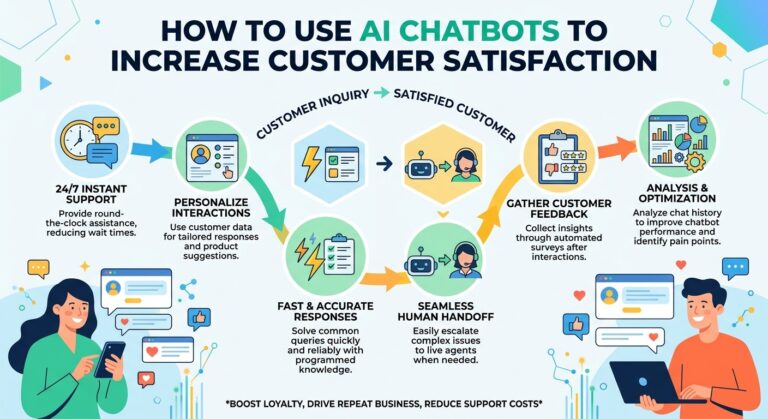
AI handles simple questions → AI identifies a complex issue → Customer is transferred to a human → Human receives relevant context
This combination can improve both efficiency and satisfaction.
Use AI to Improve Customer Response Consistency
Customers expect accurate and consistent information.
If one employee gives a different answer from another, customers can become confused.
AI chatbots can help provide standardized answers to common questions.
For example, information about:
- Business hours
- Return policies
- Shipping
- Pricing
- Basic procedures
can be presented consistently.
Human agents can still handle exceptions and complex situations.
The goal is consistency for routine interactions and flexibility where customers need individualized assistance.
Analyze Customer Questions to Identify Problems
Chatbot conversations can reveal valuable information about the customer experience.
If hundreds of customers ask the same question, it may indicate that important information is difficult to find.
For example, if customers frequently ask:
“How long does shipping take?”
the business may need to make shipping information easier to locate on its website.
Businesses can review chatbot interactions to identify:
- Frequently asked questions
- Common customer concerns
- Confusing processes
- Missing website information
- Product-related problems
- Recurring support issues
These insights can help businesses improve the overall customer experience.
Use AI Chatbots to Collect Customer Feedback
Businesses need to understand how customers feel about their experiences.
AI chatbots can make feedback collection easier.
After an interaction, a chatbot could ask:
“Did this answer solve your problem?”
or:
“How would you rate your experience?”
Customers can also provide open-ended feedback.
Businesses can then review the responses to identify trends and opportunities for improvement.
The most important step is to act on useful feedback rather than simply collecting it.
Support Customers Throughout Their Journey
Customer satisfaction is not created during a single interaction.
It develops across the entire customer journey.
AI chatbots can provide assistance at different stages.
Before a purchase
They can answer questions and explain products or services.
During a purchase
They can guide customers toward useful information and next steps.
After a purchase
They can provide basic support, product guidance, and answers to common questions.
This continuous assistance can create a more consistent customer experience.
Keep the Chatbot Easy to Use
A complicated chatbot can create more frustration than it solves.
Customers should not need to learn a special command system.
A good chatbot experience should be simple.
Businesses should:
- Use clear language
- Provide helpful prompts
- Avoid unnecessary questions
- Keep responses focused
- Make important options easy to find
- Avoid overly long automated messages
The chatbot should make the customer’s task easier, not create additional work.
Make AI Conversations Feel Helpful, Not Robotic
Customers can often tell when they are receiving generic automated responses.
The goal is not necessarily to make AI pretend to be human.
The goal is to make the conversation useful.
Businesses can improve chatbot communication by focusing on:
- Clear language
- Friendly responses
- Relevant information
- Context awareness
- Useful follow-up questions
- Straightforward instructions
For example, instead of saying:
“Input invalid. Please try again.”
A better response might be:
“I couldn’t find that information. Could you check the order number and try again, or would you like help from our support team?”
The second response gives the customer a clearer path forward.
Monitor and Improve Chatbot Performance
Customer needs change, and chatbots should improve over time.
Businesses should regularly review chatbot conversations and performance.
Look for:
- Questions the chatbot cannot answer
- Incorrect responses
- Customer frustration
- High escalation rates
- Repeated conversations
- Abandoned chats
This information can help businesses improve the chatbot’s knowledge and workflows.
An AI chatbot should not be treated as a one-time setup.
It should be continuously monitored and refined.
Important Metrics for Measuring Customer Satisfaction
Businesses should measure whether their AI chatbot is actually improving the customer experience.
Useful metrics include:
Customer Satisfaction Score
Ask customers to rate their experience after an interaction.
First Response Time
Measure how quickly customers receive an initial response.
Resolution Rate
Track how many issues are successfully resolved.
Escalation Rate
Measure how often conversations require human assistance.
Customer Effort
Consider how easy it is for customers to get the help they need.
Repeat Contact Rate
Track whether customers need to contact the business repeatedly about the same issue.
Chat Abandonment Rate
Measure how often customers leave before their issue is addressed.
Together, these metrics can provide a clearer picture of chatbot performance.
Common Mistakes That Can Hurt Customer Satisfaction
Mistake 1: Using AI for Every Situation
Some issues require human expertise.
Businesses should not force automation into situations where it is not appropriate.
Mistake 2: Making Human Support Difficult to Access
Customers should have a clear way to request additional help.
Mistake 3: Providing Incorrect Information
Chatbots must be regularly reviewed to help ensure information remains accurate.
Mistake 4: Overcomplicating the Conversation
Customers should not have to answer ten questions to get a simple answer.
Mistake 5: Ignoring Customer Feedback
Negative feedback should be investigated and used to improve the experience.
Mistake 6: Focusing Only on Cost Savings
Reducing workload can be valuable, but customer satisfaction should remain a central goal.
An inexpensive chatbot that frustrates customers can cost a business more in lost trust and opportunities.
How SmileLineAI Can Support Better Customer Satisfaction
AI-powered customer communication platforms such as SmileLineAI can help businesses explore ways to improve customer interactions through intelligent automation.
A customer-focused AI strategy can help businesses:
- Provide faster responses
- Automate routine questions
- Improve communication availability
- Create more consistent interactions
- Support personalized engagement
- Reduce repetitive workloads
- Identify common customer concerns
The key is to use automation to make customer communication easier and more helpful.
AI should support the customer experience rather than becoming a barrier between customers and the business.
When a situation requires human expertise, businesses should maintain an effective handoff process.
A Simple Strategy for Getting Started
Businesses can begin improving customer satisfaction with AI chatbots by following these steps:
Step 1: Review Common Customer Questions
Identify the questions customers ask most frequently.
Step 2: Automate Simple, Repetitive Requests
Start with low-complexity interactions where automation can provide clear value.
Step 3: Create Accurate Responses
Ensure the chatbot uses reliable and up-to-date business information.
Step 4: Add Personalization Carefully
Use relevant customer context to make interactions more useful without becoming intrusive.
Step 5: Build Human Escalation Paths
Determine exactly when and how customers can be transferred to a human agent.
Step 6: Collect Feedback
Ask customers whether the chatbot was helpful.
Step 7: Continuously Improve
Use conversation data, customer feedback, and performance metrics to refine the chatbot.
The Future of AI Chatbots and Customer Satisfaction
AI chatbots will likely become more capable of understanding context, managing conversations, and supporting personalized customer experiences.
Future developments may include:
- More advanced conversational AI
- Real-time personalization
- Proactive customer assistance
- Better AI-to-human handoffs
- Voice-based AI support
- Multilingual customer communication
- More connected customer service systems
However, the future of customer satisfaction will not be defined by how much a business automates.
It will be defined by how effectively technology helps customers solve problems and achieve their goals.
The best AI customer service strategies will combine:
AI for speed and scale + humans for empathy and complex problem-solving.
Conclusion
AI chatbots can be powerful tools for increasing customer satisfaction when they are designed around genuine customer needs.
They can provide instant responses, 24/7 assistance, personalized guidance, consistent information, and support throughout the customer journey.
At the same time, businesses must recognize the limitations of automation.
Customers should be able to reach human support when problems are complex, sensitive, or unresolved.
The goal is not to replace every customer conversation with AI.
The goal is to use AI to make simple interactions faster and easier while giving human employees more time to provide the expertise, empathy, and personal attention that customers value.
By finding the right balance between AI automation and human support, businesses can create a smoother customer experience, improve satisfaction, and build stronger long-term relationships.
The most successful AI chatbot is not the one that talks the most—it is the one that helps customers get what they need quickly, accurately, and with as little effort as possible.