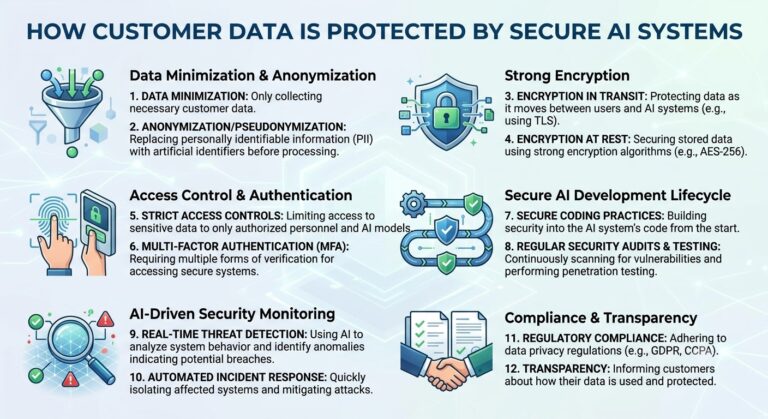
How Customer Data Is Protected by Secure AI Systems
In today’s digital economy, customer data has become one of the most valuable assets for businesses. Organizations collect and process information such as names, contact details, purchasing behavior, communication history, and customer preferences to deliver better services and personalized experiences.
As businesses increasingly rely on artificial intelligence (AI) to improve customer interactions and streamline operations, concerns about data security and privacy continue to grow. Customers want assurance that their personal information is protected from unauthorized access, cyber threats, and misuse.
Fortunately, modern AI systems are designed not only to enhance customer experiences but also to strengthen data protection. In this article, we explore how secure AI systems help safeguard customer information and why data security is essential for building customer trust.
Why Customer Data Protection Matters
Every customer interaction generates valuable information. Businesses use this data to improve products, personalize communication, and make informed decisions.
However, data breaches and cyberattacks can lead to serious consequences, including:
- Loss of customer trust
- Financial losses
- Regulatory penalties
- Reputational damage
- Business disruption
Protecting customer data is not only a legal obligation but also a critical component of maintaining long-term customer relationships.
The Role of AI in Data Security
Artificial intelligence has become a powerful tool in modern cybersecurity. Unlike traditional security systems that rely heavily on predefined rules, AI can continuously learn, adapt, and identify potential threats in real time.
Secure AI systems help organizations:
- Detect unusual behavior
- Monitor network activity
- Identify security vulnerabilities
- Prevent unauthorized access
- Respond quickly to cyber threats
By automating security processes, AI helps businesses stay ahead of evolving digital threats.
AI-Powered Threat Detection
One of the most effective ways AI protects customer data is through advanced threat detection.
AI systems can analyze massive volumes of data and identify suspicious patterns that may indicate:
- Cyberattacks
- Account takeovers
- Fraudulent activities
- Unauthorized access attempts
- Malware infections
Because AI continuously monitors systems in real time, potential threats can often be detected and addressed before they cause significant damage.
Data Encryption and Secure Storage
Encryption is one of the most important methods for protecting sensitive customer information.
Secure AI systems help enhance encryption by:
- Automatically identifying sensitive data
- Encrypting customer information during transmission
- Monitoring storage environments for vulnerabilities
- Managing encryption protocols efficiently
Even if data is intercepted, encryption ensures that unauthorized individuals cannot easily access or understand the information.
Intelligent Access Control
Not every employee or system should have access to all customer data.
AI-powered access control systems help businesses manage permissions by:
- Verifying user identities
- Monitoring login behavior
- Detecting suspicious access attempts
- Restricting access to sensitive information
These systems ensure that customer data is only available to authorized individuals who need it for legitimate business purposes.
Continuous Monitoring and Risk Assessment
Cybersecurity is not a one-time process. Businesses must continuously monitor systems and evaluate risks.
AI helps organizations maintain security by:
- Tracking system performance
- Identifying emerging vulnerabilities
- Monitoring communication channels
- Assessing potential security risks
Continuous monitoring allows businesses to respond quickly to changing threats and maintain strong data protection practices.
Reducing Human Error
Human error remains one of the leading causes of data breaches.
Common mistakes include:
- Sharing information with unauthorized users
- Weak password practices
- Improper handling of sensitive data
- Misconfigured security settings
AI reduces these risks by automating security processes and identifying potential errors before they result in security incidents.
By minimizing manual intervention, businesses can improve overall data protection.
AI and Privacy Compliance
Many businesses must comply with data privacy regulations designed to protect customer information.
Examples include:
- General Data Protection Regulation (GDPR)
- California Consumer Privacy Act (CCPA)
- Various regional privacy laws
AI systems help support compliance by:
- Monitoring data usage
- Tracking customer consent
- Managing data retention policies
- Generating compliance reports
Automation simplifies privacy management while reducing the risk of non-compliance.
Balancing Personalization and Privacy
Customers appreciate personalized experiences, but they also expect businesses to protect their personal information.
Secure AI systems help balance these priorities by:
- Using data responsibly
- Limiting unnecessary data collection
- Providing transparent privacy practices
- Protecting sensitive customer information
Responsible AI ensures businesses can deliver personalized services without compromising privacy.
Building Customer Trust Through Secure AI
Trust is essential in any customer relationship. When customers know their information is protected, they are more likely to engage with a business and share valuable data.
Businesses can strengthen trust by:
- Implementing robust AI security measures
- Communicating privacy policies clearly
- Providing transparency about data usage
- Continuously improving security practices
A strong commitment to security demonstrates that a business values and respects customer privacy.
The Role of AI Communication Platforms
Modern AI communication platforms help businesses automate customer interactions while maintaining strong security standards.
Solutions like SmileLineAI support secure customer engagement through intelligent automation, protected communication channels, and responsible data management practices.
By integrating secure AI technologies, businesses can improve customer experiences while safeguarding sensitive information.
The Future of AI-Powered Data Protection
As cyber threats become more sophisticated, AI security systems will continue to evolve.
Future developments may include:
- More advanced threat detection capabilities
- Enhanced privacy-preserving AI technologies
- Improved fraud prevention systems
- Stronger automated compliance management
- Greater transparency in data handling
Businesses that invest in secure AI solutions today will be better prepared for future security challenges.
Final Thoughts
Artificial intelligence is transforming the way businesses manage customer communication and data protection. Through advanced threat detection, intelligent access control, encryption, and continuous monitoring, secure AI systems help organizations protect valuable customer information from modern cyber threats.
As customer expectations for privacy and security continue to grow, businesses must prioritize responsible data protection strategies. Secure AI systems provide the tools needed to safeguard information, maintain compliance, and build lasting customer trust.
Organizations that embrace secure AI technologies will not only strengthen their cybersecurity posture but also create a safer and more reliable experience for their customers.