How AI Improves Business Productivity and Efficiency
Introduction
In today’s competitive business environment, productivity and efficiency are essential for long-term success. Companies are constantly looking for ways to accomplish more with fewer resources while maintaining high-quality products and services. As customer expectations continue to grow, businesses must find innovative ways to improve operations without increasing costs.
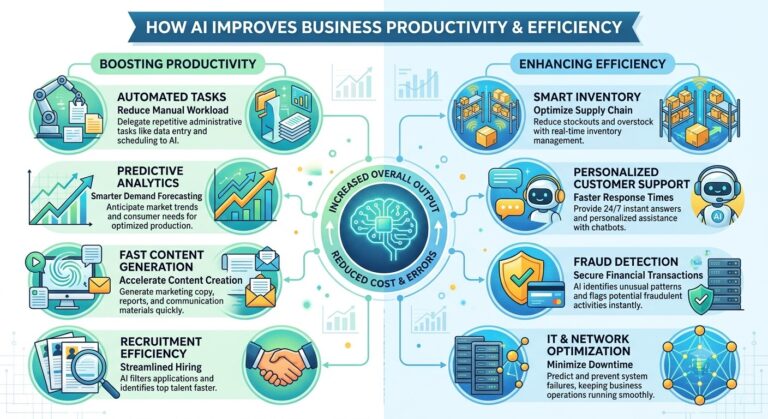
Artificial intelligence (AI) has become one of the most effective technologies for boosting business productivity and efficiency. By automating repetitive tasks, analyzing large amounts of data, optimizing workflows, and enhancing decision-making, AI enables organizations to work smarter instead of harder.
Whether you’re a startup, a small business, or a large enterprise, AI can help improve performance across nearly every department. In this article, we’ll explore how AI improves business productivity and efficiency and why investing in AI is becoming a strategic priority for modern businesses.
AI in Business: What Is It?
Artificial intelligence refers to computer systems that can perform tasks typically requiring human intelligence. These tasks include learning from data, recognizing patterns, understanding language, making predictions, and solving problems.
In business, AI is commonly used for:
- Customer service automation
- Workflow management
- Marketing optimization
- Sales forecasting
- Data analysis
- Inventory management
- Financial reporting
- Employee productivity
By integrating AI into everyday operations, businesses can improve performance while reducing manual effort.
Automating Repetitive Tasks
One of the greatest benefits of AI is its ability to automate repetitive work. Many daily business activities consume valuable employee time without directly contributing to growth.
AI can automate tasks such as:
- Data entry
- Invoice processing
- Appointment scheduling
- Email sorting
- Document management
- Report generation
Automation allows employees to spend more time on strategic initiatives, innovation, and customer relationships.
Streamlining Business Workflows
Efficient workflows are essential for productivity. AI helps businesses eliminate bottlenecks by automating routine processes and improving coordination across departments.
Examples of AI-powered workflow improvements include:
- Automatic task assignments
- Workflow approvals
- Project tracking
- Team notifications
- Document routing
- Process monitoring
These improvements reduce delays, improve collaboration, and help projects move forward more efficiently.
Enhancing Customer Service
Customer service is one of the most common applications of AI.
AI-powered chatbots and virtual assistants can:
- Answer frequently asked questions
- Provide 24/7 customer support
- Handle multiple customer conversations simultaneously
- Route inquiries to the appropriate department
- Assist customers with orders and account information
Faster responses improve customer satisfaction while reducing the workload of support teams.
Improving Employee Productivity
AI serves as a digital assistant that helps employees work more efficiently.
AI can:
- Organize schedules
- Summarize documents
- Generate reports
- Recommend next actions
- Prioritize tasks
- Retrieve important information quickly
By reducing administrative work, employees have more time to focus on creative problem-solving and business growth.
Supporting Smarter Decision-Making
Business leaders rely on accurate information to make effective decisions.
AI analyzes large datasets to identify trends, forecast outcomes, and generate actionable insights.
Businesses can use AI to:
- Predict customer demand
- Monitor sales performance
- Optimize pricing strategies
- Identify operational inefficiencies
- Forecast future growth opportunities
Better insights lead to faster and more informed decisions.
Increasing Marketing Efficiency
Marketing requires constant analysis and optimization. AI helps businesses improve marketing performance by automating and enhancing many marketing activities.
AI-powered marketing tools can:
- Segment customer audiences
- Personalize email campaigns
- Recommend content topics
- Optimize advertising campaigns
- Schedule social media posts
- Analyze campaign performance
These capabilities improve marketing productivity while increasing return on investment.
Improving Sales Performance
AI helps sales teams focus on high-value opportunities instead of manual administrative work.
AI-powered sales tools can:
- Score leads
- Predict buying behavior
- Recommend follow-up actions
- Automate customer outreach
- Track customer engagement
This allows sales professionals to close more deals while spending less time on repetitive tasks.
Reducing Operational Costs
Efficiency improvements naturally lead to cost savings.
AI helps businesses reduce costs by:
- Automating manual processes
- Reducing human error
- Improving resource allocation
- Increasing employee productivity
- Optimizing operational workflows
Businesses can grow without proportionally increasing staffing or operational expenses.
Better Data Management
Every business generates valuable information. AI makes it easier to organize, process, and analyze business data.
AI can:
- Detect trends
- Organize customer records
- Monitor key performance indicators
- Generate business reports
- Identify improvement opportunities
Accurate data management supports better planning and long-term growth.
Supporting Business Scalability
As businesses expand, workloads increase significantly.
AI enables organizations to scale by:
- Managing larger customer volumes
- Automating repetitive processes
- Supporting growing teams
- Maintaining service quality
- Increasing operational capacity
Scalable AI solutions allow businesses to grow without overwhelming employees.
Strengthening Collaboration Across Teams
AI helps departments work together more effectively by improving communication and information sharing.
AI-powered collaboration tools can:
- Coordinate tasks
- Track project progress
- Share updates automatically
- Manage documentation
- Improve workflow transparency
Improved collaboration leads to faster project completion and better business outcomes.
Responsible AI Implementation
To maximize productivity while maintaining trust, businesses should implement AI responsibly.
Best practices include:
- Protecting customer data
- Maintaining transparency
- Monitoring AI performance
- Keeping human oversight for important decisions
- Regularly updating AI systems
Responsible AI builds confidence among customers and employees alike.
How SmileLineAI Helps Improve Productivity
AI-powered communication platforms like SmileLineAI help businesses improve productivity by automating customer interactions and streamlining communication.
SmileLineAI enables organizations to:
- Respond instantly to customer inquiries
- Provide 24/7 customer support
- Automate repetitive conversations
- Personalize customer engagement
- Improve response times
- Reduce operational workload
By integrating AI into customer communication, businesses can improve efficiency while delivering exceptional customer experiences.
The Future of AI and Business Productivity
As AI technology continues to evolve, businesses can expect even greater productivity improvements through:
- Predictive automation
- Advanced business analytics
- Smarter workflow optimization
- Intelligent resource planning
- Real-time decision support
- Hyper-personalized customer interactions
Organizations that embrace AI today will be better prepared for future business challenges and opportunities.
Final Thoughts
Artificial intelligence is transforming how businesses improve productivity and efficiency. By automating repetitive tasks, optimizing workflows, supporting smarter decisions, and enhancing customer service, AI enables organizations to achieve more while using fewer resources.
Rather than replacing employees, AI empowers teams to focus on innovation, customer relationships, and strategic growth. Businesses that adopt AI thoughtfully and responsibly will gain a competitive advantage, improve operational performance, and position themselves for long-term success in an increasingly digital world.