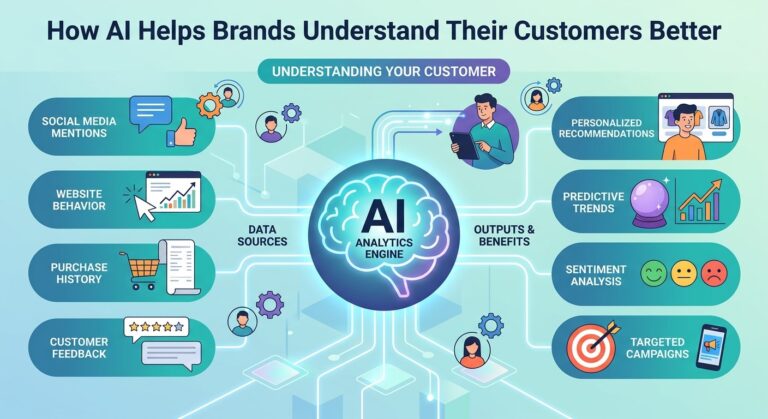
How AI Helps Brands Understand Their Customers Better
Introduction
Understanding customers has always been one of the most important parts of building a successful business. Brands need to know what customers want, what problems they face, what influences their purchasing decisions, and what keeps them coming back.
However, customer behavior is becoming more complex. People interact with businesses through websites, social media, mobile apps, email, chat, and other digital channels. Collecting and understanding all this information manually can be difficult and time-consuming.
Artificial intelligence (AI) is changing this process.
AI can analyze large amounts of customer data, identify patterns, understand conversations, and provide actionable insights. Instead of relying only on assumptions or basic surveys, businesses can use AI to develop a deeper understanding of their customers.
In this article, we’ll explore how AI helps brands understand their customers better and how these insights can improve marketing, customer service, personalization, and long-term business growth.
Why Understanding Customers Matters
Customer understanding helps businesses make better decisions.
When brands understand their customers, they can:
- Create more relevant products
- Improve customer service
- Personalize marketing campaigns
- Identify customer pain points
- Improve customer satisfaction
- Increase customer retention
- Discover new business opportunities
A deeper understanding of customers allows companies to focus their resources on what matters most to their audience.
AI Can Analyze Large Amounts of Customer Data
One of the biggest advantages of AI is its ability to process large amounts of information quickly.
Businesses collect data from sources such as:
- Website visits
- Purchase history
- Customer support conversations
- Social media interactions
- Email engagement
- Product reviews
- Surveys
- Search behavior
AI can analyze these sources to identify patterns that may be difficult for humans to recognize manually.
Understanding Customer Behavior
AI helps brands identify how customers interact with their products and services.
For example, AI can analyze:
- Which pages customers visit
- Which products they view
- How long they spend on a website
- What they purchase
- When they return
- Where they stop during the buying process
These insights help businesses understand customer journeys and identify opportunities to improve them.
AI Helps Identify Customer Preferences
Different customers have different preferences.
AI can analyze customer interactions to identify individual or group preferences.
For example, a business may discover that certain customers prefer:
- Specific product categories
- Particular communication channels
- Certain types of content
- Specific pricing options
- Particular service features
Understanding these preferences allows brands to provide more relevant experiences.
AI-Powered Customer Segmentation
Traditional customer segmentation often relies on basic characteristics such as age, location, or gender.
AI can create more sophisticated customer segments based on actual behavior.
AI-powered segmentation can consider:
- Purchase frequency
- Customer interests
- Engagement levels
- Browsing behavior
- Spending patterns
- Product preferences
This allows businesses to create more meaningful customer groups.
Understanding Customer Sentiment
Customer feedback contains valuable information about how people feel about a brand.
AI-powered sentiment analysis can analyze reviews, messages, surveys, and conversations to identify whether customer feedback is generally:
- Positive
- Negative
- Neutral
More advanced systems can also identify specific topics behind customer sentiment.
For example, customers may be positive about a product but frustrated with shipping. This distinction gives businesses a clearer picture of where improvements are needed.
AI Can Analyze Customer Conversations
Customer conversations are a valuable source of business intelligence.
AI can analyze conversations from:
- Live chat
- Customer support
- Messaging platforms
- Voice interactions
These conversations can reveal frequently asked questions, recurring problems, customer concerns, and emerging trends.
Instead of treating support conversations only as service requests, businesses can use them as a source of customer insights.
Predicting Customer Needs
AI can move beyond analyzing what customers have already done.
Predictive AI can identify patterns that may indicate what customers are likely to do next.
Businesses can use predictive insights to:
- Recommend relevant products
- Identify potential customer churn
- Predict purchase intent
- Offer proactive support
- Create personalized campaigns
This allows brands to respond to customer needs before customers explicitly communicate them.
Creating Better Customer Personas
Customer personas help businesses understand their target audiences.
AI can analyze real customer data to help businesses build more accurate personas based on actual behavior rather than assumptions.
AI-generated insights can help identify:
- Common customer goals
- Frequent pain points
- Buying motivations
- Preferred communication methods
- Common objections
This can improve marketing and product development strategies.
Improving Personalized Marketing
Once businesses understand their customers better, they can create more relevant marketing campaigns.
AI can help personalize:
- Email campaigns
- Product recommendations
- Advertising
- Website content
- Promotional offers
- Social media communication
Instead of sending the same message to everyone, businesses can deliver content that is more relevant to individual customer interests.
Improving Customer Service
Customer insights can also improve customer support.
AI can use customer context to help provide more relevant responses.
For example, AI-powered customer service systems may consider previous interactions when assisting a returning customer.
This can reduce the need for customers to repeatedly explain their situation.
The result can be:
- Faster support
- More relevant responses
- Less customer frustration
- Better service consistency
Identifying Customer Pain Points
One of the most valuable applications of AI is identifying recurring customer problems.
AI can analyze thousands of interactions to determine which issues appear most frequently.
Businesses may discover problems related to:
- Product usability
- Checkout processes
- Pricing
- Delivery
- Customer support
- Website navigation
Identifying these issues allows businesses to prioritize improvements based on actual customer experiences.
AI Helps Brands Improve Products
Customer insights can influence product development.
By analyzing reviews, support conversations, purchasing behavior, and feedback, AI can identify features customers frequently request or problems they commonly experience.
Businesses can use these insights to:
- Improve existing products
- Develop new features
- Identify market opportunities
- Remove unnecessary complexity
This creates a stronger connection between customer needs and product development.
Real-Time Customer Insights
Traditional customer research can take weeks or months.
AI can provide insights much faster.
Real-time analysis allows businesses to identify changes in:
- Customer sentiment
- Product demand
- Engagement
- Customer questions
- Purchasing behavior
Businesses can respond quickly when customer expectations or market conditions change.
AI Supports Better Customer Retention
Understanding customers is essential for retention.
AI can identify behavioral patterns that may suggest a customer is becoming less engaged.
Potential warning signals may include:
- Reduced purchases
- Lower website activity
- Decreased communication engagement
- Fewer product interactions
- Negative customer feedback
Businesses can then take appropriate steps to improve the customer experience.
Protecting Customer Data
While AI provides powerful customer insights, businesses must handle customer data responsibly.
Companies should prioritize:
- Data security
- Privacy protection
- Transparency
- Appropriate access controls
- Responsible AI practices
Customers should understand how their information is being used and businesses should follow applicable privacy requirements.
Trust should remain a central part of every AI-powered customer strategy.
How SmileLineAI Can Help Businesses Understand Customers
AI-powered customer communication platforms such as SmileLineAI can help businesses turn customer interactions into useful insights.
By using intelligent communication and automation, businesses can:
- Analyze customer conversations
- Identify common questions
- Improve response quality
- Personalize customer interactions
- Identify recurring customer needs
- Improve customer engagement
This allows organizations to better understand customers while reducing the workload associated with manually managing and reviewing large volumes of conversations.
How Businesses Can Start Using AI for Customer Insights
Businesses don’t need to implement advanced AI systems across every department immediately.
A practical approach is to start with a few key areas.
Step 1: Identify Important Customer Data
Determine where customer information is being collected, such as websites, support systems, CRM platforms, and communication channels.
Step 2: Identify Customer Questions and Problems
Use AI to analyze customer conversations and feedback to discover recurring issues.
Step 3: Segment Your Customers
Create meaningful customer groups based on behavior, interests, and engagement.
Step 4: Personalize Customer Interactions
Use AI insights to improve recommendations, communication, and support.
Step 5: Measure the Results
Track customer satisfaction, engagement, conversions, retention, and response times.
Continuous measurement helps businesses determine whether their AI strategy is creating meaningful improvements.
The Future of AI-Powered Customer Understanding
AI will continue to make customer insights more detailed and actionable.
Future AI systems are expected to become increasingly capable of:
- Understanding customer intent
- Analyzing conversations in real time
- Predicting customer needs
- Detecting emotional signals
- Connecting customer data across channels
- Generating personalized recommendations
As AI becomes more integrated into customer experience platforms, businesses will be able to understand customers more deeply while responding to their needs more quickly.
Conclusion
AI is changing how brands understand their customers. Instead of relying solely on surveys, assumptions, and manually analyzed reports, businesses can use artificial intelligence to analyze customer behavior, conversations, preferences, feedback, and engagement patterns at scale.
These insights can improve virtually every part of the customer journey—from marketing and product development to customer service and retention.
The most successful brands will not simply collect more customer data. They will use AI to turn that data into meaningful insights and then use those insights to create better experiences.
When AI and human understanding work together, businesses can build stronger relationships, serve customers more effectively, and create long-term competitive advantages.