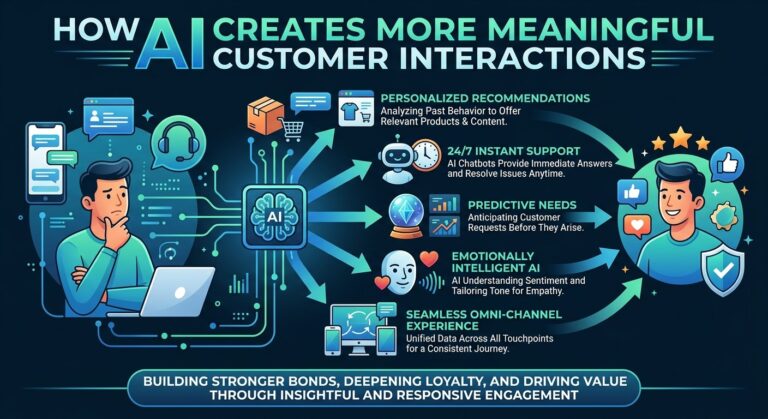
How AI Creates More Meaningful Customer Interactions
Introduction
Customer interactions are at the heart of every successful business relationship. Whether a customer is asking a question, looking for a product, requesting support, or providing feedback, every interaction is an opportunity for a brand to build trust and create a positive experience.
However, customers increasingly expect businesses to understand their needs and respond quickly. Generic messages, repetitive questions, and long waiting times can make customers feel disconnected from a brand.
Artificial intelligence (AI) is changing this.
Rather than simply automating conversations, modern AI can help businesses make customer interactions more relevant, personalized, responsive, and useful. By analyzing customer information and understanding conversational context, AI can help businesses deliver experiences that feel more meaningful.
In this article, we’ll explore how AI creates more meaningful customer interactions, the benefits for businesses and customers, and how companies can use AI to strengthen customer relationships.
What Are Meaningful Customer Interactions?
A meaningful customer interaction is more than simply answering a question.
It happens when a customer feels that a business:
- Understands their needs
- Provides relevant information
- Responds at the right time
- Makes the process easier
- Values their concerns
- Provides a consistent experience
Meaningful interactions help turn ordinary transactions into stronger customer relationships.
AI can support these interactions by helping businesses understand customers and respond more intelligently.
AI Makes Customer Communication More Personalized
Personalization is one of the biggest ways AI improves customer interactions.
Traditional communication often delivers the same message to an entire audience. AI can analyze customer information and behavior to help businesses tailor interactions.
AI-powered personalization can consider:
- Previous purchases
- Customer preferences
- Browsing activity
- Previous conversations
- Engagement patterns
- Product interests
This allows businesses to provide information that is more relevant to each customer.
For example, instead of recommending random products, an AI system can use previous interactions to suggest products that are more likely to match a customer’s interests.
AI Helps Businesses Understand Customer Intent
Customers don’t always explain exactly what they need.
They may use informal language, incomplete sentences, or different phrases to describe the same problem.
Conversational AI can analyze the context of a conversation to identify the likely intent behind a customer’s request.
For example:
“I haven’t received my order yet.”
The customer may actually be asking about delivery status, a delayed shipment, or an order problem.
Understanding intent allows AI to provide a more useful response instead of simply matching keywords.
Faster Responses Create Better Experiences
Waiting is one of the biggest sources of customer frustration.
AI-powered communication systems can respond to common questions almost immediately.
Customers can receive help with:
- Product information
- Account questions
- Order information
- Basic troubleshooting
- Scheduling
- Frequently asked questions
Faster responses reduce friction and make interactions more convenient.
When an issue requires human assistance, AI can also help route the conversation to the appropriate employee.
AI Provides 24/7 Customer Assistance
Customers don’t always need help during traditional business hours.
An AI-powered customer service system can provide assistance around the clock.
This is particularly useful for:
- International businesses
- Online stores
- Digital services
- Global customers
- Businesses with high customer volumes
24/7 availability gives customers more flexibility while reducing pressure on human support teams.
AI Remembers Customer Context
Repeatedly explaining the same problem can be frustrating.
AI-powered customer experience systems can use relevant conversation history and customer information to maintain context when properly integrated with business systems.
This can help customers avoid repeating basic information.
For example, if a customer has already explained an issue during an earlier interaction, relevant information can potentially be made available to the next stage of support.
The result is a smoother and more connected experience.
AI Helps Employees Have Better Customer Conversations
AI doesn’t have to communicate directly with customers all the time.
It can also work behind the scenes to help customer service representatives.
AI can provide employees with:
- Suggested responses
- Customer summaries
- Relevant information
- Knowledge base recommendations
- Conversation summaries
- Suggested next steps
This allows employees to spend less time searching for information and more time listening to customers and solving complex problems.
AI Creates More Relevant Recommendations
Meaningful interactions often involve helping customers discover something useful.
AI can analyze customer behavior to provide relevant recommendations.
Businesses can use AI to recommend:
- Products
- Services
- Content
- Features
- Educational resources
- Support options
When recommendations are genuinely relevant, customers receive more value from their interactions with a brand.
AI Helps Businesses Become More Proactive
Traditional customer service is often reactive. A customer experiences a problem and then contacts the business.
AI can help businesses become more proactive by identifying patterns that may indicate a customer needs assistance.
For example, AI may help identify:
- Customers experiencing repeated problems
- Customers who appear to be losing engagement
- Unusual account activity
- Common product difficulties
- Frequently encountered service issues
Businesses can then take appropriate action before small problems become larger ones.
AI Analyzes Customer Feedback
Customer feedback is one of the most valuable sources of information for a business.
AI can analyze large volumes of:
- Reviews
- Surveys
- Support conversations
- Emails
- Messages
- Social media feedback
This can help businesses identify recurring themes and customer concerns.
For example, if many customers mention difficulty using a particular feature, the business can prioritize improving that feature.
AI therefore turns customer conversations into actionable business insights.
AI Helps Brands Understand Customer Sentiment
Beyond identifying what customers say, AI can help analyze the overall sentiment expressed in customer communications.
Sentiment analysis can categorize interactions as generally:
- Positive
- Negative
- Neutral
Businesses can use these insights to identify potential customer experience problems and understand how customers feel about products or services.
However, sentiment analysis should be treated as a supporting signal rather than a perfect measurement of human emotion.
AI Improves Omnichannel Communication
Customers may communicate with a business through multiple channels.
They might:
- Discover a product through social media.
- Visit the company’s website.
- Ask a question through live chat.
- Contact customer support later.
- Complete their purchase through another channel.
AI can help connect these interactions when the underlying systems are properly integrated.
This creates a more consistent customer journey and reduces communication gaps.
AI Makes Customer Service More Consistent
Customers expect consistent information regardless of when or where they contact a business.
AI can help organizations maintain consistent responses to common questions by using centralized information and predefined business guidelines.
This can reduce situations where different representatives provide conflicting information.
Human employees can still handle complex situations while AI supports consistency for routine interactions.
AI Can Reduce Repetitive Conversations
Customer service teams often answer the same questions repeatedly.
AI can handle many routine questions, allowing human representatives to focus on more complicated customer needs.
Common examples include:
- Business hours
- Basic product information
- Appointment requests
- Order questions
- Account instructions
- Frequently asked questions
This benefits both customers and employees.
Customers get faster answers, while employees gain more time for meaningful conversations.
AI and the Human Touch
Meaningful customer interactions should not eliminate human involvement.
Some situations require:
- Empathy
- Judgment
- Creativity
- Negotiation
- Emotional understanding
- Complex problem-solving
AI is most effective when it supports human employees rather than attempting to replace every interaction.
A strong customer experience strategy combines AI efficiency with human empathy.
How SmileLineAI Can Support Meaningful Customer Interactions
AI-powered customer communication platforms such as SmileLineAI can help businesses improve the quality and efficiency of customer interactions.
AI-powered communication can help organizations:
- Respond to customers faster
- Automate routine conversations
- Personalize customer interactions
- Provide consistent information
- Support customers around the clock
- Reduce repetitive workloads
- Improve customer engagement
By combining intelligent automation with customer-focused communication, businesses can create more responsive experiences without placing additional pressure on their support teams.
How Businesses Can Use AI to Create Better Interactions
Businesses can begin with a few practical strategies.
- Identify Repetitive Customer Questions
Find the questions employees answer most frequently and determine which ones can be safely automated.
- Improve Customer Data
Make sure customer information is accurate, organized, and appropriately protected.
- Personalize Communication
Use relevant customer information to make recommendations and messages more useful.
- Connect AI With Human Support
Create clear pathways for customers to reach employees when AI cannot adequately address their needs.
- Analyze Customer Feedback
Use AI to identify recurring problems and opportunities for improving the customer experience.
- Measure Results
Track metrics such as:
- Customer satisfaction
- Response times
- Resolution rates
- Customer retention
- Engagement
- Conversion rates
Continuous measurement helps businesses understand whether AI is genuinely improving customer interactions.
Responsible AI Builds Better Customer Relationships
Meaningful interactions depend on trust.
Businesses should make responsible AI practices a priority by:
- Protecting customer information
- Being transparent about AI usage
- Maintaining appropriate human oversight
- Monitoring AI-generated responses
- Avoiding misleading communication
- Providing human assistance when appropriate
Customers should feel that AI is making their experience easier—not making it more difficult or impersonal.
The Future of AI Customer Interactions
AI-powered customer communication will continue to evolve.
Future systems are likely to become better at:
- Understanding conversational context
- Predicting customer needs
- Personalizing interactions
- Supporting voice conversations
- Analyzing customer feedback
- Coordinating communication across channels
AI may increasingly operate as an intelligent layer across the entire customer journey, helping businesses understand customers and respond more effectively.
The goal isn’t simply to automate more conversations. It is to make each interaction more useful.
Conclusion
AI is changing the way businesses communicate with their customers. By understanding customer intent, personalizing communication, analyzing feedback, reducing response times, and supporting employees, AI can help create more meaningful customer interactions.
The most successful businesses will not use AI simply because it is new technology. They will use it strategically to solve real customer problems and make interactions easier, faster, and more relevant.
AI can handle repetitive tasks, analyze customer information, and provide intelligent assistance—but human empathy and judgment remain essential.
When artificial intelligence and human expertise work together, businesses can create customer experiences that are not only more efficient but also more meaningful.
The future of customer communication isn’t about more interactions. It’s about better interactions.