How AI Chatbots Improve Sales and Lead Generation
Introduction
Generating leads and converting them into customers are two of the biggest challenges for businesses operating online. Companies can invest heavily in advertising, content marketing, social media, and search engine optimization to attract visitors, but attracting traffic is only the beginning.
The next challenge is turning those visitors into meaningful conversations and potential customers.
This is where AI chatbots for sales and lead generation can make a significant difference.
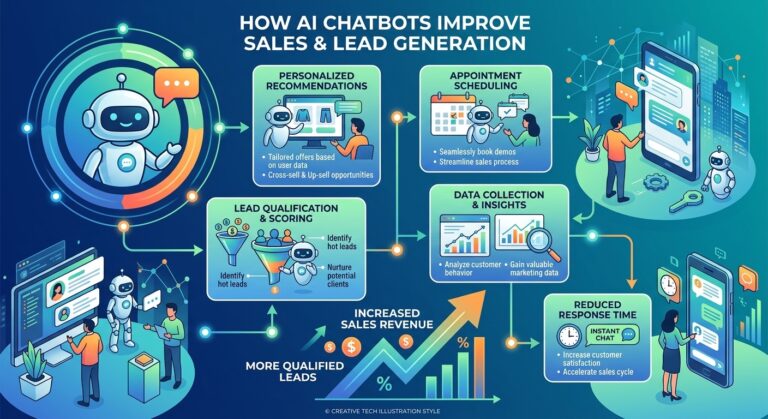
Instead of leaving website visitors to browse pages independently, AI chatbots can engage them in real-time conversations. They can answer questions, identify customer needs, recommend relevant products or services, collect contact information, qualify prospects, and guide potential customers toward the next step.
AI chatbots can essentially transform a static website into an interactive sales environment.
When implemented strategically, they can help businesses capture more opportunities while reducing repetitive work for sales and marketing teams.
What Are AI Sales and Lead Generation Chatbots?
An AI sales chatbot is a conversational software system designed to help businesses engage potential customers and support the sales process.
Unlike a traditional contact form, which requires a visitor to decide to submit their information, a chatbot can initiate a conversation.
For example:
Chatbot: “Welcome! What are you looking for today?”
Visitor: “I’m looking for an affordable customer service solution.”
Chatbot: “I’d be happy to help. How many people are on your customer support team?”
The conversation can continue based on the visitor’s responses.
Depending on the business and its technology stack, an AI chatbot can:
- Engage website visitors
- Answer product questions
- Recommend services
- Collect contact information
- Qualify leads
- Identify customer intent
- Schedule consultations
- Direct customers to relevant products
- Support purchasing decisions
- Assist sales representatives
This makes conversational AI useful throughout the sales funnel.
Why Lead Generation Matters for Online Businesses
A business cannot grow consistently without potential customers entering its sales pipeline.
Traditional lead generation methods include:
- Contact forms
- Landing pages
- Email campaigns
- Advertising
- Social media
- Search engine optimization
- Webinars
- Downloadable resources
These methods can be effective, but they often depend on visitors taking a specific action.
AI chatbots introduce another option: conversational lead generation.
Instead of asking visitors to fill out a long form, businesses can invite them to have a conversation.
This can make the process feel more natural and interactive.
AI Chatbots Engage Visitors Immediately
Many website visitors leave without contacting a business.
They may be interested in a product or service but still have unanswered questions.
An AI chatbot can provide an immediate opportunity to start a conversation.
For example:
“Looking for the right solution? Tell us what you’re trying to achieve, and we’ll help you find the relevant information.”
This simple invitation can encourage visitors to interact.
Once a conversation begins, the business has an opportunity to understand the visitor’s needs.
AI Chatbots Capture Leads 24/7
Traditional sales teams have working hours.
Websites do not.
Visitors can arrive at any time, including evenings, weekends, and holidays.
An AI chatbot can remain available to engage potential customers outside normal business hours.
A visitor who discovers a company at 11 p.m. does not necessarily have to wait until the next morning to ask a question.
The chatbot can:
- Start the conversation.
- Understand the visitor’s needs.
- Answer basic questions.
- Collect relevant contact information.
- Provide a next step.
The sales team can then follow up when appropriate.
AI Chatbots Qualify Leads Automatically
Not every lead has the same potential value.
Sales representatives can waste time contacting people who are simply researching products or who do not match the company’s target market.
AI chatbots can ask qualifying questions before passing leads to the sales team.
For example:
- What product or service are you interested in?
- What type of business do you operate?
- What is your approximate budget?
- How soon are you looking to purchase?
- How large is your organization?
- What problem are you trying to solve?
The answers can help businesses identify which conversations deserve additional attention.
AI Chatbots Ask Questions Conversationally
Traditional lead forms often ask visitors to provide several pieces of information at once.
A chatbot can collect information gradually.
For example:
Chatbot: “What service are you interested in?”
Visitor: “SEO.”
Chatbot: “Are you looking to improve an existing website or launch SEO for a new website?”
Visitor: “An existing website.”
Chatbot: “Thanks. Approximately how large is your website?”
This conversational process can feel less demanding than completing a lengthy form.
The chatbot can collect information naturally while keeping the visitor engaged.
AI Chatbots Help Identify Customer Intent
Understanding why someone is visiting a website is essential for effective sales.
A visitor searching for pricing has different intentions from someone looking for technical support.
AI chatbots can ask questions that reveal the visitor’s goals.
For example:
“Are you looking to purchase a solution, compare options, or simply learn more?”
The response can determine the direction of the conversation.
Identifying customer intent helps businesses provide more relevant information.
AI Chatbots Can Recommend Products and Services
Customers can become overwhelmed when websites offer many products or service packages.
AI chatbots can help simplify the decision-making process.
For example, an online software company could ask:
- How many users do you have?
- Which features do you need?
- What type of business do you operate?
- What is your approximate budget?
Based on the customer’s answers, the chatbot can direct the visitor toward relevant options.
This can turn product discovery into a personalized conversation.
AI Chatbots Answer Sales Questions Instantly
Potential customers often have questions before making a purchase.
They may want to know:
- How much does it cost?
- What features are included?
- Is there a free trial?
- How does the product work?
- What makes this solution different?
- Is it suitable for a small business?
- How long does implementation take?
If customers cannot find answers quickly, they may leave.
An AI chatbot can provide immediate answers to common sales questions.
This can help remove friction from the buying process.
AI Chatbots Can Overcome Common Buying Obstacles
Customers sometimes hesitate because they lack information.
For example:
Customer: “I’m interested, but I’m not sure which plan I need.”
Instead of requiring the customer to search through documentation, a chatbot can ask about their requirements.
The conversation could lead to:
“Based on what you’ve told me, this option may be worth exploring. Would you like to see the details?”
The chatbot is not necessarily forcing a sale.
It is helping the customer move forward with better information.
AI Chatbots Can Support Different Stages of the Sales Funnel
AI chatbots can be useful throughout the customer journey.
Awareness
The chatbot can explain what the business offers.
Interest
It can answer questions and provide educational information.
Consideration
It can compare products or services.
Decision
It can provide pricing, features, and next steps.
Purchase
It can guide customers toward checkout or booking.
Post-purchase
It can answer common questions and provide support.
This makes AI chatbots useful beyond simple lead collection.
AI Chatbots Can Schedule Sales Meetings
Many businesses rely on consultations, demonstrations, or sales calls.
Scheduling these meetings can involve unnecessary back-and-forth communication.
An AI chatbot can help move prospects toward scheduling.
For example:
Chatbot: “Would you like to speak with a specialist?”
Visitor: “Yes.”
Chatbot: “Great. I can help you find an available consultation time.”
The customer can then be directed toward the appropriate scheduling process.
This can reduce friction between initial interest and sales contact.
AI Chatbots Can Help Recover Lost Opportunities
Not every visitor is ready to purchase immediately.
Some visitors may leave because they need more information.
Depending on the business’s systems and customer permissions, conversational tools can support follow-up strategies.
For example, a chatbot can encourage visitors to:
- Subscribe to updates
- Request more information
- Save a product
- Book a consultation
- Download a resource
- Contact the sales team
The goal is to preserve opportunities that might otherwise disappear.
AI Chatbots Can Support Personalized Sales Conversations
Personalization can make sales communication more relevant.
Instead of giving every visitor the same message, an AI chatbot can respond based on the conversation.
For example:
A visitor says:
“I run a small online store and need help improving customer support.”
The chatbot can focus the conversation on customer support solutions for smaller businesses rather than providing unrelated information.
Relevant conversations can make it easier for prospects to find useful answers.
AI Chatbots Can Increase Sales Team Productivity
Sales representatives often spend time on administrative tasks.
They may manually:
- Collect lead information
- Research basic customer requirements
- Answer repetitive questions
- Sort leads
- Schedule meetings
- Write initial responses
AI can automate parts of this process.
A chatbot can collect information before a salesperson becomes involved.
The sales representative can then begin the conversation with a better understanding of the prospect.
This can help sales teams spend more time on meaningful conversations.
AI Chatbots Can Help Prioritize Leads
Not every inquiry deserves the same level of attention.
AI chatbots can collect information that helps businesses categorize leads.
For example, leads could be organized according to factors such as:
- Customer needs
- Company size
- Product interest
- Purchase timeframe
- Budget range
- Level of engagement
The sales team can then decide how to prioritize follow-up based on the business’s own criteria.
This can make the sales pipeline more organized.
AI Chatbots Can Connect Marketing and Sales
Marketing and sales teams sometimes operate separately.
Marketing generates traffic and leads, while sales follows up with prospects.
AI chatbots can connect these activities.
A visitor arriving from a marketing campaign can immediately enter a relevant conversation.
For example, someone clicking an advertisement for a specific service could be greeted with information related to that service.
This creates a more connected journey:
Advertisement → Website → AI Conversation → Lead Qualification → Sales Follow-Up
The customer does not have to navigate through unrelated information.
AI Chatbots Can Improve Customer Engagement
Lead generation is not just about collecting email addresses.
A lead becomes more valuable when the business understands the person’s needs.
Conversational AI can encourage visitors to explain what they are looking for.
This creates richer customer interactions.
Instead of:
Name + Email + Phone Number
the business may learn:
Who the customer is + What they need + What problem they have + What solution they are considering + When they want to act
This information can make subsequent sales conversations more relevant.
AI Chatbots Can Reduce Lead Response Delays
A lead can lose momentum if the business takes too long to respond.
AI chatbots can engage potential customers immediately.
Even if a human salesperson cannot respond immediately, the chatbot can:
- Acknowledge the inquiry
- Answer initial questions
- Collect information
- Provide relevant resources
- Guide the customer toward a next step
This helps keep the conversation moving.
AI Chatbots Can Support E-Commerce Sales
E-commerce websites are particularly suitable for conversational AI.
Online shoppers may need help deciding between products.
A chatbot can ask about:
- Budget
- Preferences
- Product requirements
- Intended use
- Size
- Features
- Availability
It can then direct shoppers toward relevant products.
For example:
“I’m buying a laptop for video editing.”
The chatbot could ask:
“What type of video editing software do you use, and what is your approximate budget?”
The conversation becomes a digital shopping assistant.
AI Chatbots Can Support Service-Based Businesses
AI sales chatbots are not limited to online stores.
They can also help service-based businesses such as:
- Marketing agencies
- Consulting firms
- Software companies
- Real estate businesses
- Education providers
- Professional services
- Repair companies
- Digital agencies
A chatbot can explain services, identify customer requirements, collect lead information, and direct qualified prospects toward consultations.
AI Chatbots Can Improve the Customer Experience During Sales
Effective sales are not simply about convincing people to buy.
Customers want to understand whether a product or service is appropriate for them.
AI chatbots can support that process by providing information when customers need it.
A helpful chatbot should focus on:
- Understanding customer needs
- Providing accurate information
- Answering questions
- Reducing confusion
- Guiding customers toward appropriate next steps
This creates a customer-centered approach to conversational sales.
How to Build an Effective AI Lead Generation Strategy
Businesses can begin with a simple process.
Step 1: Define the Ideal Customer
Identify the type of customer the business wants to attract.
Step 2: Identify Common Sales Questions
Review conversations with prospects and identify recurring questions.
Step 3: Build a Conversational Flow
Create a chatbot journey that starts with a simple question and gradually learns about the visitor.
Step 4: Add Lead Qualification
Ask questions that help determine whether a visitor is a relevant prospect.
Step 5: Provide Useful Recommendations
Use customer responses to direct visitors toward relevant products, services, or resources.
Step 6: Create Human Escalation
Allow prospects to connect with a salesperson when the conversation becomes complex or high-value.
Step 7: Measure Performance
Track lead generation, qualification, engagement, and conversion metrics.
Important Metrics for AI Chatbot Sales Performance
Businesses should measure more than the number of conversations.
Number of conversations
How many visitors interact with the chatbot?
Lead capture rate
How many conversations result in lead information?
Qualified lead rate
How many captured leads meet the company’s criteria?
Appointment rate
How many prospects schedule a call or consultation?
Conversion rate
How many chatbot-assisted prospects become customers?
Customer engagement
How long do visitors interact with the chatbot and how many complete the intended journey?
Sales team efficiency
Does the chatbot reduce repetitive work and provide better-qualified prospects?
These metrics can help businesses determine where the chatbot is creating value and where improvements are needed.
Common Mistakes to Avoid
- Asking for too much information
A chatbot should not overwhelm visitors with a long list of questions.
Start with the information that matters most.
- Being too aggressive
Customers do not want to feel pressured into purchasing.
The chatbot should assist rather than manipulate.
- Providing inaccurate information
Incorrect product or pricing information can damage trust.
- Ignoring human support
High-value or complex prospects may need to speak with a salesperson.
- Focusing only on lead quantity
A large number of poor-quality leads may be less useful than a smaller number of relevant prospects.
- Failing to improve the chatbot
Customer questions change over time.
Businesses should continuously review conversations and update the system.
AI Chatbots and Human Sales Teams
The best approach is often a combination of AI and human expertise.
AI can:
- Start conversations
- Answer common questions
- Collect information
- Qualify prospects
- Recommend relevant resources
- Schedule appointments
Human sales professionals can:
- Build relationships
- Handle complex negotiations
- Understand unique customer situations
- Provide detailed consultations
- Close complex deals
This creates a hybrid sales process.
AI creates the conversation. Humans deepen the relationship.
How SmileLineAI Can Support AI-Powered Sales
Platforms such as SmileLineAI can be part of a broader strategy for businesses exploring AI-powered customer communication and engagement.
AI customer communication can support sales by making it easier to interact with website visitors, answer questions, personalize conversations, and identify potential opportunities.
The goal should not simply be to automate sales.
Instead, businesses can use AI to make the sales journey more responsive and useful.
When routine conversations are automated, sales teams can spend more time understanding prospects, developing relationships, and handling opportunities that require human expertise.
The Future of AI Chatbots for Sales and Lead Generation
AI chatbots are becoming increasingly capable of supporting more stages of the sales process.
Future conversational systems may become more integrated with:
- CRM platforms
- E-commerce systems
- Marketing automation
- Scheduling tools
- Customer databases
- Product catalogs
- Analytics platforms
This could allow businesses to create more connected sales journeys.
Imagine a customer asking:
“Which plan should I choose?”
The AI could potentially consider the customer’s stated needs, explain relevant options, answer follow-up questions, and help the customer move toward the appropriate next step.
The future of AI-powered sales is therefore likely to involve more than automated conversations.
It will involve intelligent customer journeys.
Conclusion
AI chatbots are changing the way businesses approach sales and lead generation.
They can engage website visitors, answer questions, collect information, qualify leads, recommend products, schedule appointments, and support sales teams.
For businesses, this creates an opportunity to turn websites and digital channels into more interactive sales environments.
However, successful chatbot sales strategies require more than automation.
Businesses need to focus on customer needs, provide accurate information, ask useful questions, protect customer information, and create easy paths to human assistance.
The most effective model is often a combination of AI and people.
AI can handle the initial conversation and repetitive tasks, while human sales professionals focus on complex discussions, relationship building, and important purchasing decisions.
As conversational AI continues to evolve, businesses that use chatbots strategically can create more responsive customer journeys while giving sales teams better opportunities to focus on qualified prospects.