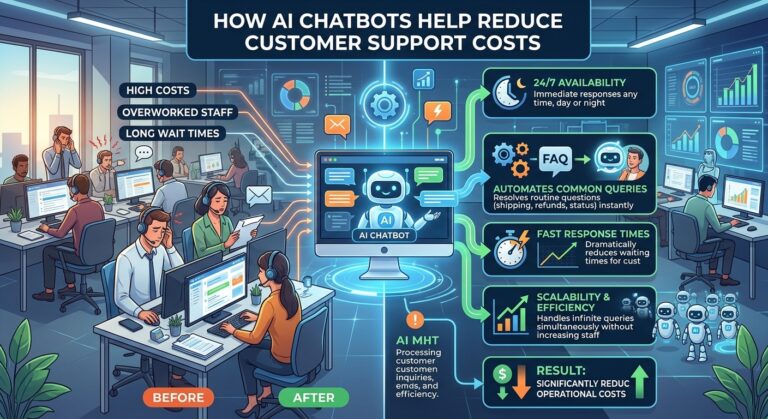
How AI Chatbots Help Reduce Customer Support Costs
Introduction
Customer support is one of the most important parts of running a successful business, but it can also become one of the most expensive. As a company grows, the number of customer questions, support requests, product inquiries, and service issues often increases as well.
Hiring additional support employees can help businesses manage higher demand, but continuously expanding a customer service team can significantly increase operating costs. Businesses must consider salaries, training, scheduling, software, management, and other expenses associated with maintaining a large support operation.
AI chatbots provide another approach.
By automating repetitive customer interactions and assisting human support teams, AI chatbots can help businesses handle more conversations without increasing support resources at the same rate. They can answer common questions, provide information, collect details, guide customers through basic processes, and route more complicated issues to human representatives.
However, the goal should not simply be to replace human support. The most effective strategy is to use AI to handle appropriate tasks while allowing human agents to concentrate on conversations that require judgment, empathy, and specialized assistance.
What Are AI Chatbots for Customer Support?
AI customer support chatbots are software systems that use artificial intelligence to communicate with customers through conversational interfaces.
Depending on their configuration, chatbots can help customers with tasks such as:
- Answering frequently asked questions
- Explaining products and services
- Providing business information
- Helping customers navigate websites
- Checking basic order information
- Collecting customer details
- Qualifying support requests
- Scheduling appointments
- Providing troubleshooting guidance
- Routing conversations to human agents
Unlike traditional support systems that may depend entirely on predefined menus, modern AI chatbots can understand natural-language questions and provide conversational responses.
This makes them particularly useful for businesses that receive large numbers of repetitive customer inquiries.
Automating Repetitive Customer Questions
One of the simplest ways AI chatbots can reduce customer support costs is by handling repetitive questions automatically.
Many businesses receive similar questions every day.
Customers may repeatedly ask:
- What are your business hours?
- How much does this service cost?
- How long does delivery take?
- What payment methods do you accept?
- Where can I find your products?
- How can I contact support?
- What is your return policy?
Human employees do not necessarily need to manually answer every one of these questions.
An AI chatbot can provide immediate answers, allowing support employees to focus on more complex customer needs.
Over time, this can reduce the amount of repetitive work handled manually.
Providing 24/7 Customer Assistance
Traditional customer support often depends on business operating hours.
Customers who need help outside those hours may have to wait until the next business day.
AI chatbots can provide automated assistance at any time, including evenings, weekends, and holidays.
This does not mean every issue can be resolved automatically. Instead, the chatbot can provide useful information immediately and determine whether a human representative is required.
For example, a customer contacting a company at midnight may receive answers to common questions rather than simply seeing a message that support is closed.
This can improve accessibility while reducing pressure on employees during regular business hours.
Reducing the Number of Support Tickets
Support tickets can consume significant employee time.
If a large percentage of tickets involve simple questions, businesses can use chatbots to resolve some of those requests before they reach a human agent.
For example, instead of an employee manually answering hundreds of questions about delivery times, the chatbot can provide relevant information automatically.
This can reduce ticket volume and allow support teams to dedicate more time to complex cases.
Reducing Response Times
Customers generally do not want to wait hours or days for answers to simple questions.
AI chatbots can respond almost immediately to many routine inquiries.
Faster responses can reduce the number of follow-up messages customers send while waiting for assistance.
For example, if a customer asks whether a particular service is available and receives an immediate answer, there may be no need for additional emails or calls.
Reducing unnecessary back-and-forth communication can help businesses use support resources more efficiently.
Helping Human Agents Handle More Customers
AI chatbots do not have to operate independently.
They can also work as assistants for human customer service representatives.
A chatbot can handle simple questions while human agents focus on more complicated requests.
This can increase the number of customers a support team can serve without requiring the company to increase staffing at the same rate as customer demand.
The result is a hybrid support model in which AI handles appropriate tasks and employees handle situations that require human expertise.
Handling Multiple Conversations at Once
A human support representative generally communicates with a limited number of customers at the same time.
An AI chatbot can potentially handle many conversations simultaneously.
This is particularly valuable during periods of high demand.
For example, a business may experience a sudden increase in customer inquiries after:
- Launching a new product
- Running a promotion
- Releasing an update
- Experiencing a service disruption
- Publishing a popular marketing campaign
Instead of requiring a large temporary increase in support staff, a chatbot can handle many routine questions automatically.
Reducing Customer Support Workload
Employee workload is closely connected to operating costs.
When employees spend large amounts of time answering repetitive questions, businesses may need additional staff to maintain acceptable response times.
AI chatbots can reduce repetitive workloads by taking care of appropriate routine interactions.
This allows employees to spend more time on activities such as:
- Complex troubleshooting
- Customer retention
- Complaint resolution
- High-value customer conversations
- Technical support
- Relationship management
The objective is to make human employees more productive rather than simply reduce the number of employees.
Improving Agent Productivity
AI can also assist employees directly.
For example, an AI-powered system can help agents find relevant information, summarize conversations, suggest responses, or organize customer requests.
Instead of searching through multiple systems to find an answer, employees may be able to access useful information more quickly.
Even small improvements in productivity can become significant when multiplied across hundreds or thousands of support interactions.
Reducing Training Pressure
Customer support teams often require training when new employees join the organization.
Training may involve:
- Product information
- Company policies
- Support procedures
- Frequently asked questions
- Communication standards
- Troubleshooting processes
AI chatbots can provide consistent responses to common questions, reducing some of the repetitive knowledge demands placed on new employees.
They can also serve as a support resource for agents who need to locate information quickly.
However, businesses should still provide appropriate training for human employees, particularly for complex customer interactions.
Handling First-Level Support
Many support organizations divide customer service into different levels.
First-level support often deals with straightforward questions and basic troubleshooting.
AI chatbots can be useful at this stage.
For example, a chatbot could guide customers through basic steps before escalating an issue to a specialized support team.
This can help prevent specialized employees from spending time on simple issues that could have been resolved earlier.
Improving Support Ticket Routing
Not every customer request should go to the same department.
AI chatbots can collect information about a customer’s problem and help determine where the conversation should go next.
For example, a chatbot could identify whether a request involves:
- Billing
- Technical support
- Product information
- Account assistance
- Sales
- Returns
- Appointments
The chatbot can then route the request appropriately.
Better routing can reduce the amount of time employees spend transferring customers between departments.
Reducing Unnecessary Phone Calls
Phone support can require significant employee resources.
Customers may call because they cannot find basic information online or because they want an immediate answer.
An AI chatbot can provide another communication channel for customers who prefer messaging.
When customers can resolve simple questions through chat, some calls may be avoided.
This can help reduce pressure on phone support teams, particularly during peak periods.
Supporting Self-Service
Customer self-service is another important area where AI chatbots can reduce costs.
Instead of requiring customers to contact an employee for every question, businesses can provide automated assistance that guides customers toward useful information.
For example, a chatbot can help customers find:
- Help articles
- Product documentation
- Account instructions
- Troubleshooting steps
- Policy information
- Setup guides
The chatbot essentially becomes a conversational entry point to the company’s knowledge base.
Helping Customers Before They Contact Support
A chatbot can sometimes prevent a support request from occurring in the first place.
For example, imagine a customer is trying to complete a purchase but becomes confused about shipping options.
A chatbot can proactively provide assistance before the customer submits a support request.
Similarly, a chatbot can answer questions while customers are browsing products or services.
Early assistance can reduce unnecessary support interactions while improving the customer journey.
Reducing Support Costs During Business Growth
Scaling customer support can be challenging.
As a company gains more customers, support demand may increase.
Businesses that rely entirely on human support may need to continually expand their teams to keep up.
AI chatbots provide an additional layer of support capacity.
They can help businesses manage increased interaction volumes without requiring every additional conversation to be handled manually.
This does not eliminate the need for employees, but it can make scaling customer support more manageable.
Helping Small Businesses Compete With Larger Companies
Small businesses may not have the resources to maintain large customer service departments.
An AI chatbot can give a smaller company an automated support capability that operates throughout the day.
For a growing business, this can be especially useful when employees have to manage multiple responsibilities.
Instead of having one employee constantly monitor basic customer questions, the chatbot can handle routine inquiries while the team focuses on higher-value work.
Reducing Customer Support Backlogs
Large support backlogs can increase costs because employees must spend additional time processing old requests while new ones continue to arrive.
Chatbots can help reduce this pressure by handling appropriate routine inquiries immediately.
When fewer simple questions enter the manual support queue, human agents can concentrate on unresolved or complicated cases.
This can help maintain a healthier support workflow.
Improving Consistency in Customer Responses
Different employees may sometimes provide slightly different answers to the same question.
An AI chatbot can provide standardized information based on approved business knowledge.
Consistent responses can be useful for:
- Pricing information
- Business policies
- Product specifications
- Service details
- Frequently asked questions
Businesses should still monitor chatbot responses to ensure that the underlying information remains accurate and appropriate.
Supporting Sales and Customer Service Together
AI chatbots can sometimes reduce costs while also supporting revenue-generating activities.
For example, a chatbot can answer customer questions about a product and then guide an interested visitor toward purchasing or speaking with a sales representative.
This can create a more connected experience between marketing, sales, and customer support.
A single conversation may begin with a basic question and eventually become a sales opportunity.
Identifying Opportunities to Improve Support
Chatbot conversations can also provide businesses with valuable operational insights.
When companies analyze recurring customer questions, they may discover:
- Confusing product information
- Website navigation problems
- Frequently misunderstood policies
- Missing documentation
- Product issues
- Common customer concerns
These insights can help businesses fix problems that generate unnecessary support requests.
In this way, chatbot data can contribute to cost reduction beyond simple automation.
How to Calculate AI Chatbot Cost Savings
Businesses should measure actual results rather than assuming that chatbot implementation automatically reduces costs.
Useful metrics include:
Support Requests Automated
Measure how many conversations are successfully handled without human intervention.
Human Handoff Rate
Track how often conversations need to be transferred to employees.
Average Resolution Time
Compare the time required to resolve customer issues before and after chatbot implementation.
Cost Per Support Interaction
Estimate the resources required to handle different types of customer requests.
Customer Satisfaction
Cost reduction should not come at the expense of customer experience.
Agent Productivity
Measure whether employees can handle more meaningful work or resolve cases more efficiently.
Support Ticket Volume
Monitor whether automation reduces repetitive tickets.
AI Chatbots Should Not Replace Human Support Completely
Reducing customer support costs does not mean removing human employees from the support process.
Some customer situations require empathy, negotiation, judgment, or specialized knowledge.
Human agents are particularly important for:
- Complex complaints
- Sensitive issues
- High-value customers
- Technical problems
- Account disputes
- Escalated cases
- Situations involving exceptions to normal policies
The strongest approach is often a combination of AI and human support.
AI can handle repetitive tasks while employees focus on conversations where human involvement matters most.
Common Mistakes When Using Chatbots to Reduce Costs
Businesses should avoid reducing costs at the expense of customer experience.
Common mistakes include:
- Automating every interaction
- Making it difficult to reach a human
- Using outdated chatbot information
- Ignoring chatbot errors
- Measuring only automation volume
- Collecting unnecessary customer information
- Creating complicated conversations
- Failing to monitor customer satisfaction
- Treating chatbot deployment as a one-time project
Cost savings should be considered alongside quality, satisfaction, accuracy, and resolution rates.
Best Practices for Cost-Effective AI Customer Support
Businesses can improve their results by following several practical principles.
Start With Repetitive Tasks
Identify the questions employees answer repeatedly and determine which can safely be automated.
Use Human Escalation
Make it easy for customers to reach an employee when automation is insufficient.
Maintain Accurate Knowledge
Regularly update product, pricing, policy, and service information.
Monitor Performance
Track both financial and customer-experience metrics.
Improve Based on Real Conversations
Analyze failed conversations and customer feedback to identify opportunities for improvement.
Scale Gradually
Start with a focused use case and expand the chatbot’s responsibilities as performance improves.
The Future of AI-Powered Customer Support
AI-powered customer support is moving toward a hybrid model where automation and human expertise work together.
Future customer service systems are likely to become increasingly capable of understanding customer intent, retrieving relevant information, assisting human agents, and handling routine processes.
However, successful implementation will continue to depend on more than technology.
Businesses will need to balance automation with accuracy, privacy, transparency, customer satisfaction, and human assistance.
The companies that approach AI as a tool for improving customer service operations rather than simply cutting headcount can create more sustainable support strategies.
How SmileLineAI Can Help Businesses Improve Customer Support
SmileLineAI is designed around the growing need for smarter AI-powered customer communication.
Businesses can use AI customer platforms to support conversations, automate repetitive interactions, improve response times, and help customer service teams manage growing communication demands.
The most effective approach is to identify where customers need immediate assistance, automate appropriate routine interactions, and maintain a smooth path to human support when necessary.
This approach can help businesses improve operational efficiency while continuing to provide customers with meaningful support.
Conclusion
AI chatbots can help businesses reduce customer support costs by automating repetitive questions, providing 24/7 assistance, reducing support ticket volume, improving response times, assisting human agents, and handling multiple conversations simultaneously.
However, cost reduction should never be the only objective.
A successful AI customer support strategy balances automation with customer satisfaction, accurate information, data protection, and human expertise.
By starting with appropriate use cases, measuring real performance, maintaining accurate information, and continuously improving chatbot conversations, businesses can create a support system that is both more efficient and more scalable.
As customer expectations continue to evolve, AI chatbots can become an important part of modern customer service—helping businesses manage increasing demand while allowing human teams to focus on the interactions where they provide the greatest value.