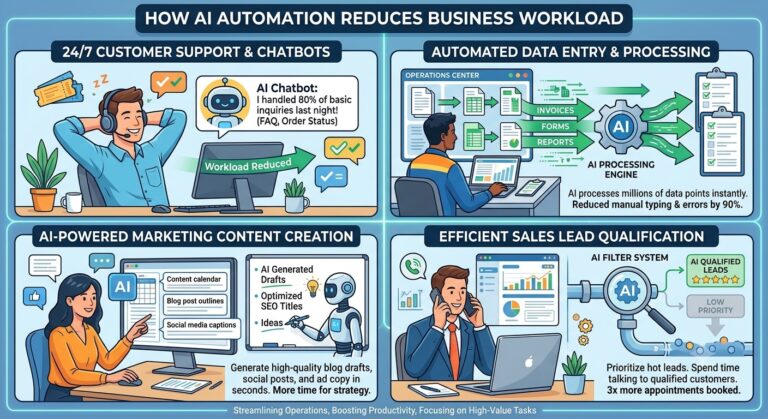
How AI Automation Reduces Business Workload
Introduction
Running a business involves countless daily tasks, from answering customer inquiries and managing emails to processing orders and organizing data. While these responsibilities are essential, many are repetitive and time-consuming, preventing employees from focusing on strategic initiatives that drive growth.
Artificial intelligence (AI) automation is transforming how businesses operate by handling routine processes with speed and accuracy. Instead of spending hours on manual tasks, organizations can use AI-powered solutions to automate workflows, improve productivity, and deliver better customer experiences.
Whether you’re a startup, a small business, or a growing enterprise, AI automation can help reduce workloads while improving efficiency and reducing operational costs.
In this article, we’ll explore how AI automation reduces business workload, the key areas where it creates value, and why businesses are increasingly investing in AI-powered automation.
AI Automation: What Is It?
AI automation combines artificial intelligence with automated workflows to perform tasks that traditionally required human effort.
Unlike simple automation, AI can:
- Learn from data
- Understand natural language
- Recognize patterns
- Make recommendations
- Adapt to changing situations
This enables businesses to automate not only repetitive tasks but also more intelligent processes that improve overall operations.
Why Businesses Are Turning to AI Automation
As businesses grow, workloads naturally increase. Customer inquiries become more frequent, administrative tasks expand, and managing operations becomes more complex.
AI automation helps businesses:
- Save time
- Improve productivity
- Reduce repetitive work
- Increase operational efficiency
- Deliver faster customer service
- Support business growth
By automating routine responsibilities, employees can focus on higher-value work that requires creativity, critical thinking, and relationship building.
Automating Repetitive Administrative Tasks
Administrative work often consumes a significant portion of the workday.
AI can automate tasks such as:
- Data entry
- Document processing
- Invoice generation
- Appointment scheduling
- Calendar management
- Report creation
Automating these responsibilities reduces manual effort while improving accuracy and consistency.
Improving Customer Service Efficiency
Customer support teams often receive hundreds of repetitive questions every day.
AI-powered customer service solutions can automatically handle inquiries related to:
- Frequently asked questions
- Product information
- Order tracking
- Appointment booking
- Account assistance
- Return policies
This allows customer service representatives to focus on complex issues that require human judgment and empathy.
Faster Email and Message Management
Businesses receive large volumes of emails and messages every day.
AI can help by:
- Categorizing incoming messages
- Prioritizing urgent requests
- Suggesting responses
- Automatically answering common inquiries
- Routing messages to the appropriate department
This significantly reduces the time employees spend managing communications.
Streamlining Workflow Management
AI automation improves internal business processes by connecting different systems and reducing manual handoffs.
Examples include:
- Task assignments
- Project updates
- Workflow approvals
- Document routing
- Team notifications
Automated workflows reduce delays and help projects move forward more efficiently.
Supporting Sales and Lead Management
Sales teams often spend valuable time qualifying leads and following up with prospects.
AI automation helps by:
- Identifying qualified leads
- Scoring prospects
- Scheduling follow-ups
- Tracking customer interactions
- Sending personalized messages
This allows sales professionals to focus on building relationships and closing deals.
Enhancing Marketing Productivity
Marketing teams can also benefit from AI automation.
AI tools can assist with:
- Email marketing campaigns
- Social media scheduling
- Audience segmentation
- Campaign optimization
- Performance reporting
Automation helps marketers deliver consistent campaigns while spending less time on repetitive tasks.
Improving Data Analysis
Businesses collect large amounts of information every day.
Instead of manually reviewing reports, AI can analyze data and provide insights into:
- Customer behavior
- Sales performance
- Marketing effectiveness
- Operational efficiency
- Business trends
These insights support faster and more informed decision-making.
Reducing Human Error
Manual processes are more likely to result in mistakes such as:
- Data entry errors
- Missed deadlines
- Incorrect calculations
- Duplicate records
AI automation performs tasks consistently, helping reduce errors while improving business accuracy.
Supporting Employees Instead of Replacing Them
One common misconception is that AI replaces employees.
In reality, AI automation is most effective when it works alongside people.
AI handles repetitive work, while employees focus on:
- Strategic planning
- Creative problem-solving
- Customer relationships
- Innovation
- Complex decision-making
This collaboration improves both productivity and employee satisfaction.
Lowering Operational Costs
By automating routine activities, businesses can reduce expenses related to:
- Manual processing
- Administrative labor
- Customer support operations
- Workflow delays
- Error correction
These savings can be reinvested into business growth, employee development, and innovation.
AI Automation Supports Business Scalability
As businesses grow, workloads naturally increase.
AI automation enables organizations to scale operations without proportionally increasing staffing requirements.
Businesses can:
- Handle more customer inquiries
- Process additional transactions
- Manage expanding workflows
- Support larger customer bases
Scalable automation helps companies grow more efficiently.
Best Practices for Implementing AI Automation
To maximize the benefits of AI automation, businesses should:
- Identify repetitive tasks suitable for automation
- Set clear automation goals
- Choose scalable AI solutions
- Integrate AI with existing systems
- Train employees to work alongside AI
- Monitor performance and continuously improve processes
A well-planned implementation strategy ensures successful adoption.
How SmileLineAI Supports Business Automation
Modern AI platforms like SmileLineAI help businesses automate customer communication and improve operational efficiency.
SmileLineAI provides AI-powered solutions that enable organizations to:
- Automate customer conversations
- Deliver instant responses
- Improve customer engagement
- Streamline communication workflows
- Reduce support workloads
- Enhance overall productivity
By integrating intelligent automation into daily operations, businesses can improve efficiency while maintaining exceptional customer experiences.
The Future of AI Automation
AI automation continues to evolve, offering even more advanced capabilities.
Future developments may include:
- Smarter predictive automation
- Advanced workflow optimization
- Voice-enabled automation
- Real-time business insights
- Hyper-personalized customer interactions
- Autonomous business processes
Businesses that invest in AI automation today will be better prepared to adapt to future opportunities and market changes.
Final Thoughts
AI automation is helping businesses reduce workload by eliminating repetitive tasks, improving operational efficiency, and supporting employees with intelligent tools. Rather than replacing human expertise, AI enables teams to focus on meaningful work that drives innovation and customer satisfaction.
From customer service and marketing to workflow management and data analysis, AI automation offers practical solutions that save time, reduce costs, and improve business performance.
As organizations continue to embrace digital transformation, AI automation will play an increasingly important role in helping businesses grow, remain competitive, and deliver outstanding customer experiences.