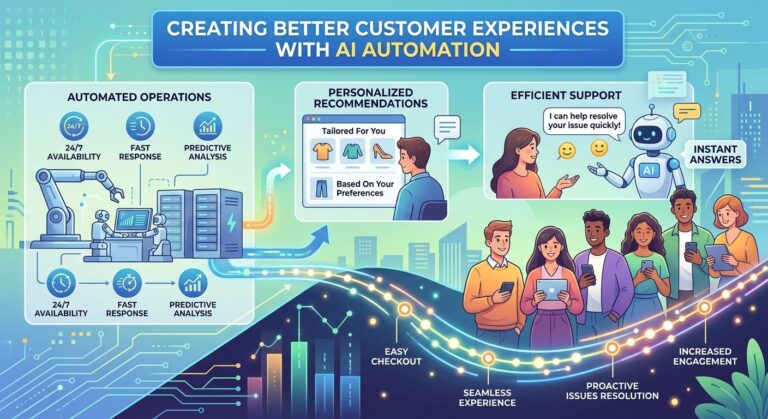
Creating Better Customer Experiences With AI Automation
Introduction
Customer expectations are constantly evolving. People want businesses to respond quickly, understand their needs, provide useful information, and make every interaction as convenient as possible.
For growing businesses, meeting these expectations can be challenging. Customer inquiries increase, employees have more repetitive tasks, and managing communication across multiple channels can become complicated.
AI automation is changing how businesses solve these challenges.
By combining artificial intelligence with automation, companies can respond to customers faster, personalize interactions, streamline support processes, and provide assistance around the clock.
AI automation isn’t simply about reducing manual work. When implemented correctly, it can help businesses create smoother, smarter, and more consistent customer experiences.
In this article, we’ll explore how AI automation creates better customer experiences, its key benefits, practical applications, and how businesses can prepare for the future of customer service.
What Is AI Automation?
AI automation combines artificial intelligence with automated processes to perform tasks that traditionally require human intervention.
Unlike basic automation, which follows predefined rules, AI-powered automation can analyze information, understand language, recognize patterns, and make context-based decisions within defined limits.
Businesses can use AI automation for:
- Customer support
- Lead management
- Marketing communication
- Customer follow-ups
- Appointment scheduling
- Frequently asked questions
- Data analysis
- Personalized recommendations
This allows organizations to automate repetitive processes while providing more intelligent customer interactions.
Why Customer Experience Matters
Customer experience encompasses every interaction a customer has with a business.
This includes:
- Discovering a brand
- Visiting a website
- Asking questions
- Purchasing a product
- Receiving customer support
- Providing feedback
- Returning for another purchase
A poor experience can cause customers to leave, while a positive experience can encourage loyalty and repeat business.
AI automation gives companies new ways to improve these interactions at scale.
Faster Customer Responses
One of the most immediate benefits of AI automation is speed.
Customers often expect answers almost immediately, particularly when they are browsing products or trying to resolve simple problems.
AI-powered systems can automatically respond to common questions without requiring an employee to manually handle every request.
Faster responses can help:
- Reduce waiting times
- Improve customer satisfaction
- Prevent customers from abandoning interactions
- Increase engagement
- Reduce support queues
Speed doesn’t solve every customer problem, but it can significantly improve the overall experience.
Providing 24/7 Customer Support
Traditional customer service teams typically operate according to scheduled working hours.
Customers, however, may need assistance at any time.
AI automation allows businesses to provide customer assistance outside normal operating hours.
AI-powered systems can help customers with routine requests during:
- Evenings
- Weekends
- Holidays
- Different time zones
This creates a more convenient experience and allows businesses to maintain customer engagement around the clock.
Personalized Customer Communication
Automation doesn’t have to mean generic communication.
AI can analyze relevant customer information and use it to personalize interactions.
Businesses can personalize:
- Recommendations
- Marketing messages
- Follow-ups
- Customer support
- Website experiences
- Promotional communication
For example, an AI system can use previous interactions to help determine which information may be most relevant to a returning customer.
This creates experiences that feel more tailored rather than one-size-fits-all.
AI Understands Customer Intent
Customers don’t always communicate using exact keywords.
They may use conversational language, abbreviations, incomplete sentences, or different expressions for the same request.
AI-powered conversational systems can analyze language and context to determine the likely intent behind a message.
For example:
Customer: “My package still isn’t here.”
The system may recognize that the customer is asking about an order or delivery issue and provide an appropriate response or route the request to a human representative.
Understanding intent makes automated interactions more useful.
Reducing Repetitive Customer Questions
Customer service teams often spend significant amounts of time answering the same questions.
Examples include:
- What are your business hours?
- How can I reset my password?
- Where is my order?
- What payment methods do you accept?
- How do I schedule an appointment?
AI automation can handle many routine questions automatically.
This gives customers immediate access to information while allowing employees to focus on more complex problems.
AI Helps Employees Deliver Better Service
AI automation can improve the employee experience as well as the customer experience.
AI tools can assist customer service teams by providing:
- Suggested responses
- Customer summaries
- Conversation histories
- Relevant knowledge
- Automated notes
- Recommended next steps
Employees can spend less time searching for information and more time solving customer problems.
This creates a collaborative model in which AI handles repetitive work and humans focus on situations requiring judgment and empathy.
Proactive Customer Support
Traditional customer service is often reactive. Customers experience a problem and then contact the business.
AI automation can help businesses become more proactive.
AI can identify patterns that may indicate a customer needs assistance.
For example, a business could use AI to detect:
- Repeated failed actions
- Frequent support requests
- Reduced customer engagement
- Unusual account activity
- Customers experiencing a particular product issue
Businesses can then determine whether proactive communication or assistance is appropriate.
AI-Powered Customer Recommendations
AI automation can make product and content discovery more useful.
Recommendation systems can analyze customer activity and identify products, services, or content that may be relevant.
Recommendations can be based on:
- Previous purchases
- Browsing activity
- Customer preferences
- Product interactions
- Similar customer behavior
Useful recommendations can improve convenience while creating additional opportunities for engagement.
Automating Customer Follow-Ups
Following up with customers is important, but manually managing every follow-up can be time-consuming.
AI automation can help businesses schedule or trigger appropriate follow-up communication.
Examples include:
- Post-purchase messages
- Appointment reminders
- Customer feedback requests
- Product information
- Re-engagement campaigns
Automated follow-ups help businesses stay connected with customers without requiring employees to manually track every interaction.
AI Improves Omnichannel Customer Experiences
Customers communicate with businesses through many channels.
These can include:
- Websites
- Social media
- Messaging platforms
- Mobile applications
- Voice communication
AI automation can help businesses coordinate communication across these channels when their systems are properly integrated.
A connected approach can reduce repetition and make customer interactions feel more consistent.
AI Turns Customer Conversations Into Insights
Customer conversations contain valuable information.
AI can analyze customer interactions to identify:
- Frequently asked questions
- Common complaints
- Product concerns
- Customer preferences
- Emerging trends
- Service problems
These insights can help businesses improve their products, services, and customer experience strategies.
Instead of treating every customer conversation as an isolated event, companies can use AI to identify broader patterns.
AI Helps Improve Customer Retention
Customer experience has a strong connection to retention.
AI automation can help businesses identify changes in customer behavior that may indicate declining engagement.
Potential warning signals include:
- Fewer purchases
- Reduced activity
- Lower engagement
- Negative feedback
- Increased support problems
Businesses can investigate these signals and determine appropriate ways to improve the customer’s experience.
AI and Customer Feedback
Customer feedback is essential for continuous improvement.
AI can analyze large volumes of:
- Reviews
- Surveys
- Chat conversations
- Support tickets
- Emails
- Messages
Businesses can use AI to identify recurring themes and prioritize areas that need attention.
For example, if customers frequently mention difficulty navigating a website, the business can investigate and improve the user experience.
Creating More Consistent Customer Experiences
Consistency is an important part of customer trust.
Customers expect accurate information regardless of when or where they contact a business.
AI automation can help standardize responses to common questions and ensure employees have access to consistent information.
This can reduce discrepancies between different customer service interactions.
Human employees can still handle complex situations while AI supports consistency for routine requests.
Responsible AI Automation
Businesses should not automate customer interactions simply because automation is possible.
Some situations require human empathy, judgment, or creativity.
Organizations should consider:
- Which tasks are appropriate for automation
- When customers should be transferred to human agents
- How customer data is protected
- How AI responses are monitored
- How customers are informed about AI interactions
Responsible implementation helps ensure that automation improves the customer experience instead of creating additional frustration.
How SmileLineAI Can Support AI Automation
AI-powered customer communication platforms such as SmileLineAI can help businesses modernize the way they communicate with customers.
AI-powered automation can help organizations:
- Automate routine customer conversations
- Provide faster responses
- Improve customer engagement
- Personalize communication
- Provide continuous customer assistance
- Reduce repetitive workloads
By combining AI automation with customer-focused communication, businesses can improve operational efficiency while creating more responsive customer experiences.
How to Implement AI Automation for Better Customer Experiences
Businesses can begin with a focused strategy rather than attempting to automate everything at once.
- Identify Customer Pain Points
Determine where customers experience delays, confusion, or repetitive processes.
- Find Repetitive Tasks
Identify tasks that employees perform frequently and that can be safely automated.
- Choose the Right AI Solution
Select technology that fits your business goals, customer needs, and existing systems.
- Keep Human Support Available
Create clear pathways for customers to reach human representatives when necessary.
- Monitor AI Performance
Regularly review AI responses to identify errors, gaps, or opportunities for improvement.
- Protect Customer Information
Use appropriate security and privacy practices when collecting and processing customer data.
- Measure Results
Track important metrics such as:
- Customer satisfaction
- Response time
- Resolution time
- Customer retention
- Engagement
- Conversion rates
These measurements can help determine whether AI automation is producing meaningful improvements.
The Future of AI Customer Experience Automation
AI automation will continue to evolve as businesses adopt more sophisticated customer experience technologies.
Future developments may include:
- More advanced conversational AI
- Real-time personalization
- Predictive customer support
- AI-powered voice interactions
- Proactive customer engagement
- Automated customer journey optimization
- More intelligent recommendation systems
AI may increasingly become an invisible layer that supports customers throughout their entire journey.
The goal will not simply be to automate more tasks. It will be to make customer interactions more useful, convenient, and relevant.
Conclusion
AI automation is transforming the way businesses create customer experiences.
By providing faster responses, personalized communication, 24/7 assistance, intelligent recommendations, proactive support, and valuable customer insights, AI can help organizations deliver better experiences while reducing repetitive workloads.
However, effective AI automation requires balance. Businesses should automate routine processes while preserving human involvement where empathy, judgment, and complex problem-solving are essential.
The future of customer experience will combine the speed and scalability of AI with the understanding and empathy of human teams.
Businesses that adopt this approach can create more efficient operations, stronger customer relationships, and experiences that keep customers coming back.
AI automation isn’t just about doing more with less. It’s about creating better customer experiences at scale.