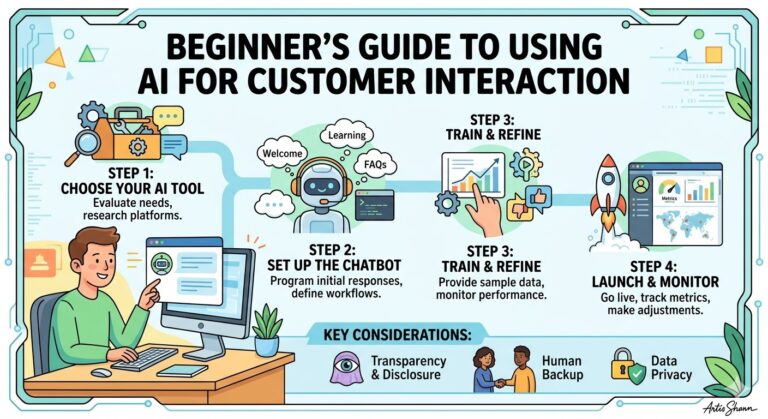
Beginner’s Guide to Using AI for Customer Interaction
Artificial intelligence (AI) is no longer a technology reserved for large corporations or tech companies. Today, businesses of all sizes are using AI to improve customer communication, provide faster support, and create more personalized experiences.
For many business owners, however, AI can seem overwhelming or complicated. The good news is that modern AI tools are designed to be user-friendly and easy to implement, even for those with little technical experience.
This beginner’s guide will explain how AI works in customer interaction, its benefits, and how businesses can start using AI to improve customer engagement and satisfaction.
What Is AI for Customer Interaction?
AI for customer interaction refers to the use of artificial intelligence technologies to communicate with customers, answer questions, provide support, and enhance customer experiences.
AI-powered customer interaction tools can:
- Respond to customer inquiries
- Automate repetitive tasks
- Personalize communication
- Analyze customer behavior
- Provide 24/7 support
These systems help businesses engage with customers more efficiently while improving service quality.
Why Businesses Are Using AI
Customer expectations have changed significantly in recent years. Modern consumers expect:
- Fast responses
- Personalized experiences
- Around-the-clock support
- Convenient communication channels
Meeting these expectations can be challenging, especially for small businesses with limited staff.
AI helps solve these challenges by automating routine interactions and supporting customer service teams.
Benefits of AI-powered customer interaction include:
- Reduced response times
- Increased efficiency
- Improved customer satisfaction
- Lower operational costs
- Better customer insights
Common AI Tools for Customer Interaction
Businesses can use several types of AI-powered tools to improve customer communication.
AI Chatbots
Chatbots are among the most popular customer interaction tools.
AI chatbots can:
- Answer frequently asked questions
- Provide product information
- Assist with bookings and appointments
- Guide customers through processes
Because chatbots are available 24/7, customers can receive immediate assistance at any time.
Virtual Assistants
Virtual assistants offer more advanced conversational capabilities than traditional chatbots.
They can:
- Understand customer intent
- Handle complex conversations
- Access customer history
- Provide personalized recommendations
Virtual assistants create more natural and engaging customer experiences.
Automated Messaging Systems
AI-powered messaging platforms can automatically respond to customer inquiries across various communication channels.
These systems help businesses:
- Manage large volumes of messages
- Maintain consistent communication
- Improve response speed
- Support customer engagement efforts
Customer Analytics Tools
AI analytics tools collect and analyze customer data to identify trends and behavior patterns.
Businesses can use these insights to:
- Improve products and services
- Personalize marketing campaigns
- Understand customer preferences
- Enhance customer satisfaction
How AI Improves Customer Experience
AI enhances customer interactions in several important ways.
Faster Response Times
Customers appreciate quick answers to their questions.
AI systems can instantly respond to inquiries, reducing wait times and improving satisfaction.
Personalized Communication
AI analyzes customer behavior and preferences to deliver personalized experiences.
Examples include:
- Customized product recommendations
- Personalized promotions
- Tailored support solutions
Personalization helps customers feel valued and understood.
Consistent Customer Service
Unlike human teams that may vary in performance, AI systems provide consistent responses and service quality.
This consistency helps create a reliable customer experience across all communication channels.
24/7 Availability
AI-powered systems never need breaks or sleep.
Businesses can offer continuous support, ensuring customers receive assistance whenever they need it.
Getting Started With AI Customer Interaction
Businesses new to AI should start with simple solutions and gradually expand their use of automation.
Step 1: Identify Customer Communication Challenges
Begin by evaluating current customer interaction processes.
Ask questions such as:
- Are response times too slow?
- Are customer inquiries repetitive?
- Is support staff overwhelmed?
Identifying challenges helps determine where AI can provide the most value.
Step 2: Choose the Right AI Solution
Select AI tools based on your business needs.
For example:
- Chatbots for customer support
- Automated messaging for social media
- AI analytics for customer insights
- Virtual assistants for personalized engagement
Choosing the right solution ensures a smoother implementation process.
Step 3: Integrate AI Into Existing Systems
Many modern AI platforms integrate easily with websites, CRM systems, messaging apps, and customer service software.
Start with one communication channel before expanding to others.
Step 4: Monitor Performance
After implementation, track important metrics such as:
- Customer satisfaction
- Response times
- Resolution rates
- Engagement levels
Monitoring performance helps optimize AI effectiveness over time.
Common Misconceptions About AI
Many businesses hesitate to adopt AI because of common myths.
Myth: AI Is Only for Large Companies
Modern AI solutions are affordable and accessible for businesses of all sizes.
Myth: AI Replaces Human Employees
AI is designed to support employees by automating repetitive tasks, allowing teams to focus on higher-value activities.
Myth: AI Is Too Difficult to Use
Many AI platforms offer simple interfaces and require little technical expertise.
Businesses can often implement AI without hiring specialized developers.
The Importance of Responsible AI
As businesses adopt AI, they should also prioritize ethical and responsible usage.
Responsible AI practices include:
- Protecting customer privacy
- Being transparent about AI usage
- Monitoring for bias
- Maintaining human oversight when necessary
Responsible implementation helps build trust and improve customer relationships.
The Role of AI Communication Platforms
Modern AI communication platforms make it easier than ever for businesses to engage customers effectively.
Solutions like SmileLineAI provide intelligent customer communication tools that help businesses automate support, improve engagement, and deliver personalized experiences while maintaining security and transparency.
These platforms allow organizations to benefit from AI without requiring advanced technical knowledge.
The Future of AI in Customer Interaction
AI technology continues to evolve rapidly.
Future developments are expected to include:
- More natural conversations
- Advanced personalization
- Improved predictive support
- Enhanced voice interaction
- Smarter customer insights
Businesses that begin adopting AI today will be better prepared to take advantage of future innovations.
Final Thoughts
Artificial intelligence is transforming customer interaction by making communication faster, more personalized, and more efficient. Businesses no longer need extensive technical expertise or large budgets to benefit from AI-powered tools.
By starting with simple AI solutions such as chatbots, automated messaging, and customer analytics, organizations can improve customer experiences and streamline operations.
As AI technology continues to advance, businesses that embrace intelligent customer interaction strategies will be well-positioned to build stronger relationships, increase customer satisfaction, and achieve long-term growth.