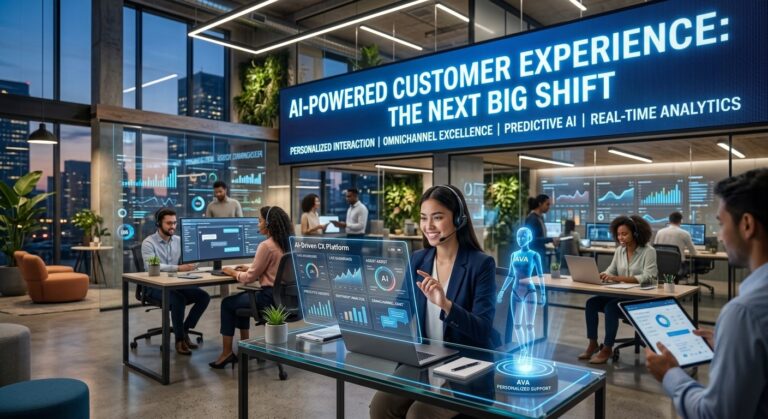
AI-Powered Customer Experience: The Next Big Shift
Introduction
Customer experience has become one of the most important factors separating successful businesses from their competitors. Customers expect fast responses, personalized interactions, convenient communication, and consistent service across every channel.
Meeting these expectations manually can be difficult, especially as businesses grow. Customer inquiries increase, communication becomes more complex, and employees have to manage large amounts of information.
This is where AI-powered customer experience is creating a major shift.
Artificial intelligence allows businesses to understand customer behavior, automate communication, personalize interactions, and provide support around the clock. Instead of treating every customer interaction the same way, AI enables companies to create more intelligent and responsive experiences.
The result is a new approach to customer experience where technology and human expertise work together.
What Is AI-Powered Customer Experience?
AI-powered customer experience refers to the use of artificial intelligence to improve the way customers interact with a business.
AI can be integrated into different stages of the customer journey, including:
- Marketing
- Sales
- Customer support
- Product discovery
- Website experiences
- Messaging
- Voice communication
- Customer retention
AI systems can analyze information, recognize patterns, understand language, and provide automated responses based on customer needs.
This makes customer interactions faster, more relevant, and more scalable.
Why Customer Experience Is Changing
Customer expectations have changed dramatically in the digital age.
People are accustomed to instant information and convenient digital services. They may become frustrated when they encounter:
- Long response times
- Repetitive questions
- Generic communication
- Difficult support processes
- Limited service availability
- Disconnected interactions
Businesses that fail to meet these expectations risk losing customers to competitors.
AI provides new ways to address these challenges while allowing businesses to maintain efficient operations.
AI Enables 24/7 Customer Support
One of the biggest advantages of AI-powered customer experience is continuous availability.
AI-powered assistants can provide support outside traditional business hours, including evenings, weekends, and holidays.
They can help customers:
- Find information
- Answer common questions
- Navigate services
- Receive basic troubleshooting assistance
- Start support requests
- Find the appropriate department
This gives customers access to assistance whenever they need it.
Faster Customer Response Times
Speed matters in customer service.
Customers don’t always want to wait for an employee to become available before receiving an answer.
AI can instantly respond to common questions and requests, reducing unnecessary waiting.
Faster responses can help businesses:
- Improve customer satisfaction
- Reduce support queues
- Increase engagement
- Resolve simple issues quickly
- Allow employees to focus on complex cases
AI therefore improves both customer convenience and employee productivity.
Personalized Customer Interactions
Personalization is becoming a major component of modern customer experience.
AI can analyze customer information and interactions to provide more relevant communication.
Businesses can personalize:
- Product recommendations
- Marketing messages
- Customer support
- Promotions
- Content
- Follow-up communication
Instead of delivering identical experiences to every customer, AI can help businesses respond according to individual needs and preferences.
AI Understands Customer Intent
Modern conversational AI is becoming increasingly capable of understanding what customers are trying to accomplish.
A customer may ask a question in several different ways, but AI can analyze the meaning behind the request.
For example, customers might ask:
- “Where’s my order?”
- “Can you check my delivery?”
- “When will my package arrive?”
Although the wording is different, the underlying intent is similar.
Understanding customer intent allows AI systems to provide more useful and natural responses.
AI-Powered Conversational Customer Service
Conversational AI is becoming an important part of customer experience strategies.
AI-powered chat systems can communicate with customers through:
- Websites
- Messaging platforms
- Mobile applications
- Customer portals
- Other digital communication channels
These systems can handle routine conversations while transferring more complex situations to human representatives.
This creates a hybrid customer service model that combines automation with human expertise.
AI Helps Employees Deliver Better Service
AI-powered customer experience isn’t only about customers. It can also improve the employee experience.
AI can provide support agents with:
- Conversation summaries
- Relevant customer information
- Suggested responses
- Knowledge base information
- Recommended next steps
Employees spend less time searching for information and more time solving customer problems.
This can improve both productivity and service quality.
Turning Customer Conversations Into Insights
Customer conversations contain valuable information.
Every question, complaint, request, and comment can reveal something about customer expectations.
AI can analyze conversations to identify:
- Frequently asked questions
- Common complaints
- Product issues
- Customer preferences
- Emerging trends
- Service problems
Businesses can use these insights to improve products, services, marketing, and customer support.
Predictive Customer Experience
AI is also moving customer experience from reactive to proactive.
Traditional customer service often waits for customers to report problems.
Predictive AI can identify patterns that may indicate a customer needs assistance.
Businesses can potentially use AI to:
- Identify customers at risk of leaving
- Predict customer needs
- Recommend relevant products
- Detect unusual customer behavior
- Trigger proactive communication
This allows companies to address potential issues before they become larger problems.
AI and Omnichannel Customer Experiences
Customers often interact with businesses across several channels.
They may discover a product through social media, visit a website, ask a question through chat, and later contact customer support.
AI can help connect these interactions when systems are properly integrated.
A more connected experience means customers don’t have to repeatedly provide the same information every time they switch channels.
This can create a smoother and more consistent customer journey.
AI Improves Customer Journey Mapping
Understanding the customer journey is essential for identifying friction.
AI can analyze customer interactions across different stages to identify where customers encounter difficulties.
Businesses can discover:
- Where customers abandon purchases
- Which pages generate confusion
- Which support questions appear frequently
- Where customers experience delays
- Which interactions generate high engagement
These insights help organizations continuously improve the customer journey.
The Role of AI Personalization
AI personalization goes beyond simply addressing customers by name.
Artificial intelligence can consider multiple signals to determine what may be relevant to a customer.
These signals can include:
- Previous interactions
- Purchase behavior
- Browsing activity
- Communication preferences
- Engagement patterns
Businesses can then use these insights to deliver more relevant experiences.
Building Trust in AI-Powered Experiences
Technology alone does not create a great customer experience. Trust is equally important.
Businesses implementing AI should prioritize:
- Transparency
- Data privacy
- Security
- Accurate information
- Human oversight
- Responsible automation
Customers should have appropriate ways to reach a human when an AI system cannot adequately resolve their issue.
The goal should be to use AI to enhance customer relationships rather than make customers feel disconnected from a business.
AI and the Human Touch
One of the biggest misconceptions about AI customer experience is that automation means eliminating human interaction.
In reality, AI can help employees focus on situations where human judgment and empathy are most valuable.
AI can handle routine tasks while employees handle:
- Complex complaints
- Sensitive situations
- High-value customers
- Strategic conversations
- Problems requiring human judgment
This combination creates a more balanced customer experience.
How SmileLineAI Can Support AI-Powered Customer Experience
AI-powered communication platforms such as SmileLineAI can help businesses modernize customer interactions.
Businesses can use intelligent AI communication to:
- Automate routine customer conversations
- Provide faster responses
- Improve customer engagement
- Personalize interactions
- Reduce repetitive support workloads
- Provide assistance around the clock
By integrating AI into customer communication, organizations can improve operational efficiency while creating more responsive experiences for their customers.
How Businesses Can Prepare for the AI Customer Experience Shift
Businesses don’t need to transform every customer interaction overnight.
A practical approach is to start with high-impact areas.
- Identify Customer Pain Points
Determine where customers experience delays, confusion, or frustration.
- Select Suitable AI Use Cases
Start with applications such as FAQs, customer support, scheduling, recommendations, or automated communication.
- Connect Relevant Data
Make sure AI systems have access to accurate and appropriately managed information.
- Train Employees
Teach teams how AI works and how they should collaborate with AI systems.
- Measure Customer Experience
Monitor metrics such as:
- Customer satisfaction
- Response time
- Resolution time
- Engagement
- Retention
- Conversion rates
- Continuously Improve
AI implementation should be treated as an ongoing process rather than a one-time project.
The Future of AI-Powered Customer Experience
The next generation of customer experience will likely become increasingly intelligent and personalized.
Businesses can expect continued developments in:
- Conversational AI
- Predictive customer service
- Real-time personalization
- AI voice assistants
- Automated customer journey optimization
- Intelligent recommendation systems
- Proactive customer engagement
AI will increasingly operate behind the scenes, helping businesses understand what customers need and determining how to respond more effectively.
Why AI-Powered Customer Experience Is the Next Big Shift
The importance of AI is not simply that it can automate customer service.
The larger shift is that AI allows businesses to build more responsive, personalized, predictive, and scalable customer experiences.
Companies can use AI to understand customers better, support employees, reduce friction, and deliver consistent service across growing customer bases.
Businesses that adopt this approach early can build stronger relationships while improving operational efficiency.
Conclusion
AI-powered customer experience is becoming a major shift in the way businesses interact with their customers.
Artificial intelligence can improve response times, personalize communication, automate routine support, analyze customer conversations, and provide valuable insights into customer behavior.
However, successful AI implementation requires more than automation. Businesses must combine AI with responsible data practices, human oversight, and a genuine focus on customer needs.
The future of customer experience will not be purely human or purely automated. It will be a combination of intelligent AI systems and human expertise working together.
Businesses that embrace this combination can deliver better experiences, improve customer loyalty, increase efficiency, and build a stronger competitive position in the digital economy.