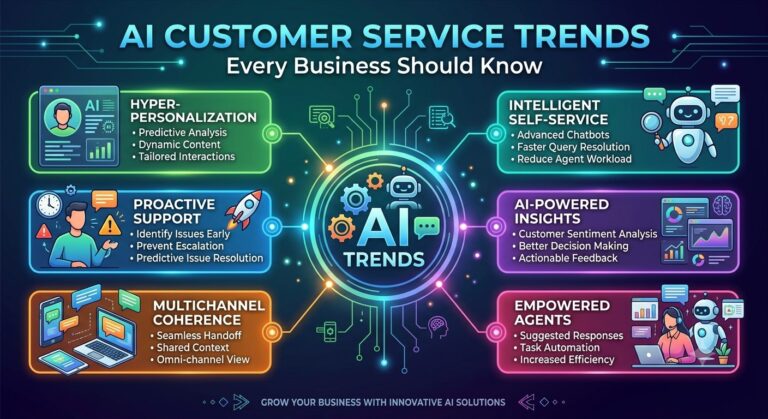
AI Customer Service Trends Every Business Should Know
Introduction
Customer service is evolving faster than ever. Modern consumers expect instant responses, personalized interactions, and support that is available whenever they need it. To meet these expectations, businesses are increasingly turning to artificial intelligence (AI).
AI-powered customer service solutions are no longer just a future trend—they are becoming a standard part of business operations. From intelligent chatbots to predictive customer support, AI is helping companies improve efficiency while delivering better customer experiences.
In this article, we’ll explore the most important AI customer service trends every business should know and how these innovations are shaping the future of customer engagement.
- AI Chatbots Are Becoming More Intelligent
Early chatbots could only follow simple scripts. Today’s AI chatbots use natural language processing (NLP) and machine learning to understand customer intent and respond in a more human-like way.
Modern AI chatbots can:
- Answer complex questions
- Understand conversation context
- Provide personalized recommendations
- Transfer customers to human agents when needed
As chatbot technology improves, businesses can handle larger volumes of customer inquiries without sacrificing service quality.
- 24/7 Customer Support Is Becoming the Norm
Customers expect support at all hours, not just during business hours. AI-powered systems allow businesses to provide continuous assistance around the clock.
Benefits of 24/7 AI support include:
- Faster response times
- Improved customer satisfaction
- Support for international customers
- Increased lead capture outside business hours
Businesses that offer always-available support gain a significant competitive advantage.
- Hyper-Personalized Customer Experiences
AI is making personalization more advanced than ever. By analyzing customer behavior, purchase history, and previous interactions, AI can deliver highly relevant recommendations and support.
Examples include:
- Personalized product suggestions
- Customized marketing messages
- Tailored support responses
- Individual customer journey recommendations
Personalization helps businesses build stronger relationships and increase customer loyalty.
- Predictive Customer Support
One of the most exciting AI trends is predictive support. Instead of waiting for customers to report a problem, AI can identify potential issues before they occur.
Predictive AI can help businesses:
- Detect service disruptions
- Identify customers at risk of leaving
- Recommend proactive solutions
- Reduce customer churn
This shift from reactive to proactive customer service is becoming a major competitive differentiator.
- Voice AI Is Growing Rapidly
Voice assistants are becoming an important part of customer service strategies. AI-powered voice systems can handle phone inquiries, appointment scheduling, order tracking, and other routine requests.
As voice recognition technology improves, customers will increasingly expect natural voice interactions with businesses.
- Omnichannel AI Communication
Customers interact with businesses through websites, mobile apps, social media, email, and messaging platforms. AI is helping companies create seamless experiences across all these channels.
Omnichannel AI provides:
- Consistent customer experiences
- Centralized conversation management
- Better customer insights
- Improved support efficiency
Customers can switch between channels without losing the context of their conversation.
- AI Is Assisting Human Support Teams
AI is not replacing customer service agents—it is helping them work more efficiently.
AI tools can:
- Suggest responses
- Summarize customer conversations
- Retrieve relevant information
- Prioritize urgent requests
- Analyze customer sentiment
This allows human agents to focus on complex issues that require empathy and critical thinking.
- Sentiment Analysis and Emotion Detection
Advanced AI systems can analyze the emotional tone of customer messages. Businesses can use sentiment analysis to identify frustrated customers and prioritize urgent cases.
Benefits include:
- Faster escalation of critical issues
- Improved customer satisfaction
- Better support quality
- More empathetic service
- AI-Driven Customer Analytics
Every customer interaction generates valuable data. AI analytics tools help businesses uncover insights such as:
- Common customer concerns
- Support performance trends
- Customer behavior patterns
- Opportunities for service improvement
These insights enable smarter decision-making and continuous improvement.
- Greater Focus on AI Ethics and Privacy
As AI becomes more integrated into customer service, businesses must prioritize responsible AI practices.
Key considerations include:
- Protecting customer data
- Being transparent about AI usage
- Preventing bias in automated systems
- Maintaining human oversight
Customers are more likely to trust companies that use AI responsibly.
How Businesses Can Prepare
To take advantage of these trends, businesses should:
- Evaluate current customer service processes
- Identify opportunities for automation
- Invest in scalable AI platforms
- Train employees to work with AI tools
- Monitor AI performance regularly
- Prioritize customer privacy and transparency
The Role of AI Customer Service Platforms
Modern platforms such as SmileLineAI make it easier for businesses to adopt AI-powered customer service solutions. These platforms help organizations automate conversations, personalize interactions, and improve customer engagement across multiple communication channels.
By combining intelligent automation with user-friendly tools, businesses can deliver faster and more effective customer experiences.
Conclusion
AI is transforming customer service from a reactive support function into a proactive, personalized, and highly efficient business strategy. Intelligent chatbots, predictive support, voice AI, omnichannel communication, and AI-assisted support teams are becoming essential tools for modern businesses.
Companies that stay ahead of these AI customer service trends will be better positioned to improve customer satisfaction, reduce operational costs, and build stronger long-term relationships.
As customer expectations continue to evolve, businesses that embrace AI strategically will gain a significant advantage in delivering exceptional customer experiences.