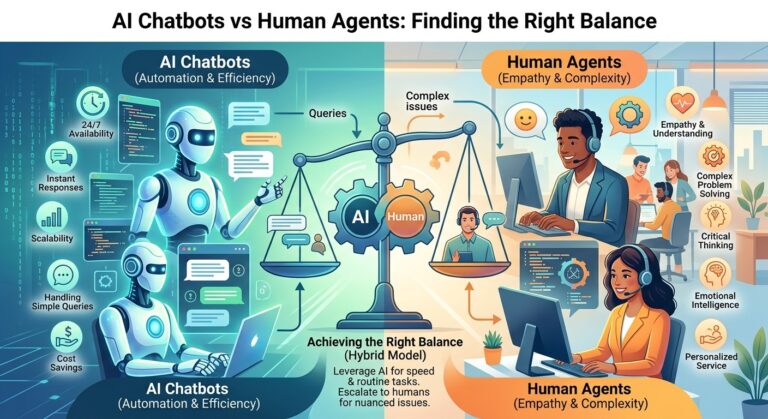
AI Chatbots vs Human Agents: Finding the Right Balance
Introduction
Customer expectations are changing faster than ever. People want quick answers, convenient communication, personalized experiences, and reliable support whenever they need it. At the same time, businesses need to control costs, improve efficiency, and provide consistent customer service across multiple channels.
This has created an important question for modern businesses:
Should customer service rely on AI chatbots, human agents, or a combination of both?
AI chatbots can answer questions within seconds, operate around the clock, and handle large numbers of conversations simultaneously. Human agents, on the other hand, provide empathy, judgment, creativity, and the ability to understand complex situations.
The debate between AI chatbots vs human agents should not necessarily be about choosing one over the other. The better approach is to understand what each does best and create a customer service strategy where technology and people work together.
The right balance can help businesses deliver faster support while maintaining the human connection customers value.
What Are AI Chatbots?
AI chatbots are software systems that use artificial intelligence and conversational technology to communicate with customers.
Unlike basic rule-based chatbots, modern AI-powered systems can understand natural language, analyze customer questions, recognize intent, and provide contextually relevant responses.
Businesses can use AI chatbots for tasks such as:
- Answering frequently asked questions
- Providing product information
- Helping customers navigate websites
- Collecting customer information
- Qualifying leads
- Supporting online purchases
- Handling basic troubleshooting
- Scheduling appointments
- Providing order information
- Routing customers to human agents
Their biggest advantage is scalability. An AI chatbot can potentially handle many conversations simultaneously without requiring a separate employee for every interaction.
What Are Human Customer Service Agents?
Human agents are customer service professionals who communicate directly with customers through channels such as live chat, email, phone, and social media.
Human support remains extremely valuable because people can understand situations that require context, emotional awareness, judgment, and flexibility.
Human agents are particularly useful when customers:
- Have complicated problems
- Are frustrated or upset
- Need customized solutions
- Have unusual requests
- Need negotiation
- Require detailed explanations
- Are dealing with sensitive situations
- Need reassurance before making a decision
Human agents bring something AI cannot fully replicate: genuine human understanding and interpersonal judgment.
AI Chatbots vs Human Agents: Key Differences
AI chatbots and human agents have different strengths.
Factor | AI Chatbots | Human Agents |
Response speed | Very fast | Depends on availability |
Availability | 24/7 | Usually scheduled |
Scalability | Very high | Limited by team size |
Repetitive tasks | Excellent | Can become inefficient |
Complex problems | Limited depending on system | Strong |
Emotional understanding | Limited | Strong |
Personal judgment | Limited | Strong |
Consistency | High | Can vary |
Empathy | Simulated | Genuine |
Cost per interaction | Potentially lower at scale | Higher |
Handling unusual situations | Limited | Flexible |
Decision-making | Based on programmed/system capabilities | Human judgment |
The table makes one thing clear: AI and humans are good at different things.
That is why the most effective customer service strategy often combines both.
The Biggest Advantages of AI Chatbots
- Instant Responses
Customers do not always want to wait several minutes or hours for an answer.
AI chatbots can respond almost immediately to many routine questions.
For example, a customer might ask:
“What time does your support team close?”
Instead of waiting for an agent, the chatbot can provide the answer immediately.
Fast responses can make digital interactions more convenient and reduce unnecessary waiting.
- 24/7 Availability
Human teams typically operate according to schedules.
AI chatbots can continue operating outside normal business hours.
This is particularly useful for online businesses serving customers across different countries and time zones.
A customer who visits a website late at night can still receive basic assistance.
- Handling Repetitive Questions
Customer service teams often answer the same questions repeatedly.
AI chatbots are well suited for repetitive requests involving:
- Pricing
- Business hours
- Product information
- Shipping
- Account instructions
- Basic troubleshooting
- Policies
- Frequently asked questions
Automating these interactions allows human employees to focus on more valuable work.
- Handling Multiple Conversations
A human agent may only be able to manage a limited number of conversations at once.
An AI chatbot can potentially handle many conversations simultaneously.
This scalability becomes especially valuable during:
- Product launches
- Promotions
- Holiday seasons
- Major marketing campaigns
- Sudden increases in website traffic
AI can absorb routine demand without requiring businesses to immediately expand their support team.
The Biggest Advantages of Human Agents
- Empathy
Customers sometimes need more than information.
They need to feel heard.
If someone is frustrated because a product arrived damaged, a robotic response may not be enough.
A human agent can acknowledge the customer’s frustration, understand the situation, and respond with empathy.
- Complex Problem-Solving
Some problems cannot be resolved through simple automated responses.
Human agents can investigate complicated situations, ask detailed questions, examine context, and make decisions based on circumstances.
This flexibility is one of the strongest reasons human support remains important.
- Emotional Intelligence
Customer interactions can involve emotions.
Customers may be:
- Confused
- Frustrated
- Excited
- Worried
- Angry
- Uncertain
Human agents can interpret emotional cues and adjust their communication accordingly.
- Creative Solutions
AI systems work within their capabilities, information, instructions, and connected business systems.
Human agents can sometimes think outside standard procedures and find creative solutions.
This is particularly useful when a customer’s situation does not fit an existing workflow.
Where AI Chatbots Work Best
AI chatbots are especially effective at the beginning of many customer interactions.
They can act as the first point of contact.
For example:
Customer: “I need help choosing a service.”
AI Chatbot: “I’d be happy to help. What type of service are you looking for?”
The chatbot can ask basic questions, understand the customer’s intent, and provide relevant information.
If the issue is straightforward, the conversation can end there.
If the situation is more complicated, the chatbot can transfer the conversation to a human agent.
This creates a practical division of responsibilities.
Where Human Agents Work Best
Human agents should generally handle conversations where human judgment adds significant value.
These can include:
Complex complaints
When a customer has a complicated complaint, a human agent can investigate and provide a personalized response.
High-value customers
Businesses may want experienced employees to handle important accounts and high-value customer relationships.
Sensitive situations
Certain customer concerns require discretion, empathy, and careful communication.
Escalations
When a chatbot cannot solve a problem, a human should be available to take over.
Complex sales conversations
Some purchases require consultation, negotiation, or detailed product guidance.
Why Businesses Should Not Completely Replace Human Agents
The idea of replacing all customer service employees with AI may appear attractive because automation can reduce repetitive workloads.
However, completely removing human support can create problems.
Customers may become frustrated if they cannot reach a person when dealing with a difficult issue.
An AI chatbot may provide an accurate answer but still fail to address the customer’s emotional needs.
There is also a risk of customers becoming trapped in repetitive chatbot loops.
For example:
Customer: “I need to speak to someone.”
Chatbot: “I can help you with your account.”
Customer: “No, I need a person.”
Chatbot: “Here are some account options.”
This type of experience can quickly damage customer satisfaction.
The solution is not necessarily less AI.
The solution is better AI-human collaboration.
The Hybrid Customer Service Model
A hybrid customer service model combines AI chatbots with human agents.
The chatbot handles straightforward interactions while human employees handle complex or sensitive conversations.
A typical workflow might look like this:
Customer visits website → AI chatbot starts conversation → AI identifies intent → Simple issue is resolved → Complex issue is escalated → Human agent takes over
This approach allows businesses to automate where automation makes sense without eliminating human support.
How AI and Human Agents Can Work Together
Step 1: AI Handles Initial Contact
The chatbot welcomes the customer and identifies what they need.
Step 2: AI Answers Simple Questions
If the question is straightforward, the chatbot provides the answer.
Step 3: AI Collects Relevant Information
If the customer needs additional assistance, the chatbot can gather basic information before transferring the conversation.
Step 4: Human Agent Takes Over
The agent receives the conversation context and continues from where the chatbot stopped.
Step 5: AI Assists the Agent
AI can also help employees by summarizing conversations, suggesting responses, retrieving information, or organizing customer details.
This means AI does not only serve customers directly. It can also become an employee support tool.
AI Can Make Human Agents More Efficient
One of the most powerful applications of AI is helping human employees work better.
Instead of spending time searching through knowledge bases or writing repetitive responses, agents can use AI assistance to speed up certain tasks.
AI can potentially help agents with:
- Conversation summaries
- Response suggestions
- Information retrieval
- Customer history
- Knowledge-base searches
- Ticket categorization
- Follow-up reminders
- Routine documentation
This allows employees to focus more attention on the customer instead of administrative tasks.
AI Chatbots Can Improve Human Customer Service
At first glance, chatbots and human agents may appear to compete with one another.
In practice, AI can actually improve the work of human agents.
Imagine a customer contacts a business with a complicated problem.
Before reaching an agent, the chatbot has already collected:
- The customer’s name
- The reason for contacting support
- Relevant account information
- Previous troubleshooting steps
- The customer’s specific question
The human agent can begin with useful context instead of asking the customer to repeat everything.
This creates a smoother transition from automation to human support.
Finding the Right Balance
There is no universal ratio of AI to human support that works for every business.
The right balance depends on factors such as:
- Industry
- Customer expectations
- Product complexity
- Customer volume
- Support team size
- Type of customer inquiries
- Business hours
- Service requirements
An online store selling simple products may automate many common questions.
A financial, legal, medical, or technical business may require significantly more human involvement for certain interactions.
The goal should be to determine which conversations benefit from automation and which benefit from human expertise.
Signs That a Business Should Use More AI
A business may benefit from expanding chatbot automation when:
- Employees answer the same questions repeatedly
- Customers frequently wait for basic information
- Support volume is increasing
- Customers need assistance outside business hours
- The business receives many simple inquiries
- Employees spend too much time on repetitive tasks
These are strong opportunities for AI-powered customer service.
Signs That a Business Needs More Human Support
Businesses should increase human involvement when:
- Customers frequently request human assistance
- Chatbot conversations have high escalation rates
- Customers complain about automated support
- Problems require complex judgment
- Customers are frequently frustrated
- The business handles sensitive issues
- Customers need highly personalized solutions
AI should never become an obstacle between customers and the support they need.
How to Measure AI Chatbot Performance
Businesses should not judge chatbot success simply by the number of conversations handled.
More meaningful metrics can include:
Customer satisfaction
Are customers happy with the interaction?
Resolution rate
How many problems are successfully resolved without additional support?
Escalation rate
How often does the chatbot need to transfer customers to human agents?
Response time
How quickly are customers receiving assistance?
Conversion rate
Does the chatbot help visitors become customers?
Employee productivity
Does automation reduce repetitive work for support teams?
Customer retention
Does the overall support experience encourage customers to stay with the business?
These measurements provide a more complete picture of whether AI is creating value.
Common Mistakes Businesses Should Avoid
Mistake 1: Automating Everything
Not every interaction should be automated.
Some conversations require human involvement.
Mistake 2: Making Human Support Difficult to Reach
Customers should have an obvious escalation path when necessary.
Mistake 3: Using a Generic Chatbot
A chatbot should understand the company’s products, services, policies, and customer needs.
Mistake 4: Ignoring Customer Feedback
If customers repeatedly complain about chatbot interactions, businesses should investigate and improve the system.
Mistake 5: Forgetting the Employee Experience
AI should make employees more productive, not simply add another complicated system to manage.
The Future of AI Chatbots and Human Agents
The future of customer service is unlikely to be simply “AI versus humans.”
Instead, businesses are moving toward intelligent collaboration.
AI systems will increasingly handle routine communication, information retrieval, personalization, and workflow automation.
Human employees will continue to provide empathy, strategic thinking, complex problem-solving, and relationship management.
This could create a new model of customer service where AI handles the scale while people handle the human side of customer relationships.
The most successful businesses may not be those that automate the most.
They may be the businesses that automate the right things.
How SmileLineAI Fits Into the AI-Human Balance
For businesses exploring AI-powered customer communication, SmileLineAI can be positioned as part of a broader strategy for improving digital customer interactions.
The goal of AI customer platforms should not simply be to replace conversations with machines.
Instead, businesses can use AI to make communication faster, more consistent, and more efficient while preserving opportunities for meaningful human interaction.
When AI handles repetitive conversations and helps organize customer interactions, human employees can dedicate more time to the customers and situations that need personal attention.
That combination can create a stronger customer experience.
A Simple Framework for Businesses
Businesses looking to introduce AI chatbots can use this basic framework:
- Identify repetitive interactions.
Find questions that employees answer repeatedly.
- Automate simple tasks.
Use AI for predictable, low-risk conversations.
- Create clear escalation rules.
Determine when customers should be transferred to a human.
- Give agents conversation context.
Avoid forcing customers to repeat information.
- Train employees to work with AI.
Teach teams how to use AI assistance effectively.
- Monitor customer feedback.
Look for frustration, confusion, and unanswered questions.
- Continuously improve.
Use real conversations and performance data to refine the system.
Conclusion
The debate over AI chatbots vs human agents does not need to end with one winner.
AI chatbots are excellent at speed, availability, scalability, repetitive tasks, and instant information. Human agents excel at empathy, judgment, complex problem-solving, creativity, and relationship building.
The strongest customer service strategy combines these strengths.
AI can handle the routine work and provide the first layer of assistance. Human agents can step in when customers need deeper understanding, personalized solutions, or emotional support.
The right balance allows businesses to deliver efficient service without sacrificing the human connection that makes customer relationships meaningful.
As AI technology continues to evolve, the question businesses should ask is not “Should we choose AI or humans?”
The better question is:
“How can AI and our people work together to give customers the best possible experience?”
That mindset can turn AI from a simple automation tool into a powerful partner for modern customer service and long-term business growth.