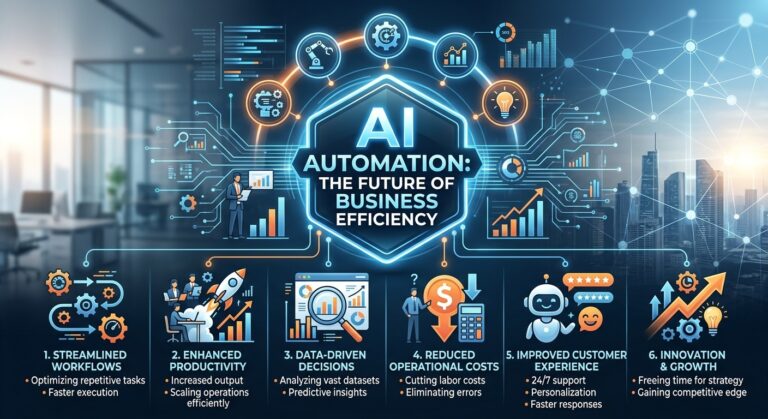
AI Automation: The Future of Business Efficiency
Introduction
Business efficiency has always been an important factor in long-term success. Companies constantly look for ways to reduce unnecessary work, improve productivity, respond faster to customers, and make better use of their resources.
For many years, businesses achieved efficiency through traditional software automation. Rules-based systems could move data, send notifications, generate reports, and perform other predictable tasks.
Artificial intelligence is taking automation to another level.
AI automation combines automation technologies with artificial intelligence to handle tasks that involve language, information processing, classification, analysis, communication, and decision support.
Instead of simply following a fixed sequence of commands, AI-powered systems can process information, recognize patterns, generate content, understand natural-language requests, and assist employees with complex workflows.
This is why AI automation is becoming an important part of the future of business efficiency.
From customer service and sales to marketing, finance, operations, and internal communication, AI can help businesses redesign how work gets done.
What Is AI Automation?
AI automation is the use of artificial intelligence to automate or assist with business tasks and workflows.
Traditional automation generally follows predefined rules.
For example:
If a customer submits a form → send a confirmation email.
AI automation can work with more flexible information.
For example:
A customer submits a message → AI analyzes the request → identifies the topic → summarizes the issue → retrieves relevant information → drafts a response → routes the request when necessary.
This ability to work with unstructured information makes AI automation useful across a much wider range of business processes.
AI automation can support:
- Customer service
- Sales
- Marketing
- Data analysis
- Administration
- Human resources
- Internal communication
- Document processing
- Workflow management
- Business operations
Why AI Automation Matters for Business Efficiency
Efficiency is not simply about doing more work faster.
True business efficiency involves making better use of people, time, technology, and resources.
AI automation can contribute by reducing repetitive tasks, improving information access, shortening response times, and helping employees focus on higher-value activities.
When small improvements are applied across hundreds or thousands of business processes, the overall impact can become significant.
Automating Repetitive Tasks
One of the most obvious applications of AI automation is handling repetitive work.
Employees may spend significant amounts of time on tasks such as:
- Data entry
- Email sorting
- Document organization
- Information searches
- Report preparation
- Scheduling
- Customer inquiries
- Meeting summaries
AI can assist with many of these activities.
This gives employees more time to focus on work that requires human judgment, creativity, and collaboration.
Increasing Employee Productivity
AI automation can function as a digital assistant for employees.
Rather than completing every step manually, employees can use AI to help draft documents, summarize information, organize data, research topics, and prepare communications.
For example, an employee preparing a customer report could use AI to summarize relevant information before reviewing and finalizing the report.
The employee remains responsible for the final output, while AI reduces some of the repetitive preparation work.
Improving Customer Service Efficiency
Customer service is one of the areas where AI automation can have a direct operational impact.
AI chatbots can answer common questions, provide basic information, guide customers through processes, and identify when human assistance is needed.
This allows customer service teams to focus on complex cases.
For example, a chatbot might answer questions about:
- Business hours
- Product information
- Shipping
- Pricing
- Basic troubleshooting
- Appointment availability
Human agents can then spend more time on complicated customer issues.
Providing 24/7 Automated Assistance
Human teams generally work according to schedules.
AI systems can provide automated assistance outside normal operating hours.
This can be particularly valuable for businesses serving customers across different time zones.
A customer who visits a website late at night may still be able to obtain answers to common questions instead of waiting until the next business day.
Continuous availability can improve convenience while reducing the need for employees to manually monitor routine requests around the clock.
Improving Sales Efficiency
Sales teams often spend considerable time on administrative work.
AI automation can assist with:
- Lead qualification
- Customer research
- Follow-up preparation
- Meeting summaries
- Email drafting
- Lead organization
- Customer information analysis
For example, an AI system can help categorize leads according to predefined business criteria and provide sales representatives with relevant information before they contact a prospect.
This allows sales professionals to spend more time engaging with customers.
Automating Lead Qualification
Not every lead has the same level of interest or urgency.
AI systems can analyze information collected through forms, conversations, and other appropriate sources to help categorize potential customers.
A chatbot could ask questions about:
- Business size
- Customer needs
- Budget
- Timeline
- Product requirements
The resulting information can help sales teams prioritize follow-up activities.
Streamlining Marketing Operations
Marketing involves many repetitive activities.
AI automation can assist marketers with:
- Content research
- Campaign planning
- Email drafting
- Customer segmentation
- Performance summaries
- Social media planning
- Audience analysis
AI does not replace marketing strategy.
Instead, it can reduce the time required for certain operational tasks.
Marketers can then dedicate more attention to positioning, creativity, brand strategy, and customer understanding.
Making Data Analysis Faster
Businesses generate large amounts of data.
Analyzing that information manually can be time-consuming.
AI systems can help summarize information, identify patterns, organize data, and produce preliminary insights.
For example, an organization might use AI to analyze customer feedback and identify recurring themes.
Employees can then review those findings and determine what actions should be taken.
Automating Document Processing
Many businesses work with large numbers of documents.
AI can assist with:
- Extracting information
- Summarizing documents
- Categorizing files
- Comparing content
- Finding specific information
- Generating preliminary reports
This can be especially useful when employees need to process large volumes of information.
Human review remains important for sensitive or high-impact documents.
Improving Internal Communication
AI automation can help employees manage large amounts of internal communication.
For example, AI can assist with:
- Summarizing meetings
- Identifying action items
- Drafting internal announcements
- Organizing information
- Answering questions about company documentation
Instead of manually reviewing every communication, employees can use AI to identify the information most relevant to them.
Creating Smarter Business Workflows
AI automation can connect multiple business activities into a coordinated workflow.
Consider a customer support process:
- A customer submits a request.
- AI analyzes the message.
- The request is categorized.
- Relevant information is retrieved.
- A response is drafted.
- A human reviews it when necessary.
- The request is resolved.
- The interaction is recorded.
Automating parts of this workflow can reduce delays and unnecessary manual handoffs.
Reducing Operational Bottlenecks
A small manual delay can sometimes affect an entire business process.
For example, if every customer request must be manually categorized before reaching the correct department, the support workflow may become slower as demand increases.
AI automation can assist with classification and routing.
Removing these bottlenecks can help businesses maintain more consistent workflows.
Helping Businesses Scale
Business growth often creates operational challenges.
More customers can mean:
- More support requests
- More leads
- More documents
- More transactions
- More communication
- More administrative work
AI automation can provide additional processing capacity without requiring every additional task to be completed manually.
This can make certain business processes easier to scale.
Reducing Response Times
Speed matters in many business processes.
Customers want quick answers. Employees need timely information. Sales teams want fast lead follow-up.
AI automation can reduce delays by responding immediately to appropriate requests and preparing information for employees.
Faster workflows can improve both internal productivity and customer experience.
Supporting Small Businesses
AI automation is not limited to large organizations.
Small businesses can use AI to help manage tasks that would otherwise require significant employee time.
For example, a small company may automate:
- Customer questions
- Appointment scheduling
- Lead capture
- Email assistance
- Marketing tasks
- Document organization
- Basic reporting
This can allow small teams to manage more activities without dramatically increasing administrative workload.
Improving Employee Focus
One of the most important benefits of AI automation is the ability to shift employee attention toward higher-value work.
Instead of spending hours on repetitive administrative tasks, employees may have more time for:
- Strategy
- Innovation
- Customer relationships
- Creative work
- Problem-solving
- Collaboration
- Professional development
Efficiency should ultimately create more opportunities for meaningful work.
Supporting Remote and Hybrid Teams
AI automation can also help distributed teams.
Remote employees often need to search for information, catch up on meetings, coordinate tasks, and manage communication across different time zones.
AI tools can assist with:
- Meeting summaries
- Information retrieval
- Task organization
- Document analysis
- Communication drafting
This can reduce some of the administrative friction associated with remote work.
Improving Knowledge Management
Businesses often have valuable information spread across multiple systems.
Employees may spend significant time searching for the right document or answer.
AI-powered knowledge systems can allow employees to ask questions using natural language.
For example:
“What is our current process for handling customer refunds?”
An AI system connected to appropriate company information can help locate the relevant documentation.
Better knowledge access can reduce wasted time.
Creating More Consistent Processes
Human employees may complete the same process differently.
AI automation can standardize appropriate parts of a workflow.
For example, an AI system can help ensure that incoming customer requests are categorized using consistent criteria.
Consistency can make business operations easier to monitor and improve.
Supporting Better Decision-Making
AI automation can help employees process information before making decisions.
For example, AI may summarize:
- Customer feedback
- Sales activity
- Operational data
- Marketing performance
- Support requests
Employees can then use those summaries as inputs when making business decisions.
AI should support decision-making rather than automatically replace human judgment in high-impact situations.
Improving Customer Experience
Business efficiency and customer experience are closely connected.
When internal processes become faster and more organized, customers may benefit from:
- Faster responses
- Fewer delays
- More consistent information
- Easier communication
- Better support
AI automation can therefore improve both operational efficiency and customer-facing experiences.
Reducing Support Costs
AI chatbots and automated support systems can handle many routine customer interactions.
This can reduce the volume of repetitive work performed manually.
Instead of requiring employees to answer the same question hundreds of times, a chatbot can provide automated assistance while human representatives focus on more complex issues.
The objective should be efficient support, not simply eliminating human involvement.
Helping Employees Work With More Data
Businesses are increasingly data-driven.
However, more data can also create information overload.
AI automation can help employees organize and summarize large volumes of information.
For example, a manager could use AI to summarize customer feedback across multiple channels.
The manager can then investigate important findings without manually reading every individual message.
Supporting Continuous Improvement
AI automation can generate information about business processes.
Organizations can analyze:
- Common customer questions
- Workflow delays
- Repetitive tasks
- Failed processes
- Support escalations
- Employee feedback
These insights can help businesses identify additional opportunities for improvement.
Automation can therefore become part of a continuous improvement cycle.
The Challenges of AI Automation
AI automation offers significant opportunities, but businesses should also understand its limitations.
Accuracy
AI systems can produce incorrect or incomplete information.
Important outputs should be reviewed appropriately.
Data Security
Businesses must protect sensitive information and understand how AI systems process data.
Employee Training
Employees need guidance on how to use AI tools effectively and responsibly.
Human Oversight
Important decisions may require human review.
Integration
AI automation is most useful when it fits naturally into existing business workflows.
Change Management
Employees may need time and support to adapt to new AI-powered processes.
How to Implement AI Automation Successfully
Businesses can follow a practical process when introducing AI automation.
Step 1: Identify Repetitive Work
Find tasks that consume significant employee time and follow predictable patterns.
Step 2: Prioritize Appropriate Use Cases
Choose processes where AI can provide clear value without creating unnecessary risk.
Step 3: Start Small
Test automation on a limited workflow before expanding.
Step 4: Involve Employees
Employees understand many workflow problems that may not be obvious to management.
Step 5: Establish Human Review
Define which outputs require human approval.
Step 6: Protect Business Data
Create appropriate security and privacy procedures.
Step 7: Measure Results
Track productivity, quality, response times, customer satisfaction, and other relevant metrics.
Step 8: Improve Continuously
Use real-world performance and employee feedback to refine automated workflows.
AI Automation and the Future of Business Efficiency
AI automation is likely to become increasingly integrated into everyday business operations.
The future may involve AI systems that can coordinate multiple tasks across different applications and departments.
Instead of automating a single step, businesses may increasingly automate entire workflows.
For example:
Customer inquiry → AI understands the request → retrieves information → updates the appropriate system → prepares a response → escalates when necessary → records the interaction.
This represents a shift from individual task automation toward intelligent workflow automation.
Businesses will still need human oversight, particularly for complex, sensitive, or high-impact decisions.
The Human Role in an Automated Business
The future of business efficiency is not simply about machines doing more work.
Human employees will continue to provide essential capabilities such as:
- Creativity
- Empathy
- Leadership
- Critical thinking
- Strategic planning
- Relationship building
- Negotiation
- Complex judgment
AI can handle many repetitive information-processing activities, but human expertise remains essential.
The strongest business models will combine automation with human strengths.
How SmileLineAI Can Support AI-Powered Business Efficiency
SmileLineAI represents the growing role of AI-powered communication and automation in modern business.
Businesses can use AI customer platforms to automate appropriate conversations, provide faster assistance, organize customer interactions, and help support teams manage increasing communication demands.
Customer communication is only one part of the larger AI automation opportunity.
The same approach can be applied throughout an organization:
Identify repetitive work → automate appropriate tasks → maintain human oversight → measure results → improve continuously.
This allows businesses to approach AI automation as a long-term efficiency strategy rather than a short-term technology trend.
Conclusion
AI automation is becoming an important part of the future of business efficiency.
By automating repetitive tasks, supporting employees, improving customer service, streamlining workflows, accelerating information processing, and helping businesses scale, AI can change how organizations operate.
However, successful automation requires thoughtful implementation.
Businesses need to select the right processes, train employees, protect data, monitor AI performance, and maintain human oversight where it matters.
The goal should not be to automate everything.
The goal should be to automate the right things.
When businesses combine intelligent automation with human creativity, judgment, and expertise, they can build more efficient operations while giving employees more time to focus on meaningful, high-value work.
AI automation is therefore more than a technology upgrade. It represents a broader shift toward smarter business processes, more responsive customer experiences, and a workplace where people and AI work together to achieve greater efficiency.