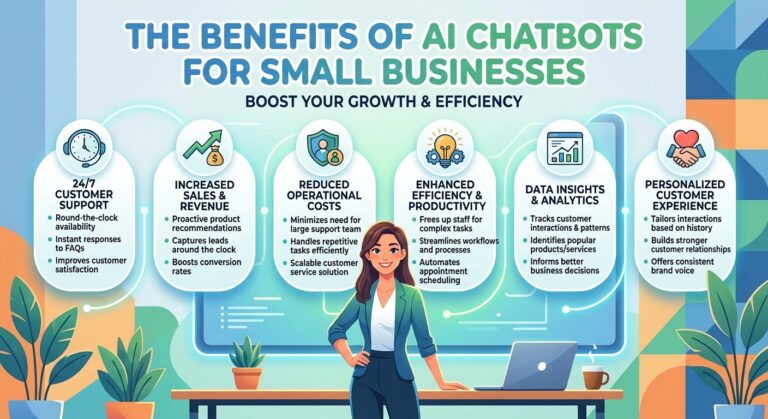
The Benefits of AI Chatbots for Small Businesses
Introduction
Running a small business often means doing more with fewer resources. Business owners and small teams have to manage customer service, marketing, sales, operations, administration, and growth at the same time.
As customer expectations continue to rise, providing fast and reliable communication can become especially challenging.
This is where AI chatbots for small businesses can make a meaningful difference.
AI chatbots can communicate with customers through websites, messaging platforms, and other digital channels. They can answer common questions, provide information, collect leads, assist shoppers, schedule appointments, and help customers find the right resources.
For small businesses, the biggest advantage is not simply automation. It is the ability to provide a more responsive customer experience without requiring a large customer service department.
When implemented properly, AI chatbots can help small businesses save time, improve customer engagement, increase efficiency, and create more opportunities for growth.
What Is an AI Chatbot for Small Business?
An AI chatbot is a software system that uses artificial intelligence to communicate with customers through conversational interactions.
A customer can type a question in natural language, and the chatbot can interpret the request and provide an appropriate response.
For example, a customer visiting a business website might ask:
“Do you offer consultations on weekends?”
Instead of waiting for an employee to respond, an AI chatbot can immediately provide the relevant information.
Depending on the system, a chatbot can also help with more advanced tasks such as:
- Lead qualification
- Product recommendations
- Appointment scheduling
- Customer support
- Frequently asked questions
- Order assistance
- Service recommendations
- Customer feedback
- Website navigation
This makes AI chatbots useful for many types of small businesses.
Why Small Businesses Are Turning to AI Chatbots
Large organizations often have dedicated departments for customer service, marketing, sales, and technical support.
Small businesses may have only a few employees handling many of these responsibilities.
This creates a productivity challenge.
If an employee spends hours answering the same customer questions every day, that time cannot be used for other important activities.
AI chatbots can automate many repetitive conversations and allow small teams to focus on higher-value responsibilities.
Instead of replacing the entire customer service process, a chatbot can become an additional member of the digital team.
AI Chatbots Provide 24/7 Customer Support
One of the biggest benefits of AI chatbots for small businesses is continuous availability.
A small business may not have enough employees to provide customer support throughout the night, weekends, and holidays.
An AI chatbot can remain available even when the business team is offline.
Customers can ask questions and receive immediate assistance at any time.
Why 24/7 availability matters
Customers may visit a website:
- Early in the morning
- Late at night
- During weekends
- During holidays
- From different time zones
A chatbot gives them an opportunity to get information without waiting for business hours.
For small businesses that serve customers online, this can create a more convenient and professional experience.
AI Chatbots Save Valuable Time
Time is one of the most valuable resources for a small business.
Owners and employees may spend significant amounts of time answering repetitive questions.
For example:
- What are your business hours?
- Where are you located?
- What services do you offer?
- How much does this cost?
- How can I book an appointment?
- Do you offer refunds?
- How long does delivery take?
These questions are important, but they do not always require human intervention.
An AI chatbot can handle many routine questions automatically.
This allows employees to dedicate more time to tasks that require human judgment, creativity, and expertise.
AI Chatbots Can Reduce Customer Response Times
Slow responses can cause potential customers to lose interest.
Someone searching for a product or service may contact several businesses at the same time.
If one company responds immediately while another takes several hours, the faster business may have a better opportunity to continue the conversation.
AI chatbots can provide immediate responses to common questions.
This creates a faster customer experience and helps businesses avoid unnecessary delays.
AI Chatbots Help Generate Leads
Small businesses need a consistent flow of potential customers.
Traditional websites often rely on contact forms to collect leads.
While forms remain useful, they require visitors to take action on their own.
A chatbot can actively start a conversation.
For example:
Chatbot: “Welcome! How can we help you today?”
Visitor: “I’m interested in your website design services.”
Chatbot: “Great! Are you looking for a new website or an improvement to an existing website?”
The chatbot can continue the conversation and collect relevant information.
This can turn passive website visitors into potential leads.
AI Chatbots Can Qualify Potential Customers
Not every lead has the same value.
A small business may receive inquiries from people who are simply researching options, while others may be ready to make a purchase.
AI chatbots can ask qualifying questions to understand what a visitor needs.
For example:
- What service are you interested in?
- What type of business do you operate?
- What is your estimated budget?
- When do you need the service?
- What problem are you trying to solve?
The information can help a business determine which leads deserve immediate human attention.
This can make sales teams more efficient.
AI Chatbots Improve Customer Engagement
A traditional website mostly communicates in one direction.
The business presents information, and the visitor reads it.
AI chatbots introduce another layer of interaction.
Visitors can ask questions and receive conversational responses.
This can encourage customers to explore products, services, and information rather than immediately leaving the website.
A chatbot can also guide visitors toward useful pages, resources, products, or contact options.
The result is a more interactive customer experience.
AI Chatbots Can Personalize Customer Experiences
Customers increasingly expect businesses to understand their individual needs.
AI chatbots can support personalization by considering the context of a conversation and information provided by the customer.
For example, a customer could say:
“I’m a beginner and need an affordable solution.”
Instead of providing a generic list of products or services, the chatbot can guide the customer toward options that better match the stated requirements.
Personalized conversations can make customers feel that the business is actually listening to them.
AI Chatbots Can Help Increase Sales
AI chatbots are not limited to customer service.
They can also support the sales process.
For an online store, a chatbot could help customers find products based on their preferences.
For a service business, it could explain different service packages.
For a consulting business, it could help potential customers understand available solutions and schedule a consultation.
A chatbot can therefore act as a digital sales assistant.
Examples of sales assistance include:
- Product recommendations
- Service comparisons
- Pricing information
- Promotions
- Product discovery
- Appointment booking
- Consultation requests
- Purchase guidance
The goal is to make it easier for customers to move from questions to action.
AI Chatbots Help Small Businesses Compete With Larger Companies
Large businesses often have substantial resources for customer service and marketing.
Small businesses may not be able to hire large teams.
AI can help reduce this gap.
A small company can use a chatbot to provide:
- Immediate website assistance
- Automated customer support
- Lead collection
- Product recommendations
- Appointment scheduling
- Basic troubleshooting
- Continuous availability
This can help a small business create a more responsive digital experience without needing a large support department.
Technology does not eliminate the difference between large and small businesses, but it can help small businesses use their resources more efficiently.
AI Chatbots Reduce Repetitive Customer Service Work
Repetitive work can affect employee productivity.
Imagine a small business receiving hundreds of questions every month about the same basic topics.
Employees must repeatedly read, understand, and answer those questions.
A chatbot can automate many of these interactions.
This allows employees to concentrate on:
- Complex customer problems
- Important sales conversations
- Relationship building
- Business strategy
- Creative work
- Product development
- Customer retention
AI automation becomes most valuable when it removes repetitive tasks rather than simply adding another technology to the workflow.
AI Chatbots Can Improve Appointment Scheduling
Service-based businesses often spend time coordinating appointments.
Businesses such as consultants, agencies, salons, repair services, coaches, and professional service providers can use conversational automation to help customers schedule appointments.
A chatbot can potentially:
- Ask what service the customer needs.
- Explain available options.
- Collect customer information.
- Direct the customer to available scheduling options.
- Provide confirmation information.
This can reduce back-and-forth communication.
Customers can move from inquiry to appointment more efficiently.
AI Chatbots Can Provide Better First-Level Support
Small businesses may not have dedicated technical support teams.
An AI chatbot can provide first-level assistance for common problems.
For example, a software business could use a chatbot to guide users through basic troubleshooting steps.
A product business could provide instructions for common product questions.
If the chatbot cannot resolve the problem, the conversation can be transferred to a human employee.
This creates a two-level support model:
AI handles simple issues → Human handles complex issues
This approach can improve efficiency while maintaining access to human expertise.
AI Chatbots Can Collect Customer Feedback
Customer feedback is essential for improving a small business.
However, businesses do not always have the time or resources to conduct surveys manually.
Chatbots can make feedback collection part of the customer journey.
For example, after a support interaction, the chatbot might ask:
“Was this answer helpful?”
It can also ask customers about:
- Product satisfaction
- Service quality
- Website experience
- Support experience
- Suggestions
- Problems they encountered
These insights can help businesses identify areas that need improvement.
AI Chatbots Can Help Businesses Understand Customer Needs
Customer conversations contain valuable information.
When businesses analyze common chatbot questions, they may discover patterns.
Customers might repeatedly ask for a product that the business does not currently offer.
They might struggle to understand a particular service.
They might frequently ask about a specific feature.
These patterns can provide useful insights for:
- Product development
- Website improvements
- Marketing
- Customer service
- Sales
- Content creation
AI chatbots can therefore become more than communication tools. They can also contribute to customer research.
AI Chatbots Can Support Marketing
Small businesses often have limited marketing resources.
Chatbots can support marketing activities by engaging visitors and directing them toward useful information.
For example, a chatbot can:
- Promote new services
- Recommend relevant content
- Encourage newsletter subscriptions
- Promote special offers
- Collect leads
- Direct customers to landing pages
- Answer questions about campaigns
This makes the chatbot part of the broader marketing strategy.
AI Chatbots Can Improve Website Navigation
Visitors sometimes struggle to find the information they need.
A chatbot can act as a conversational navigation assistant.
A visitor could ask:
“Where can I find your pricing?”
or:
“Which service is right for a new business?”
Instead of searching through menus and multiple pages, the visitor can ask directly.
This can make websites easier to use.
AI Chatbots Can Help Small Teams Scale
Business growth often creates operational challenges.
More customers mean more questions, more support requests, and more communication.
Hiring additional employees can be expensive and time-consuming.
AI chatbots can help small teams manage increasing customer interaction volumes.
This does not mean businesses should avoid hiring people.
Instead, automation can help existing teams handle larger workloads more efficiently.
That makes AI particularly valuable for businesses trying to scale without allowing customer service quality to decline.
AI Chatbots Can Improve Customer Retention
Customer acquisition is important, but customer retention is equally valuable.
Customers are more likely to have a positive relationship with a business when they can easily get answers and assistance.
AI chatbots can support retention by making communication easier after a purchase.
Customers may use them for:
- Product questions
- Order assistance
- Account information
- Troubleshooting
- Service information
- Frequently asked questions
A smoother support experience can contribute to stronger long-term customer relationships.
AI Chatbots Can Work With Human Employees
Small businesses should not think of AI as a replacement for people.
The strongest approach is often a combination of automation and human support.
AI can handle:
- Routine questions
- Basic information requests
- Initial conversations
- Lead collection
- Simple support issues
Human employees can handle:
- Complex problems
- Sensitive situations
- Complaints
- High-value sales conversations
- Personalized solutions
- Relationship management
This hybrid approach allows businesses to combine the speed of AI with the empathy and judgment of people.
How to Implement an AI Chatbot in a Small Business
Small businesses do not need to automate everything immediately.
A practical implementation process can begin with a few simple steps.
Step 1: Identify repetitive questions
Review customer emails, messages, support tickets, and phone calls.
Find questions that appear repeatedly.
Step 2: Choose useful chatbot tasks
Start with simple use cases such as FAQs, lead collection, product information, or appointment requests.
Step 3: Create accurate information
Make sure the chatbot has access to reliable business information.
Step 4: Provide a human escalation option
Customers should be able to reach a human when the chatbot cannot help.
Step 5: Monitor conversations
Review interactions to identify mistakes, unanswered questions, and customer frustrations.
Step 6: Improve over time
Use customer feedback and conversation data to make the chatbot more useful.
Common Mistakes Small Businesses Should Avoid
Automating everything
Not every conversation needs automation.
Making the chatbot difficult to reach
Customers should have a clear path to human support.
Providing outdated information
Incorrect chatbot responses can reduce customer trust.
Ignoring privacy
Businesses should carefully consider what customer information they collect and how it is used.
Failing to measure results
Businesses should track whether the chatbot is actually saving time, improving customer satisfaction, generating leads, or supporting sales.
Key Metrics to Measure AI Chatbot Success
Small businesses can track several useful metrics.
Response time
How quickly are customers receiving answers?
Resolution rate
How many questions are successfully resolved by the chatbot?
Escalation rate
How often do customers need human assistance?
Lead generation
How many qualified leads are generated through chatbot conversations?
Conversion rate
Do chatbot interactions contribute to sales or bookings?
Customer satisfaction
Are customers happy with their chatbot experience?
Employee productivity
Is the chatbot reducing repetitive workloads?
These metrics help businesses determine whether their AI investment is producing meaningful results.
The Future of AI Chatbots for Small Businesses
AI chatbots are likely to become increasingly integrated into everyday business operations.
Future systems may connect customer conversations with other business tools, allowing AI assistants to help with more complex workflows.
For example, a chatbot could potentially connect conversations with:
- Customer relationship management systems
- Scheduling platforms
- E-commerce systems
- Marketing tools
- Knowledge bases
- Customer support platforms
- Business analytics
This could transform chatbots from simple question-answering systems into broader digital business assistants.
The future of small business automation will not necessarily be about replacing employees.
It will be about giving small teams better tools to work efficiently.
How SmileLineAI Can Help Small Businesses Embrace AI
Platforms such as SmileLineAI can support businesses exploring AI-powered customer communication and digital engagement.
For a small business, the value of AI is not simply having a chatbot on a website.
The real value comes from creating better communication between the business and its customers.
A thoughtfully implemented AI customer solution can help businesses automate repetitive conversations, respond faster, provide more consistent information, and create opportunities for more personalized engagement.
Small businesses can then reserve human attention for conversations where personal expertise and empathy matter most.
Conclusion
The benefits of AI chatbots for small businesses extend far beyond automated customer support.
AI chatbots can provide 24/7 assistance, reduce repetitive work, improve response times, generate leads, support sales, personalize customer experiences, collect feedback, and help small teams manage growing workloads.
For businesses with limited resources, these advantages can be especially valuable.
However, successful chatbot implementation requires more than simply adding an AI widget to a website. Businesses need to identify meaningful use cases, provide accurate information, protect customer data, monitor performance, and maintain access to human support.
The goal should not be to replace the human side of business.
Instead, AI should handle repetitive tasks while employees focus on relationships, complex problems, creativity, and strategic growth.
For small businesses looking to compete in an increasingly digital marketplace, AI chatbots can become an important part of a smarter, faster, and more scalable customer experience.