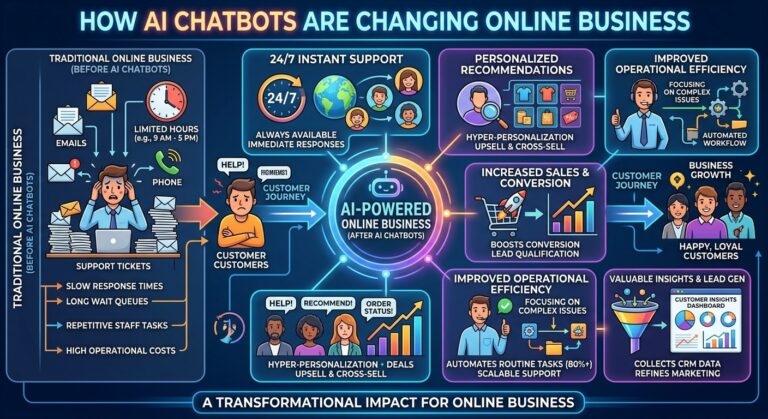
How AI Chatbots Are Changing Online Business
Introduction
The way businesses communicate with customers is changing rapidly. People expect quick answers, convenient service, personalized experiences, and support whenever they need it. For online businesses, meeting these expectations can be challenging, especially when customer inquiries arrive around the clock.
This is where AI chatbots are making a major difference.
AI chatbots use artificial intelligence and conversational technology to communicate with customers through websites, messaging platforms, applications, and other digital channels. Unlike traditional automated chat systems that rely heavily on predefined responses, modern AI chatbots can understand natural language, recognize customer intent, provide relevant information, and handle increasingly complex conversations.
For online businesses, this technology can reduce repetitive workloads, improve response times, generate leads, assist customers, and create more personalized digital experiences.
AI chatbots are not simply another website feature. They are becoming an important part of how businesses operate, communicate, sell, and build relationships with customers.
What Are AI Chatbots?
An AI chatbot is a software system designed to communicate with people using natural language.
Traditional chatbots often follow a simple decision tree. A customer selects an option, and the chatbot provides a predetermined response. AI-powered chatbots can go further by analyzing what a customer says and generating or selecting a more relevant response.
Depending on how they are designed, AI chatbots can help businesses:
- Answer frequently asked questions
- Provide product or service information
- Recommend products
- Collect customer information
- Qualify leads
- Schedule appointments
- Assist with orders
- Handle basic customer support
- Direct customers to the right department
- Provide information outside normal business hours
- Support marketing campaigns
- Automate repetitive conversations
The result is a more responsive digital environment where customers can receive assistance without always waiting for a human representative.
Why AI Chatbots Are Becoming Important for Online Businesses
Online businesses operate differently from traditional businesses. Customers may visit a website from different countries and time zones, and they may expect immediate assistance.
A visitor who cannot find an answer may simply leave the website and search for another company.
AI chatbots can help close this communication gap.
Instead of forcing customers to search through multiple pages or wait for an email response, a chatbot can provide assistance directly within the customer’s digital journey.
For example, imagine a customer visiting an online store and asking:
“Which laptop is best for video editing under my budget?”
An AI chatbot can potentially ask follow-up questions about the customer’s requirements and direct them toward relevant products.
This type of interaction can make a website feel more helpful and interactive.
AI Chatbots Provide 24/7 Customer Support
One of the biggest advantages of AI chatbots is their ability to operate continuously.
Human customer service teams have working hours, but websites remain accessible 24 hours a day.
An AI chatbot can help customers outside traditional business hours by answering common questions, explaining services, providing basic troubleshooting guidance, and collecting information for follow-up.
This is particularly valuable for online businesses serving international customers.
A customer in another time zone does not necessarily need to wait until the company’s support team starts working.
Why 24/7 support matters
Continuous support can help businesses:
- Reduce customer waiting times
- Improve website engagement
- Capture inquiries outside business hours
- Support international customers
- Reduce repetitive support requests
- Create a more convenient customer experience
The chatbot does not necessarily replace human support. Instead, it can provide the first layer of assistance and transfer more complicated issues to employees.
Faster Responses Improve Customer Experience
Speed matters in online business.
Customers frequently have multiple options available to them. If one company takes hours to answer a simple question while another provides an immediate response, the faster company may have an advantage.
AI chatbots can respond to many routine questions almost instantly.
Instead of waiting for an employee to manually respond to:
- “What are your business hours?”
- “How much does this service cost?”
- “Do you offer refunds?”
- “How can I track my order?”
- “Where can I find this product?”
- “How do I contact support?”
customers can receive immediate assistance.
Faster communication can make the overall customer journey smoother.
AI Chatbots Are Transforming Lead Generation
Lead generation is another area where AI chatbots can have a significant impact.
Traditional websites often rely on forms to collect leads. While forms are useful, they require visitors to take an additional step.
A chatbot can start the conversation immediately.
For example:
Chatbot: “What are you looking for today?”
Customer: “I’m interested in your marketing services.”
Chatbot: “Great. Are you looking for SEO, social media marketing, or a complete marketing strategy?”
The conversation can continue by collecting relevant information and identifying whether the visitor may be a potential customer.
This approach turns a passive website visit into an interactive conversation.
AI Chatbots Can Help Businesses Qualify Leads
Not every website visitor is ready to make a purchase.
Sales teams can waste significant time responding to leads that are not relevant or not ready to buy.
AI chatbots can ask qualifying questions before sending information to a sales representative.
For example, a business chatbot might ask:
- What service are you interested in?
- What is your approximate budget?
- When do you need the service?
- How large is your business?
- What problem are you trying to solve?
The answers can help businesses prioritize leads.
Sales representatives can then focus more attention on prospects who match the company’s target customer profile.
Personalized Conversations Are Becoming Easier
Personalization has become an important part of digital marketing.
Customers do not always want generic information. They want answers relevant to their specific needs.
AI chatbots can support personalized conversations by using available customer information and the context of the conversation.
For example, instead of simply saying:
“Here are our products.”
A chatbot might provide recommendations based on what the customer has already discussed.
This can make the interaction feel more relevant.
Personalized chatbot experiences can include:
- Product recommendations
- Service suggestions
- Personalized offers
- Relevant content
- Customer-specific assistance
- Context-aware responses
When implemented responsibly, personalization can help customers find what they need more efficiently.
AI Chatbots Can Increase Sales Opportunities
AI chatbots can also become part of an online business’s sales process.
A chatbot can answer product questions, explain features, compare options, recommend products, and guide customers toward the next step.
For example, an online clothing store could use a chatbot to help shoppers choose products based on:
- Size
- Style
- Budget
- Color
- Occasion
- Personal preferences
Instead of browsing hundreds of products independently, customers can receive conversational guidance.
This can make shopping easier and potentially increase conversion opportunities.
Chatbots Reduce Repetitive Work
Customer service employees frequently answer the same questions repeatedly.
While these questions may be simple, they can consume a significant amount of employee time.
AI chatbots can automate many repetitive interactions.
This allows employees to spend more time on tasks requiring:
- Critical thinking
- Creativity
- Negotiation
- Empathy
- Complex problem-solving
- Relationship management
The goal is not to automate every customer interaction.
The better strategy is to automate repetitive tasks while allowing employees to handle conversations where human involvement creates greater value.
AI Chatbots Help Small Businesses Compete
Large companies often have dedicated customer support departments, sales teams, and marketing resources.
Small businesses may not have the same resources.
AI chatbots can help smaller organizations provide a more responsive digital experience without requiring a large support team.
A small online business can potentially use a chatbot to:
- Answer FAQs
- Collect leads
- Provide product information
- Assist customers
- Schedule consultations
- Support marketing campaigns
- Route inquiries
This can allow a small team to serve more customers efficiently.
AI Chatbots Are Changing Digital Marketing
Chatbots are also becoming part of modern marketing strategies.
Instead of relying entirely on static advertisements and landing pages, businesses can use conversational experiences to engage visitors.
For example, a marketing chatbot might ask:
“What are you trying to improve in your business?”
The customer’s response can determine which information the chatbot provides next.
This creates a more interactive marketing experience.
AI chatbots can support:
- Lead generation campaigns
- Product discovery
- Content recommendations
- Promotional campaigns
- Customer surveys
- Newsletter signups
- Event registrations
Conversational marketing can make digital experiences more engaging than simply presenting information on a page.
AI Chatbots Improve the Customer Journey
The customer journey can involve many stages:
Awareness → Research → Consideration → Purchase → Support → Retention
AI chatbots can potentially support customers throughout this journey.
During the awareness stage, a chatbot can explain what the company offers.
During research, it can answer questions.
During consideration, it can compare products or services.
During purchase, it can help customers understand the process.
After purchase, it can provide support and answer common questions.
This makes the chatbot more than a customer service tool. It can become a digital assistant that supports multiple stages of the customer experience.
Chatbots Can Collect Valuable Customer Insights
Every customer conversation can provide useful information.
Businesses may learn:
- What customers frequently ask
- Which products receive the most interest
- What problems customers experience
- What information is difficult to find
- Why customers hesitate to purchase
- Which services customers request most often
These insights can help businesses improve their websites, products, marketing campaigns, and customer service processes.
However, businesses should collect and use customer information responsibly and clearly communicate relevant privacy practices.
AI Chatbots Can Support Customer Retention
Getting a customer is only part of building a successful online business.
Keeping customers is equally important.
AI chatbots can contribute to customer retention by making post-purchase support easier.
For example, customers can use a chatbot to ask about:
- Orders
- Account information
- Product usage
- Troubleshooting
- Returns
- Available services
- Frequently asked questions
When customers can easily get assistance, they may have a smoother experience with the business.
Good customer support can therefore become part of a broader customer retention strategy.
AI Chatbots Can Work Alongside Human Employees
One of the biggest misconceptions about AI chatbots is that businesses must choose between AI and human employees.
In reality, the strongest approach is often a combination of both.
AI can handle repetitive and straightforward interactions.
Humans can handle situations involving:
- Complex complaints
- Sensitive issues
- Negotiations
- High-value customers
- Unusual requests
- Emotional situations
- Strategic decisions
A well-designed chatbot should recognize when a conversation requires human assistance.
The transition should be simple and transparent rather than forcing customers to repeat their entire story.
AI Chatbots Are Making Websites More Interactive
Traditional websites primarily provide information.
AI chatbots can turn websites into interactive experiences.
Instead of asking customers to navigate through several pages, businesses can allow visitors to ask questions directly.
For example:
Customer: “I’m looking for a service for a small business.”
AI Chatbot: “I can help. What type of business do you operate?”
The interaction can then guide the visitor toward relevant information.
This conversational approach can make websites feel more dynamic and customer-focused.
Businesses Need to Use AI Chatbots Strategically
Adding a chatbot to a website does not automatically improve a business.
The chatbot must solve a real problem.
Before implementing one, businesses should identify which customer interactions are repetitive, time-consuming, or difficult to manage manually.
Good chatbot opportunities often include:
- Frequently asked questions
- Lead qualification
- Appointment scheduling
- Product discovery
- Order assistance
- Basic technical support
- Customer information requests
Businesses should avoid creating chatbots simply because AI is popular.
The technology should support a clear business objective.
Best Practices for Implementing an AI Chatbot
Businesses can improve chatbot performance by following several best practices.
- Start With Common Customer Questions
Identify the questions customers ask most frequently.
These should become the foundation of the chatbot’s knowledge and conversation flows.
- Make the Chatbot Easy to Use
Customers should immediately understand what the chatbot can help with.
Avoid unnecessary complexity.
- Provide Human Escalation
Customers should have a clear way to reach a human when necessary.
- Keep Information Accurate
Incorrect answers can damage customer trust.
Businesses should regularly review and update chatbot information.
- Protect Customer Data
Businesses should take privacy and security seriously when collecting customer information through chatbot conversations.
- Monitor Conversations
Review chatbot interactions to identify unanswered questions, misunderstandings, and opportunities for improvement.
- Measure Performance
Useful chatbot metrics can include:
- Response time
- Conversation completion rate
- Lead generation
- Customer satisfaction
- Human escalation rate
- Conversion rate
- Support ticket reduction
Measuring these metrics helps businesses determine whether the chatbot is actually creating value.
The Future of AI Chatbots in Online Business
AI chatbots are likely to become increasingly integrated into online business operations.
Future chatbot experiences may become more conversational, context-aware, personalized, and connected to business systems.
Instead of functioning as isolated chat windows, AI assistants may become connected to:
- Customer relationship management systems
- E-commerce platforms
- Marketing automation systems
- Scheduling tools
- Knowledge bases
- Customer support platforms
- Business analytics systems
This could allow businesses to create more connected customer experiences.
The future is not simply about chatbots answering questions.
It is about creating intelligent digital assistants that can help customers accomplish tasks.
AI Chatbots and the Human Touch
Despite the rapid development of artificial intelligence, human interaction remains important.
Customers do not always want automation.
Sometimes they want to speak with a real person who understands their situation.
Businesses should therefore view AI chatbots as tools that enhance customer communication rather than completely replacing human relationships.
The most effective strategy is often:
AI for speed and scale + humans for empathy and complexity.
This combination can help businesses provide efficient service while preserving the personal connection that customers value.
How SmileLineAI Can Support AI-Powered Customer Communication
For businesses exploring AI-powered customer communication, platforms such as SmileLineAI can be part of a broader strategy for creating smarter digital interactions.
AI-powered communication tools can help businesses explore opportunities around automated conversations, customer engagement, personalization, and support.
The key is to implement AI around genuine customer needs rather than treating automation as an end goal.
When technology is designed around the customer experience, AI can become a valuable part of a company’s long-term digital strategy.
Conclusion
AI chatbots are changing online business by transforming how companies communicate with customers.
They can provide faster responses, support customers around the clock, automate repetitive questions, generate and qualify leads, personalize conversations, assist with sales, and help businesses understand customer needs.
For small businesses, chatbots can provide capabilities that were once difficult to maintain without large teams. For larger organizations, they can help scale customer communication across multiple channels.
However, successful chatbot implementation is not simply about installing an AI tool.
Businesses need to identify meaningful use cases, provide accurate information, protect customer data, monitor performance, and maintain a clear path to human support.
The future of online business will likely involve a combination of artificial intelligence and human expertise.
AI chatbots can handle speed, scale, and repetitive tasks, while human employees provide empathy, creativity, judgment, and relationship-building.
Businesses that learn how to combine these strengths can create faster, smarter, and more customer-focused digital experiences.