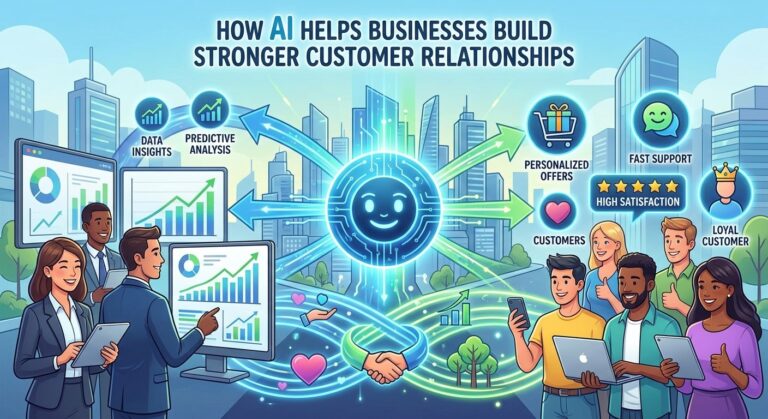
How AI Helps Businesses Build Stronger Customer Relationships
Introduction
Strong customer relationships are the foundation of long-term business success. Customers who feel understood, valued, and supported are more likely to return, recommend a brand, and develop lasting loyalty.
However, building meaningful relationships becomes more challenging as a business grows. Customer interactions increase, communication takes place across multiple channels, and employees may not have enough time to provide highly personalized attention to everyone.
Artificial intelligence (AI) is changing how businesses approach customer relationships.
AI can analyze customer behavior, personalize communication, automate routine conversations, provide faster support, and identify important customer needs. When used responsibly, these capabilities allow businesses to build stronger relationships while making customer service more efficient.
In this article, we’ll explore how AI helps businesses build stronger customer relationships and how companies can use AI to create more meaningful customer experiences.
Why Strong Customer Relationships Matter
A customer relationship is more than a single purchase or transaction.
It develops through repeated interactions between a customer and a business.
Strong customer relationships can lead to:
- Increased customer loyalty
- More repeat purchases
- Higher customer retention
- Positive reviews
- Word-of-mouth referrals
- Greater customer lifetime value
- Stronger brand reputation
Businesses that consistently provide helpful and relevant experiences have more opportunities to develop long-term customer relationships.
How AI Is Changing Customer Relationships
Traditional customer relationship strategies often depend on employees manually collecting information, communicating with customers, and analyzing feedback.
AI can support these activities by processing information quickly and automating repetitive tasks.
AI can help businesses:
- Understand customer preferences
- Analyze customer behavior
- Personalize communication
- Respond to questions faster
- Predict potential customer needs
- Identify customer concerns
- Improve customer support
This creates opportunities for businesses to build relationships at scale.
AI Helps Businesses Understand Customers Better
Understanding customers is essential for building meaningful relationships.
AI can analyze customer information from different sources, including:
- Purchase history
- Website activity
- Customer support conversations
- Email engagement
- Product interactions
- Reviews
- Surveys
Analyzing this information can reveal patterns in customer preferences and behavior.
Instead of relying only on assumptions, businesses can use AI-powered customer insights to make more informed decisions.
AI Enables Personalized Communication
Personalization is one of the most important ways AI can strengthen customer relationships.
Customers don’t all have the same needs or preferences.
AI can help businesses personalize:
- Marketing messages
- Product recommendations
- Customer support
- Follow-up communication
- Offers and promotions
- Website experiences
For example, a returning customer can receive information based on their previous interactions rather than receiving the same generic message as every other customer.
Relevant communication can make customers feel better understood.
AI Creates More Meaningful Customer Interactions
Automation doesn’t have to make communication impersonal.
When AI uses relevant context, it can help businesses provide more useful interactions.
Instead of simply responding to keywords, conversational AI can analyze the context of a customer’s request and provide a more appropriate response.
This can make digital conversations feel more relevant and efficient.
Faster Customer Support Builds Trust
Customers value businesses that respect their time.
Long waiting periods can create frustration, especially when customers need answers to simple questions.
AI-powered customer support can provide immediate responses to many routine requests.
Customers can receive assistance with:
- Frequently asked questions
- Product information
- Basic troubleshooting
- Order-related questions
- Account guidance
- Scheduling requests
Faster responses can improve convenience and contribute to a more positive customer relationship.
AI Provides 24/7 Customer Assistance
Customer needs don’t follow a strict business schedule.
Customers may have questions during evenings, weekends, holidays, or different time zones.
AI-powered systems can provide assistance around the clock.
This allows businesses to remain available even when human teams are offline.
For customers, 24/7 access can mean greater convenience. For businesses, it can mean fewer missed opportunities and reduced pressure on support teams.
AI Helps Businesses Become More Proactive
Strong relationships require businesses to anticipate customer needs rather than always waiting for customers to ask for help.
AI can analyze customer behavior to identify signals that may indicate a customer needs assistance.
For example, AI may help identify:
- Declining engagement
- Repeated support requests
- Unusual customer activity
- Potential purchasing interest
- Customers who may need additional guidance
Businesses can then determine appropriate ways to engage with those customers.
Proactive communication can demonstrate that a business is paying attention.
AI Can Help Improve Customer Retention
Customer retention is closely connected to relationship quality.
AI can analyze customer behavior to identify patterns associated with declining engagement.
Potential indicators may include:
- Fewer purchases
- Reduced website activity
- Lower communication engagement
- Negative feedback
- Reduced product usage
These insights can help businesses investigate potential problems and develop appropriate retention strategies.
AI does not replace the need to understand why a customer is leaving, but it can help businesses identify where attention may be needed.
AI Improves Customer Recommendations
Relevant recommendations can add value to customer interactions.
AI recommendation systems can analyze information such as:
- Previous purchases
- Browsing behavior
- Product preferences
- Similar customer behavior
- Current interactions
Businesses can use these insights to recommend products, services, or content that may be useful to individual customers.
When recommendations are relevant and not excessive, they can improve the customer experience.
AI Turns Customer Feedback Into Insights
Customer feedback provides valuable information about the relationship between customers and a brand.
AI can analyze large volumes of:
- Reviews
- Surveys
- Support tickets
- Chat conversations
- Emails
- Social media comments
Businesses can use AI to identify recurring themes and customer concerns.
For example, if customers repeatedly mention a difficult checkout process, the business can investigate the issue and make improvements.
Listening to customers—and acting on what they say—is essential for building trust.
AI Helps Businesses Understand Customer Sentiment
Customer relationships involve more than transactions. They also involve customer attitudes and perceptions.
AI-powered sentiment analysis can help businesses identify whether communications generally contain positive, negative, or neutral sentiment.
This can help organizations monitor customer experience trends and identify areas requiring attention.
However, sentiment analysis should be treated as a useful signal rather than a perfect measurement of human emotions.
AI Supports Consistent Communication
Consistency is important for maintaining trust.
Customers expect to receive accurate information regardless of which employee or communication channel they use.
AI can help businesses provide consistent responses to common questions and make relevant information available to customer service teams.
This can reduce confusion and improve the overall customer experience.
AI Connects Customer Interactions
Customers often communicate with businesses through multiple channels.
A customer might:
- Discover a business through social media.
- Visit its website.
- Ask a question through live chat.
- Contact customer support by email.
- Make a purchase later.
When communication systems are properly integrated, AI can help businesses connect relevant customer information across these interactions.
This creates a more consistent customer journey and reduces the need for customers to repeat themselves.
AI Helps Employees Build Better Relationships
AI isn’t only useful for communicating directly with customers.
It can also help employees provide better service.
AI tools can provide customer service representatives with:
- Conversation summaries
- Relevant customer information
- Suggested responses
- Knowledge base recommendations
- Automated notes
- Potential next steps
This reduces the amount of time employees spend searching for information.
Employees can then devote more attention to meaningful conversations and complex customer needs.
The Human Touch Still Matters
AI can improve customer relationships, but it shouldn’t replace human connection completely.
Some customer situations require:
- Empathy
- Judgment
- Creativity
- Negotiation
- Emotional understanding
- Personal attention
AI is most effective when it supports human employees rather than attempting to handle every situation alone.
Routine tasks can be automated while human representatives handle complex or sensitive conversations.
This combination creates a customer experience that is both efficient and personal.
Responsible AI Builds Customer Trust
Businesses must use AI responsibly when dealing with customer information.
Important considerations include:
- Data privacy
- Information security
- Transparency
- Human oversight
- Appropriate automation
- Accurate AI-generated information
Customers should understand how their information is being used and should have access to human assistance when necessary.
Responsible AI practices help businesses strengthen trust rather than undermine it.
How SmileLineAI Can Help Strengthen Customer Relationships
AI-powered customer communication platforms such as SmileLineAI can help businesses improve the way they interact with customers.
AI-powered communication can help organizations:
- Respond to customers faster
- Automate routine conversations
- Personalize customer interactions
- Provide continuous assistance
- Improve engagement
- Reduce repetitive communication tasks
- Support more consistent customer experiences
By combining intelligent automation with customer-focused communication, businesses can create more responsive experiences while giving employees more time to focus on high-value customer relationships.
How Businesses Can Start Using AI for Customer Relationships
Businesses don’t need to automate their entire customer experience immediately.
A gradual approach can be more effective.
- Identify Customer Pain Points
Find the areas where customers experience delays, confusion, or unnecessary friction.
- Analyze Existing Customer Interactions
Review customer questions, feedback, support requests, and purchasing behavior to identify common patterns.
- Start With Repetitive Tasks
Use AI to automate appropriate routine interactions, such as frequently asked questions and basic information requests.
- Introduce Personalization
Use customer insights to make communication and recommendations more relevant.
- Maintain Human Support
Create a clear path to human assistance for complex or sensitive situations.
- Measure Customer Relationship Improvements
Track metrics such as:
- Customer satisfaction
- Customer retention
- Repeat purchases
- Engagement
- Customer lifetime value
- Response time
- Resolution time
- Continuously Improve
AI implementation should be monitored and refined as customer expectations change.
The Future of AI and Customer Relationships
AI will continue to transform how businesses understand and communicate with customers.
Future customer relationship strategies are likely to involve increasingly sophisticated:
- Conversational AI
- Predictive customer analytics
- Real-time personalization
- AI-powered voice communication
- Proactive customer engagement
- Automated customer journey optimization
AI may increasingly help businesses understand customer needs before customers explicitly communicate them.
The objective will not simply be to automate more conversations. It will be to create interactions that are more relevant, useful, and valuable.
Conclusion
AI is becoming an important tool for businesses that want to build stronger customer relationships.
By analyzing customer behavior, personalizing communication, improving response times, providing 24/7 assistance, identifying customer concerns, and supporting employees, AI can help businesses create better customer experiences at scale.
But technology alone cannot create lasting relationships.
Businesses still need to listen to customers, protect their information, provide genuine value, and maintain human involvement when it matters most.
The strongest approach combines AI efficiency with human connection.
When businesses use AI responsibly and strategically, they can understand customers better, respond to their needs faster, and create experiences that encourage trust, satisfaction, and long-term loyalty.
AI can automate the conversation, but meaningful relationships are built by using that technology to serve customers better.