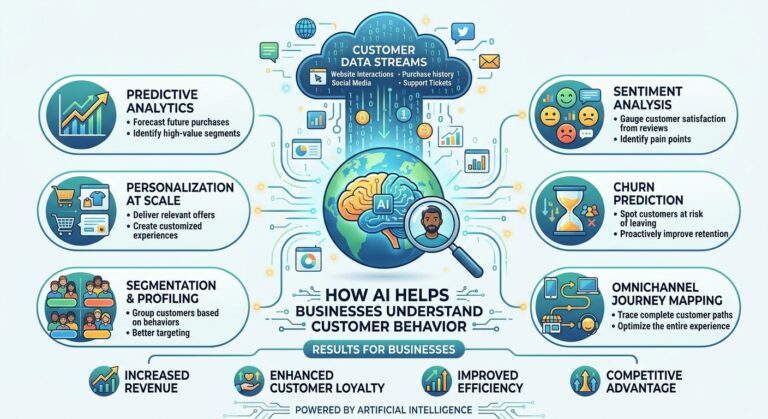
How AI Helps Businesses Understand Customer Behavior
Introduction
Understanding customer behavior is one of the most important parts of building a successful business. Companies need to know what customers want, how they make purchasing decisions, what problems they encounter, and what encourages them to remain loyal to a brand.
However, customer behavior has become increasingly difficult to understand. Customers interact with businesses across websites, social media, mobile applications, email, live chat, and other digital channels. This creates enormous amounts of information that can be difficult to analyze manually.
Artificial intelligence (AI) is changing the way businesses approach customer behavior analysis.
AI can process large amounts of customer data, identify patterns, analyze conversations, predict potential actions, and provide insights that help companies make better decisions.
In this article, we’ll explore how AI helps businesses understand customer behavior, the types of information AI can analyze, and how organizations can use these insights to create better customer experiences.
What Is Customer Behavior?
Customer behavior refers to the actions, preferences, decisions, and interactions customers have with a business.
It can include:
- Products customers view
- Products customers purchase
- Website pages they visit
- Content they engage with
- Questions they ask
- Customer service interactions
- Marketing emails they open
- Feedback they provide
- How frequently they return
Understanding these behaviors helps businesses identify customer needs and improve their products, services, and communication.
Why Understanding Customer Behavior Matters
Businesses that understand their customers can make more informed decisions.
Customer behavior insights can help organizations:
- Improve marketing campaigns
- Personalize customer experiences
- Increase conversions
- Improve customer service
- Reduce customer churn
- Develop better products
- Increase customer loyalty
Without accurate customer insights, businesses may rely on assumptions that don’t reflect what customers actually want.
How AI Analyzes Customer Data
AI can process large amounts of structured and unstructured information much faster than traditional manual analysis.
Businesses can use AI to analyze information from:
- Websites
- CRM systems
- Online stores
- Customer support platforms
- Email campaigns
- Surveys
- Product reviews
- Social media
- Messaging platforms
AI identifies patterns within this information and turns large datasets into actionable insights.
AI Identifies Customer Behavior Patterns
Individual customer actions may not reveal much on their own.
However, analyzing thousands or millions of interactions can reveal important patterns.
AI can identify trends such as:
- Products frequently viewed together
- Common purchasing times
- Repeated customer questions
- Changes in customer engagement
- Frequently abandoned pages
- Popular product categories
These patterns can help businesses understand what influences customer decisions.
AI Helps Identify Customer Preferences
Customers have different needs and interests.
AI can analyze individual behavior to identify preferences related to:
- Products
- Services
- Content
- Communication channels
- Promotions
- Shopping habits
Businesses can use these insights to create more relevant experiences for different customers.
AI-Powered Customer Segmentation
Customer segmentation involves dividing customers into groups based on shared characteristics or behaviors.
Traditional segmentation may rely heavily on demographic information.
AI can create more dynamic segments based on actual customer activity.
For example, AI may identify groups such as:
- Highly engaged customers
- Frequent buyers
- First-time visitors
- Price-sensitive shoppers
- Customers interested in specific products
- Customers showing declining engagement
Behavior-based segmentation can help businesses develop more effective marketing and customer service strategies.
Predictive Customer Behavior Analysis
One of the most powerful capabilities of AI is predictive analytics.
Instead of simply explaining what customers have done in the past, AI can analyze patterns to estimate what may happen next.
Businesses can use predictive customer analytics to identify:
- Potential purchases
- Customer churn risk
- Future product demand
- Likely customer engagement
- Potential support needs
Predictions aren’t guarantees, but they can provide useful signals for business planning and customer engagement.
AI Helps Predict Customer Churn
Customer churn can have a significant impact on business growth.
AI can analyze changes in customer behavior to identify potential warning signals.
These may include:
- Fewer purchases
- Reduced website activity
- Lower engagement
- Negative feedback
- Decreased communication
- Changes in product usage
Businesses can use these insights to investigate why engagement is declining and determine appropriate retention strategies.
Understanding Customer Intent With AI
Customers don’t always clearly explain what they need.
Conversational AI can analyze language and context to help determine customer intent.
For example, a customer asking:
“Can I change my delivery date?”
is likely seeking assistance with an existing order rather than general product information.
Understanding intent allows businesses to provide more relevant responses and direct customers toward the appropriate solution.
AI Analyzes Customer Conversations
Customer conversations contain valuable behavioral information.
AI can analyze conversations from:
- Live chat
- Messaging
- Customer support
- Voice interactions
This can reveal common questions, frustrations, product concerns, and customer expectations.
Businesses can use these insights to improve both customer service and their overall products.
AI Helps Measure Customer Sentiment
Customer behavior isn’t only about actions. It also includes how customers feel about their experiences.
AI-powered sentiment analysis can help identify whether customer communications generally express:
- Positive sentiment
- Negative sentiment
- Neutral sentiment
Businesses can use sentiment trends to identify potential customer experience problems.
For example, if negative sentiment increases after a product update, the company may want to investigate the issue.
AI Improves Customer Journey Analysis
The customer journey includes every interaction between a customer and a business.
AI can analyze these interactions to identify where customers encounter friction.
Businesses can discover:
- Where customers abandon purchases
- Which pages generate the most engagement
- Where customers request assistance
- Which steps create confusion
- Which interactions lead to conversions
Understanding the complete customer journey allows businesses to improve experiences at important touchpoints.
AI Enables Personalized Marketing
Customer behavior insights are especially valuable for marketing.
AI can help businesses create personalized campaigns based on customer activity.
Examples include:
- Personalized product recommendations
- Targeted email campaigns
- Customized promotions
- Relevant content recommendations
- Behavior-based advertising
Personalization makes marketing more relevant and can improve customer engagement.
AI Improves Product Recommendations
Recommendation systems use customer behavior to identify products or services that may be relevant.
AI can consider:
- Previous purchases
- Recently viewed products
- Customer preferences
- Similar customer behavior
- Product interactions
Relevant recommendations can make it easier for customers to discover products while creating additional opportunities for businesses.
AI Helps Improve Customer Service
Customer behavior insights can also improve customer support.
AI can identify recurring issues and common questions, helping businesses understand what customers struggle with most.
AI-powered support systems can also use available customer context to provide more relevant assistance.
This can result in:
- Faster responses
- Fewer repetitive questions
- More relevant support
- Better customer satisfaction
AI Supports Real-Time Customer Insights
Traditional customer research can take significant time to collect and analyze.
AI can provide insights much faster by continuously analyzing customer activity.
Real-time customer analytics can help businesses identify changes in:
- Customer engagement
- Product demand
- Customer sentiment
- Website behavior
- Support requests
Businesses can respond more quickly when customer behavior changes.
AI Helps Businesses Understand Customer Feedback
Customer feedback provides direct information about customer experiences.
AI can analyze large amounts of feedback from:
- Reviews
- Surveys
- Support tickets
- Emails
- Social media comments
- Chat conversations
AI can identify recurring themes and help businesses prioritize improvements.
For example, if customers repeatedly complain about a complicated checkout process, the business can investigate and simplify that experience.
Turning Customer Insights Into Business Decisions
Collecting customer data is only the first step.
The real value comes from using insights to make better decisions.
Businesses can use AI-generated customer insights to:
- Improve products
- Adjust marketing campaigns
- Optimize customer support
- Improve website experiences
- Develop new services
- Strengthen retention strategies
AI becomes most valuable when customer insights lead to meaningful action.
Protecting Customer Data
Customer behavior analysis requires responsible data management.
Businesses should prioritize:
- Data security
- Customer privacy
- Appropriate access controls
- Transparency
- Responsible AI practices
- Compliance with applicable privacy requirements
Customers should understand how their information is being used, and businesses should only collect and process information appropriately.
Trust is essential when using AI to analyze customer behavior.
How SmileLineAI Can Help Businesses Understand Customers
AI-powered customer communication platforms such as SmileLineAI can help businesses turn customer conversations into useful insights.
By combining intelligent communication with automation, businesses can better understand:
- Common customer questions
- Customer needs
- Recurring concerns
- Communication patterns
- Customer engagement
These insights can help businesses improve customer interactions while reducing the amount of manual work required to analyze large volumes of customer communication.
How to Start Using AI for Customer Behavior Analysis
Businesses don’t need to implement complex AI systems immediately.
A practical approach is to start with a few important use cases.
Step 1: Identify Your Data Sources
Determine where customer behavior information is collected.
Step 2: Define Your Business Goals
Decide what you want to understand, such as customer churn, purchasing behavior, engagement, or satisfaction.
Step 3: Choose Appropriate AI Tools
Select AI solutions that can analyze the data relevant to your objectives.
Step 4: Create Actionable Insights
Focus on insights that can directly influence business decisions.
Step 5: Measure Results
Track metrics such as:
- Customer satisfaction
- Conversion rates
- Retention
- Engagement
- Average order value
- Customer lifetime value
Step 6: Continuously Improve
Customer behavior changes over time, so AI analysis should be continuously monitored and refined.
The Future of AI Customer Behavior Analysis
AI will continue to make customer behavior analysis more sophisticated.
Future systems may become increasingly capable of:
- Predicting customer needs
- Understanding conversational context
- Analyzing customer journeys in real time
- Detecting changes in customer sentiment
- Creating highly personalized experiences
- Connecting insights across multiple channels
As AI technology develops, businesses will be able to understand customers at a deeper level while responding more quickly to changing expectations.
Conclusion
Understanding customer behavior is essential for creating better products, improving customer service, and building lasting relationships.
AI provides businesses with powerful tools to analyze customer interactions, identify behavioral patterns, understand preferences, predict potential actions, and uncover valuable insights.
The goal isn’t simply to collect more customer data. It is to turn customer behavior into meaningful business intelligence.
When businesses combine AI-powered analytics with human expertise, they can make smarter decisions, personalize customer experiences, improve engagement, and strengthen customer loyalty.
As competition continues to increase, organizations that understand their customers better will have a significant advantage—and AI can help make that deeper understanding possible.