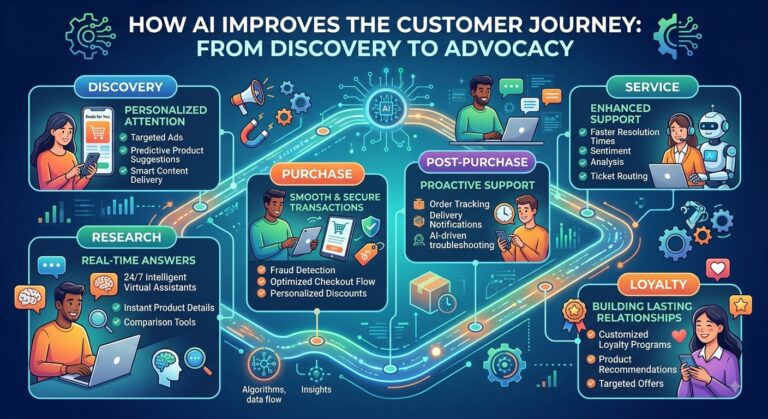
How AI Improves the Customer Journey
Introduction
The customer journey has become more complex in the digital age. Customers may discover a business through search engines, social media, advertisements, websites, email, or recommendations before eventually making a purchase. At every stage, they expect fast responses, relevant information, and a smooth experience.
Artificial intelligence (AI) is helping businesses improve this journey by making customer interactions faster, more personalized, and more convenient. From the first interaction with a brand to post-purchase support, AI can help businesses understand customer needs and deliver relevant experiences.
In this article, we’ll explore how AI improves the customer journey, the benefits of AI-powered customer engagement, and how businesses can use AI to create better experiences at every stage.
What Is the Customer Journey?
The customer journey represents the different stages a customer goes through when interacting with a business.
Although the journey varies between industries, it commonly includes:
- Awareness
- Discovery
- Consideration
- Purchase
- Onboarding
- Customer support
- Retention
- Advocacy
AI can improve each of these stages by helping businesses understand customer behavior and deliver more relevant interactions.
AI Creates Better First Impressions
The first interaction with a business can influence whether a customer continues exploring its products or services.
AI can help businesses create better first impressions through:
- Intelligent website chat
- Personalized recommendations
- Instant answers
- Relevant content suggestions
- Automated assistance
Instead of leaving visitors searching for information on their own, AI can guide them toward the information they need.
AI Improves Customer Personalization
Personalization is one of the biggest advantages of AI.
AI can analyze information such as customer behavior, previous interactions, preferences, and purchase activity to help businesses provide more relevant experiences.
Examples include:
- Personalized product recommendations
- Customized offers
- Relevant content
- Personalized email communication
- Tailored customer support
When customers receive information that matches their interests, they are more likely to remain engaged with a brand.
AI Helps Customers Find Information Faster
Customers don’t want to spend a long time searching for answers.
AI-powered search tools and virtual assistants can quickly provide information about:
- Products
- Services
- Pricing
- Features
- Availability
- Policies
- Orders
Faster access to information reduces friction and helps customers move more confidently through the buying process.
AI-Powered Chatbots Improve Customer Engagement
AI chatbots are becoming an important part of modern customer journeys.
A chatbot can assist customers by:
- Answering frequently asked questions
- Recommending products
- Collecting information
- Helping visitors navigate websites
- Scheduling appointments
- Connecting customers with human agents
Because AI chatbots can handle multiple conversations simultaneously, customers can receive assistance without waiting for an available representative.
AI Provides 24/7 Customer Support
The customer journey doesn’t always happen during standard business hours.
Customers may browse websites, compare products, or need assistance late at night or during weekends.
AI-powered customer service can provide continuous support, allowing businesses to:
- Answer questions after hours
- Capture potential leads
- Provide order information
- Handle basic support requests
- Guide customers toward relevant solutions
24/7 availability creates a more convenient customer experience.
AI Reduces Friction During the Buying Process
A complicated purchasing process can cause customers to abandon their journey.
AI can help identify and reduce friction by analyzing customer behavior.
Businesses can use AI to identify:
- Frequently abandoned pages
- Common customer questions
- Checkout problems
- Navigation issues
- Sources of customer confusion
These insights allow companies to improve their websites and purchasing processes.
AI Supports Smarter Product Recommendations
Product recommendations can help customers discover products that match their needs.
AI analyzes customer behavior and preferences to recommend potentially relevant products or services.
For example, an AI system may consider:
- Previous purchases
- Browsing behavior
- Product preferences
- Similar customer behavior
- Current interests
Relevant recommendations can make shopping easier while increasing opportunities for additional sales.
AI Improves the Post-Purchase Experience
The customer journey doesn’t end after a purchase.
Post-purchase communication is important for building customer satisfaction and loyalty.
AI can help businesses provide:
- Order updates
- Delivery notifications
- Product assistance
- Usage recommendations
- Follow-up messages
- Automated support
A strong post-purchase experience can encourage customers to return in the future.
AI Enables Proactive Customer Support
Traditional customer service often waits for customers to report a problem.
AI can help businesses identify potential issues before customers contact support.
For example, AI can analyze customer activity and identify patterns that may indicate:
- Confusion
- Potential service problems
- Abandoned purchases
- Customer dissatisfaction
- Risk of customer churn
Businesses can then proactively provide assistance.
AI Helps Businesses Understand Customer Behavior
Every interaction provides valuable information.
AI can analyze customer data to identify patterns across the customer journey.
Businesses can learn:
- Which channels customers prefer
- Where customers lose interest
- Which products receive the most attention
- What questions customers frequently ask
- Which experiences lead to conversions
These insights help companies make informed improvements to their customer experience strategy.
AI Improves Customer Retention
Acquiring new customers can be more expensive than retaining existing ones.
AI helps businesses improve retention by identifying customer behavior patterns and creating personalized engagement strategies.
AI can support retention through:
- Personalized offers
- Automated follow-ups
- Customer satisfaction analysis
- Churn prediction
- Relevant recommendations
Better retention can contribute to stronger long-term business growth.
AI Makes Customer Communication More Consistent
Customers may interact with a business through websites, social media, email, messaging platforms, and other channels.
AI can help businesses maintain consistent communication across these touchpoints.
This can create a more connected customer journey by ensuring customers receive relevant information regardless of the channel they use.
AI Helps Human Agents Deliver Better Support
AI doesn’t have to replace customer service representatives.
Instead, AI can support human agents by providing useful information during customer interactions.
AI can help agents:
- Retrieve customer information
- Summarize previous conversations
- Suggest responses
- Identify relevant solutions
- Prioritize support requests
This allows human agents to spend more time solving complex problems and building customer relationships.
AI Makes the Customer Journey More Efficient
AI automation can reduce the amount of manual work required throughout the customer journey.
Businesses can automate:
- Welcome messages
- Lead qualification
- Appointment scheduling
- Customer follow-ups
- Support responses
- Feedback collection
Automation allows businesses to maintain consistent engagement while reducing employee workloads.
The Role of AI in Omnichannel Customer Experiences
Modern customers frequently move between different communication channels.
A customer might discover a product on social media, visit a website, contact customer support, and complete a purchase through a mobile device.
AI can help connect these interactions and create a more unified experience.
An effective AI-powered omnichannel strategy can provide:
- Consistent communication
- Connected customer information
- Faster support
- Personalized interactions
- Smoother transitions between channels
Responsible Use of AI in the Customer Journey
While AI provides many benefits, businesses must use it responsibly.
Important considerations include:
- Protecting customer information
- Maintaining data security
- Being transparent about AI interactions
- Providing human assistance when needed
- Monitoring AI-generated responses
- Avoiding unnecessary data collection
Responsible AI practices help businesses build customer trust while benefiting from automation and personalization.
How SmileLineAI Can Improve Customer Engagement
AI-powered customer communication platforms such as SmileLineAI can help businesses improve interactions throughout the customer journey.
AI solutions can help organizations:
- Automate customer conversations
- Provide faster responses
- Deliver personalized interactions
- Support customers around the clock
- Reduce repetitive communication tasks
- Improve overall customer engagement
By incorporating intelligent communication into customer experience strategies, businesses can create smoother interactions while improving operational efficiency.
How to Use AI to Improve the Customer Journey
Businesses can begin implementing AI by following a practical approach.
- Map the Existing Customer Journey
Identify every major customer touchpoint, from initial discovery through post-purchase support.
- Identify Friction Points
Look for areas where customers experience delays, confusion, or unnecessary steps.
- Choose Appropriate AI Solutions
Select AI tools that address specific customer experience problems.
- Start With High-Impact Areas
Consider beginning with customer service, personalization, lead qualification, or automated communication.
- Monitor Customer Feedback
Use customer feedback and performance metrics to determine whether AI is improving the experience.
- Continuously Improve
AI implementation should be an ongoing process. Regularly evaluate results and make improvements based on customer behavior and business goals.
The Future of AI and the Customer Journey
AI will continue to make customer journeys more intelligent and personalized.
Future developments may include:
- More natural AI conversations
- Advanced predictive customer support
- Real-time personalization
- Emotion-aware interactions
- Smarter product recommendations
- AI-powered voice experiences
- More connected omnichannel journeys
As AI becomes more capable, businesses will have more opportunities to anticipate customer needs and provide assistance at the right moment.
Conclusion
AI is transforming the customer journey by making interactions faster, more personalized, and more convenient. From the first website visit to post-purchase support, artificial intelligence can help businesses understand customer needs and deliver better experiences.
The most effective approach is not simply to automate every interaction. Instead, businesses should use AI strategically to remove friction, provide timely assistance, personalize communication, and support human employees when their expertise is needed.
Companies that successfully combine AI technology with human-centered customer service can create smoother customer journeys, strengthen loyalty, improve efficiency, and build lasting competitive advantages.
As customer expectations continue to evolve, AI will become an increasingly important tool for businesses that want to deliver exceptional customer experiences.