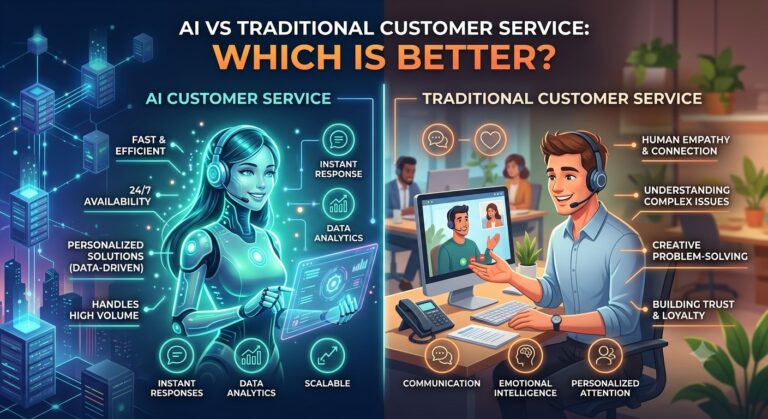
AI vs Traditional Customer Service: Which Is Better?
Customer service has always been a critical part of building successful businesses. A positive customer experience can increase loyalty, improve brand reputation, and drive long-term growth. However, the way businesses provide customer support is rapidly changing.
For decades, traditional customer service relied on human agents, phone calls, emails, and face-to-face interactions. Today, artificial intelligence (AI) is transforming customer support through automation, intelligent assistants, and personalized communication.
This raises an important question: AI vs traditional customer service—which approach is better?
The answer depends on business needs, customer expectations, and how companies combine technology with human expertise. In this article, we compare AI-powered customer service with traditional support and explore the advantages of each.
The Evolution of Customer Service
Customer service has evolved from simple communication methods into a technology-driven experience.
Traditional customer service typically includes:
- Phone support
- Email assistance
- Live chat with human agents
- In-person support
- Manual problem-solving
While these methods remain valuable, they often face challenges such as:
- Limited availability
- Long waiting times
- High operational costs
- Difficulty managing large customer volumes
AI-powered customer service introduces automation and intelligent tools to overcome these challenges.
What Is AI Customer Service?
AI customer service uses artificial intelligence technologies to help businesses communicate with customers more efficiently.
AI-powered support solutions include:
- AI chatbots
- Virtual assistants
- Automated messaging systems
- Predictive analytics
- AI-powered help desks
These tools can understand customer questions, provide instant responses, and assist support teams with daily tasks.
How Traditional Customer Service Works
Traditional customer service depends mainly on human employees handling customer interactions.
Customers communicate with businesses through channels such as:
- Phone calls
- Emails
- Live conversations
- Support tickets
Human agents provide personalized assistance by understanding customer concerns and finding solutions.
Advantages of Traditional Customer Service
Traditional support offers several important benefits.
Human Understanding
Human agents can understand emotions, frustration, and complex situations.
They can provide:
- Empathy
- Personal connection
- Emotional support
- Flexible problem-solving
For sensitive issues, human interaction remains extremely valuable.
Handling Complex Problems
Some customer issues require judgment and experience.
Human agents are better equipped for:
- Complicated complaints
- Unique customer situations
- Negotiations
- Special requests
Building Relationships
Personal conversations can create stronger customer relationships.
Customers often appreciate speaking with someone who understands their concerns and can provide personalized assistance.
Limitations of Traditional Customer Service
Although traditional support has advantages, it also has challenges.
Limited Availability
Human teams typically operate within specific working hours.
Customers may experience delays when support is unavailable.
Longer Response Times
High customer volumes can create:
- Long waiting queues
- Delayed email responses
- Slower issue resolution
Higher Operational Costs
Businesses need to invest in:
- Staff salaries
- Training
- Management
- Infrastructure
Scaling customer support can become expensive as customer demand grows.
How AI Improves Customer Service
AI addresses many limitations of traditional support by automating repetitive tasks and improving efficiency.
24/7 Customer Support
AI assistants can provide support at any time.
Customers can receive help:
- Day or night
- Weekends
- Holidays
- Outside business hours
Continuous availability improves customer satisfaction.
Faster Response Times
AI can instantly respond to customer inquiries.
Instead of waiting in a queue, customers can receive immediate assistance for common questions.
Faster responses help businesses:
- Improve customer experience
- Reduce frustration
- Increase engagement
Handling Large Customer Volumes
AI systems can manage thousands of conversations simultaneously.
This allows businesses to:
- Support more customers
- Reduce pressure on employees
- Maintain consistent service quality
AI scalability is especially useful for growing businesses.
Personalization Through AI
Modern AI systems can analyze customer information to create personalized experiences.
AI can help businesses:
- Recommend products
- Understand customer preferences
- Customize responses
- Predict customer needs
Personalized communication makes customers feel valued.
Reducing Support Costs
AI automation reduces the need for manual handling of repetitive tasks.
Businesses can save costs by:
- Automating common inquiries
- Improving employee productivity
- Reducing response delays
- Streamlining workflows
AI helps companies provide better service without constantly increasing expenses.
Challenges of AI Customer Service
While AI provides many benefits, it also has limitations.
Lack of Emotional Understanding
AI may struggle with:
- Emotional situations
- Sensitive conversations
- Complex personal concerns
Human support is still necessary for certain interactions.
Technology Dependence
AI systems require:
- Proper setup
- Maintenance
- Monitoring
- Quality data
Poor implementation can reduce effectiveness.
Customer Trust Concerns
Some customers may feel uncomfortable interacting with AI.
Businesses need to be transparent about AI usage and provide access to human support when needed.
AI vs Traditional Customer Service Comparison
Response Speed
AI: Provides instant responses and handles multiple conversations.
Traditional: Depends on agent availability and workload.
Winner: AI
Personal Connection
AI: Provides efficient automated assistance.
Traditional: Offers empathy and human understanding.
Winner: Traditional customer service
Availability
AI: Available 24/7.
Traditional: Usually limited by working hours.
Winner: AI
Complex Problem Solving
AI: Handles common and structured issues.
Traditional: Better for complicated situations.
Winner: Traditional customer service
Scalability
AI: Easily handles increasing customer demand.
Traditional: Requires additional employees and resources.
Winner: AI
The Best Approach: Combining AI and Human Support
The future of customer service is not about choosing between AI and humans.
The most effective strategy combines both.
AI can handle:
- Frequently asked questions
- Basic support requests
- Data collection
- Routine tasks
Human agents can focus on:
- Complex issues
- Customer relationships
- Problem-solving
- Personalized assistance
This creates a balanced customer service experience.
The Role of AI Customer Platforms
Modern AI customer platforms help businesses combine automation with high-quality customer support.
Solutions like SmileLineAI help organizations improve customer communication through AI-powered conversations, automation, and personalized engagement.
By combining AI technology with human expertise, businesses can create faster, smarter, and more reliable customer experiences.
The Future of Customer Service
Customer service will continue to evolve as AI technology improves.
Future trends may include:
- More intelligent AI assistants
- Advanced personalization
- Predictive customer support
- Voice-based AI interactions
- Improved human-AI collaboration
Businesses that adopt AI strategically will be better prepared for changing customer expectations.
Final Thoughts
AI and traditional customer service both have unique strengths. AI provides speed, scalability, automation, and 24/7 availability, while human agents provide empathy, creativity, and complex problem-solving.
The best customer service strategy is not replacing humans with AI—it is using AI to support human teams and improve the overall customer experience.
Businesses that successfully combine AI technology with human connection will be able to deliver faster, smarter, and more meaningful customer support.