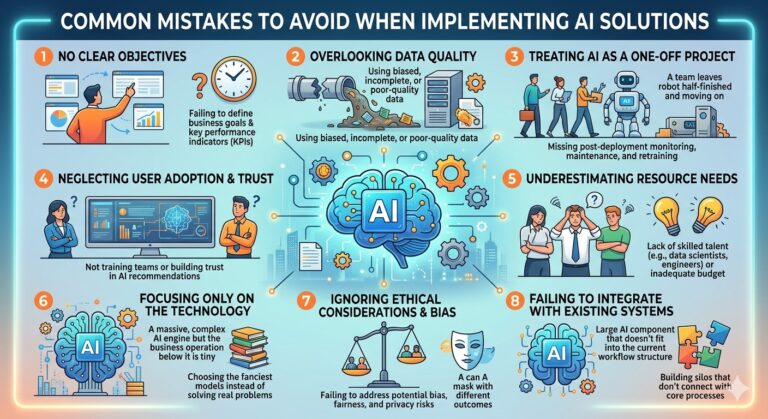
Common Mistakes to Avoid When Implementing AI Solutions
Artificial intelligence (AI) has become one of the most powerful technologies helping businesses improve operations, automate tasks, and create better customer experiences. From AI-powered customer support to intelligent analytics and automated workflows, AI solutions are helping organizations work smarter and faster.
However, adopting AI does not guarantee success. Many businesses struggle with AI implementation because they fail to plan properly, choose the wrong tools, or overlook important factors such as data quality, security, and employee training.
Understanding the common mistakes to avoid when implementing AI solutions can help businesses maximize their investment and achieve better results.
Why Proper AI Implementation Matters
AI technology can transform the way businesses operate, but successful implementation requires more than simply purchasing an AI tool.
A strong AI strategy requires:
- Clear business objectives
- Reliable data
- Proper planning
- Employee involvement
- Continuous improvement
Without the right approach, businesses may experience wasted resources, poor performance, and customer dissatisfaction.
Mistake #1: Implementing AI Without Clear Objectives
One of the most common mistakes businesses make is adopting AI without defining what they want to accomplish.
Some organizations implement AI because it is popular or because competitors are using it. However, AI should always solve a specific business problem.
Without clear goals, companies may struggle with:
- Measuring success
- Selecting the right AI tools
- Understanding business impact
- Achieving meaningful results
Before implementing AI, businesses should identify goals such as:
- Improving customer support
- Reducing repetitive tasks
- Increasing productivity
- Enhancing customer experiences
- Improving decision-making
A clear strategy ensures AI investments deliver real value.
Mistake #2: Choosing the Wrong AI Solution
Not every AI platform is designed for every business.
A common mistake is selecting an AI solution based only on features or popularity without considering actual business needs.
Businesses should evaluate:
- Platform capabilities
- Integration options
- Security features
- Scalability
- Ease of use
- Customer support
The best AI solution is one that fits the organization’s goals, workflow, and long-term plans.
Mistake #3: Ignoring Data Quality
AI systems depend on data to learn and provide accurate results. Poor-quality data can negatively affect AI performance.
Common data problems include:
- Incomplete information
- Outdated records
- Incorrect data
- Poor organization
Low-quality data can lead to:
- Inaccurate predictions
- Weak recommendations
- Poor customer interactions
- Incorrect automated decisions
Businesses should clean, organize, and secure their data before implementing AI solutions.
Mistake #4: Expecting Immediate Results
AI can create significant improvements, but successful implementation takes time.
Some businesses expect AI to instantly solve every problem. This can lead to disappointment when results require testing, adjustments, and optimization.
AI success often requires:
- Continuous monitoring
- System improvements
- Employee feedback
- Performance analysis
Treating AI as an ongoing process leads to better outcomes.
Mistake #5: Failing to Train Employees
AI tools are only effective when teams know how to use them properly.
Without employee training, businesses may face:
- Low adoption
- Confusion
- Inefficient usage
- Resistance to change
Organizations should provide:
- AI training sessions
- Clear guidelines
- Technical support
- Regular updates
Employees who understand AI can use it more effectively to improve productivity.
Mistake #6: Overlooking Customer Privacy
AI solutions often process customer information, making privacy and security essential.
Businesses must protect sensitive data by using:
- Secure storage systems
- Access controls
- Data encryption
- Responsible data practices
Ignoring privacy concerns can damage customer trust and create compliance issues.
Customers are more likely to trust businesses that use AI responsibly.
Mistake #7: Removing Human Interaction Completely
AI can automate many tasks, but it should not eliminate human involvement entirely.
Customers often need human support for:
- Complex questions
- Sensitive concerns
- Special requests
- Important decisions
The most effective AI strategies combine automation with human expertise.
AI should support employees, not replace meaningful customer relationships.
Mistake #8: Lack of AI Transparency
Customers and employees want to understand how AI systems work.
Businesses should be transparent about:
- When AI is being used
- How decisions are made
- What data is collected
- How information is protected
Transparent AI builds confidence and improves user acceptance.
Mistake #9: Poor Integration With Existing Systems
AI solutions work best when they connect smoothly with current business tools.
Poor integration can create:
- Workflow problems
- Data inconsistencies
- Extra manual work
- Reduced efficiency
Businesses should choose AI platforms that integrate with:
- Customer relationship management systems
- Communication tools
- Marketing platforms
- Business applications
Good integration makes AI easier to manage and more effective.
Mistake #10: Not Measuring AI Performance
A business cannot improve what it does not measure.
Some companies implement AI but fail to track whether it is actually helping.
Important AI performance metrics include:
- Customer satisfaction
- Response time
- Productivity improvements
- Cost savings
- Customer retention
- Conversion rates
Tracking results helps businesses optimize their AI strategy.
Mistake #11: Ignoring AI Security
Security should be a priority when implementing AI systems.
Businesses must protect AI platforms from:
- Unauthorized access
- Data leaks
- Cyber threats
- System vulnerabilities
A secure AI solution protects both business information and customer data.
Mistake #12: Not Planning for Future Growth
AI technology continues to evolve quickly. Businesses should choose solutions that can grow with their needs.
A scalable AI platform should support:
- Increasing customer interactions
- More users
- Additional features
- Expanding business operations
Choosing a flexible AI solution prevents future limitations.
Best Practices for Successful AI Implementation
Businesses can improve AI success by following these best practices:
Start With Specific Use Cases
Focus on areas where AI can create immediate value.
Improve Data Management
Maintain accurate, secure, and organized information.
Involve Employees
Encourage teams to participate in the AI adoption process.
Prioritize Security and Privacy
Protect customer and business data.
Continuously Optimize
Monitor AI performance and make improvements over time.
The Role of AI Customer Solutions
Modern AI customer solutions help businesses improve communication, automate support, and deliver personalized experiences.
Platforms like SmileLineAI help organizations use AI-powered customer engagement tools while maintaining efficiency, security, and better customer relationships.
Choosing the right AI solution allows businesses to avoid common implementation problems and achieve stronger results.
The Future of AI Adoption
As artificial intelligence continues to develop, businesses will rely on AI for more areas of operation.
Future AI success will depend on:
- Responsible implementation
- Strong data practices
- Human-AI collaboration
- Customer-focused strategies
- Continuous innovation
Organizations that approach AI carefully will be better prepared to compete in the digital future.
Final Thoughts
Implementing AI solutions can provide businesses with powerful advantages, but success depends on how the technology is adopted and managed.
Avoiding common mistakes such as poor planning, weak data practices, lack of transparency, and ignoring security can help businesses unlock the full potential of AI.
The most successful AI strategies combine advanced technology with human expertise, responsible practices, and a clear focus on improving customer experiences.