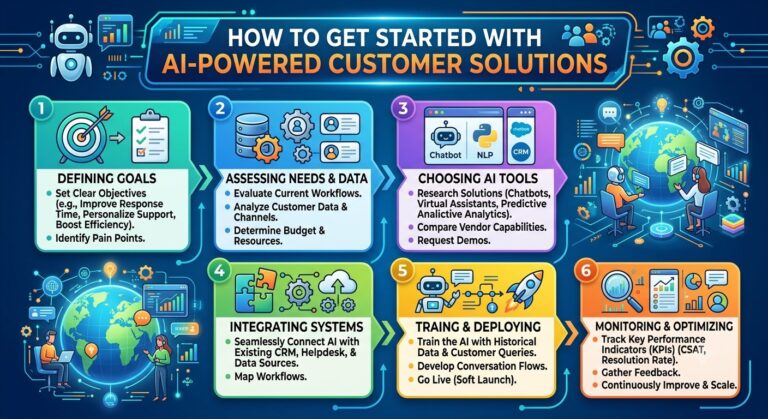
How to Get Started With AI-Powered Customer Solutions
Artificial intelligence (AI) is transforming the way businesses interact with customers. From automated support and personalized communication to intelligent data analysis and customer engagement, AI-powered customer solutions help businesses operate more efficiently while delivering exceptional customer experiences.
Many business owners recognize the potential of AI but are unsure where to begin. The good news is that modern AI tools are more accessible, affordable, and user-friendly than ever before. Businesses of all sizes can implement AI solutions without requiring extensive technical expertise.
In this guide, we’ll explore how to get started with AI-powered customer solutions, the benefits they provide, and the steps businesses can take to successfully integrate AI into their customer engagement strategies.
What Are AI-Powered Customer Solutions?
AI-powered customer solutions are technologies that use artificial intelligence to improve communication, support, and engagement with customers.
These solutions can automate repetitive tasks, analyze customer behavior, and provide personalized experiences across multiple channels.
Common examples include:
- AI chatbots
- Virtual assistants
- Automated messaging systems
- Customer analytics tools
- AI-driven recommendation engines
- Intelligent customer support platforms
By leveraging AI, businesses can improve efficiency while enhancing the overall customer experience.
Why Businesses Are Adopting AI Customer Solutions
Customer expectations continue to evolve. Today’s consumers expect:
- Instant responses
- Personalized interactions
- 24/7 availability
- Seamless communication across channels
Meeting these expectations manually can be challenging and costly.
AI-powered customer solutions help businesses:
- Improve response times
- Increase customer satisfaction
- Reduce operational costs
- Streamline customer service
- Generate valuable customer insights
As a result, AI has become an essential tool for modern customer engagement.
Step 1: Identify Your Customer Service Goals
Before implementing AI, businesses should clearly define their objectives.
Ask yourself:
- Do customers experience long wait times?
- Is your support team overwhelmed?
- Are you looking to improve customer engagement?
- Do you want to personalize customer interactions?
- Are repetitive inquiries consuming valuable resources?
Understanding your goals helps determine which AI solutions will provide the greatest value.
Step 2: Evaluate Your Current Customer Journey
Review how customers currently interact with your business.
Identify key touchpoints such as:
- Website inquiries
- Live chat conversations
- Email support
- Social media messaging
- Sales consultations
- Customer onboarding
Analyzing the customer journey helps identify areas where AI can improve efficiency and customer satisfaction.
Step 3: Start With AI Chatbots
For many businesses, AI chatbots are the easiest and most effective starting point.
AI chatbots can:
- Answer frequently asked questions
- Provide product information
- Assist with appointment scheduling
- Guide customers through purchasing processes
- Offer support outside business hours
Because chatbots handle routine inquiries automatically, support teams can focus on more complex customer needs.
Step 4: Implement Automated Messaging
Automated messaging solutions help businesses communicate consistently across multiple channels.
These systems can:
- Respond instantly to customer inquiries
- Send follow-up messages
- Deliver appointment reminders
- Share promotions and updates
Automation ensures customers receive timely communication without increasing staff workload.
Step 5: Use AI for Customer Insights
One of AI’s greatest strengths is its ability to analyze large amounts of data.
AI-powered analytics tools help businesses understand:
- Customer behavior
- Purchasing patterns
- Engagement trends
- Customer preferences
- Service performance metrics
These insights enable organizations to make data-driven decisions that improve customer experiences.
Step 6: Personalize Customer Interactions
Modern customers expect personalized experiences.
AI can help businesses tailor interactions by:
- Recommending products and services
- Delivering targeted promotions
- Customizing website experiences
- Providing personalized support
Personalization increases customer engagement and strengthens brand loyalty.
Step 7: Integrate AI With Existing Systems
Most AI solutions can integrate with existing business tools such as:
- Customer Relationship Management (CRM) platforms
- Help desk software
- Email marketing systems
- E-commerce platforms
- Social media channels
Integration ensures AI becomes part of your existing workflow rather than creating additional complexity.
Step 8: Monitor and Optimize Performance
Successful AI implementation requires ongoing monitoring and improvement.
Track key performance indicators such as:
- Customer satisfaction scores
- Response times
- Resolution rates
- Customer retention
- Engagement metrics
Regular evaluation helps businesses maximize the effectiveness of their AI-powered customer solutions.
Common Challenges and How to Overcome Them
Fear of Complexity
Many businesses assume AI is difficult to implement.
In reality, modern AI platforms offer user-friendly interfaces and simple setup processes that require minimal technical knowledge.
Concerns About Cost
AI solutions are available at various price points, making them accessible to businesses of all sizes.
Many organizations start with basic automation tools and expand their capabilities as they grow.
Worries About Replacing Human Employees
AI is designed to support employees, not replace them.
By automating repetitive tasks, AI allows teams to focus on relationship-building, problem-solving, and strategic work.
Best Practices for Responsible AI Adoption
As businesses implement AI, they should prioritize responsible and ethical practices.
Key considerations include:
- Protecting customer data
- Maintaining transparency about AI usage
- Monitoring for bias and inaccuracies
- Providing access to human support when needed
Responsible AI adoption helps build trust and improves customer confidence.
The Role of AI Communication Platforms
Modern AI communication platforms make it easier than ever to deploy intelligent customer engagement solutions.
Platforms like SmileLineAI provide businesses with AI-powered tools for customer support, lead generation, automated communication, and personalized engagement.
These solutions help organizations improve customer experiences while reducing operational complexity.
The Future of AI-Powered Customer Solutions
AI technology continues to advance rapidly, bringing new opportunities for customer engagement.
Future innovations are expected to include:
- More natural AI conversations
- Advanced predictive support
- Improved personalization
- Voice-powered customer interactions
- Smarter customer analytics
Businesses that begin adopting AI today will be well-positioned to take advantage of these emerging capabilities.
Final Thoughts
AI-powered customer solutions are transforming the way businesses engage with their audiences. By automating communication, improving personalization, and providing valuable customer insights, AI helps organizations deliver better experiences while operating more efficiently.
Getting started with AI does not require a large budget or technical expertise. By identifying business goals, implementing simple AI tools, and continuously optimizing performance, organizations can successfully integrate AI into their customer engagement strategies.
As customer expectations continue to evolve, businesses that embrace AI-powered solutions will gain a competitive advantage and build stronger, more meaningful relationships with their customers.