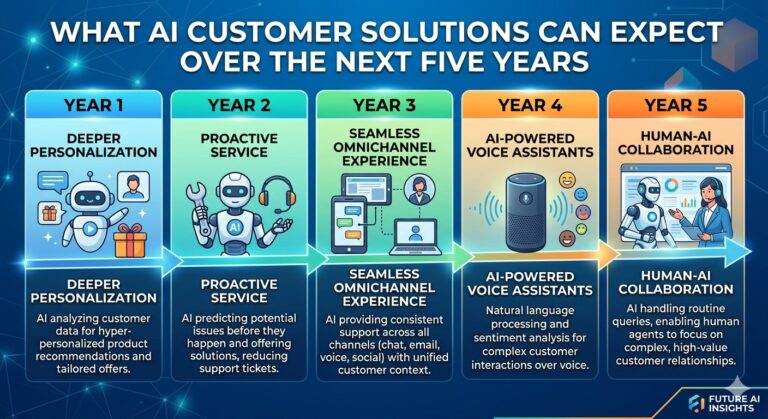
What AI Customer Solutions Can Expect Over the Next Five Years
Artificial intelligence is quickly changing how companies interact with and assist their clients. AI customer solutions are becoming a crucial component of contemporary corporate operations, ranging from chatbots and virtual assistants to predictive analytics and automated processes.
The next five years will see progressively more sophisticated AI-driven consumer experiences as technology advances. Early adoption of these advances will put businesses in a better position to boost productivity, enhance customer happiness, and maintain their competitiveness in an increasingly digital environment.
What companies and consumers may anticipate from AI customer solutions over the next five years is discussed in this article.
The Growing Role of AI in Customer Service
What AI Customer Solutions Can Expect Over the Next Five Years
Artificial intelligence is quickly changing how companies interact with and assist their clients. AI customer solutions are becoming a crucial component of contemporary corporate operations, ranging from chatbots and virtual assistants to predictive analytics and automated processes.
The next five years will see progressively more sophisticated AI-driven consumer experiences as technology advances. Early adoption of these advances will put businesses in a better position to boost productivity, enhance customer happiness, and maintain their competitiveness in an increasingly digital environment.
What companies and consumers may anticipate from AI customer solutions over the next five years is discussed in this article.
The Growing Role of AI in Customer Service
Customer expectations are changing faster than ever. Modern consumers want:
- Instant responses
- Personalized interactions
- 24/7 support
- Seamless communication across platforms
Traditional customer service systems often struggle to meet these demands at scale. AI customer solutions help businesses bridge this gap by automating communication and delivering faster, smarter support experiences.
Over the next five years, AI will become even more integrated into everyday customer interactions.
Smarter and More Human-Like Conversations
One of the biggest advancements expected in AI customer solutions is the improvement of conversational AI.
Future AI systems will better understand:
- Context and intent
- Emotional tone and sentiment
- Complex customer requests
- Natural conversational patterns
This means AI-powered conversations will feel more human and personalized, making customer interactions smoother and more engaging.
Customers will increasingly interact with AI systems that can carry meaningful conversations rather than simply answering scripted questions.
Hyper-Personalized Customer Experiences
Personalization will become far more advanced in the coming years. AI systems will analyze customer behavior, preferences, and interaction history to create highly customized experiences.
Future AI customer solutions may:
- Predict customer needs before they are expressed
- Recommend products or services with greater accuracy
- Deliver personalized communication in real time
- Adapt customer experiences dynamically across platforms
Businesses that leverage AI personalization effectively will build stronger customer loyalty and engagement.
Increased Use of Predictive Customer Support
AI will shift customer service from reactive to proactive support.
Instead of waiting for customers to report issues, AI systems will identify potential problems in advance and offer solutions before customers experience frustration.
Predictive AI may help businesses:
- Detect service disruptions early
- Prevent customer churn
- Recommend preventive maintenance or support
- Anticipate customer concerns based on behavior patterns
This proactive approach will significantly improve customer satisfaction.
Expansion of Voice and Multimodal AI
Voice technology and multimodal AI are expected to become more common in customer interactions.
Multimodal AI systems can combine:
- Text communication
- Voice recognition
- Image analysis
- Video understanding
Customers may interact with brands using voice assistants, visual interfaces, or a combination of communication methods.
For example, customers could use voice commands to troubleshoot products while AI analyzes uploaded images or videos to provide accurate assistance.
AI-Powered Omnichannel Communication
Over the next five years, businesses will continue moving toward seamless omnichannel communication powered by AI.
Customers expect consistent experiences whether they interact through:
- Websites
- Mobile apps
- Social media
- Messaging platforms
- Voice assistants
AI will unify these channels, ensuring customers receive smooth and connected experiences regardless of where the interaction begins.
Greater Collaboration Between AI and Human Agents
While AI automation will continue to expand, human support will remain essential for complex or emotionally sensitive situations.
Future customer solutions will focus on improving collaboration between AI systems and human agents.
AI will assist support teams by:
- Providing real-time customer insights
- Summarizing conversations instantly
- Suggesting solutions or responses
- Automating repetitive administrative tasks
This partnership will allow human agents to focus more on relationship-building and problem-solving.
Stronger Focus on Ethical AI and Privacy
As AI customer solutions become more advanced, businesses will face increasing pressure to ensure responsible and ethical AI usage.
Customers will expect businesses to:
- Protect personal data and privacy
- Be transparent about AI usage
- Avoid biased or unfair AI behavior
- Provide clear options for human support
Organizations that prioritize ethical AI practices will build stronger trust and credibility with customers.
AI Becoming More Accessible for Businesses
AI customer solutions will continue becoming more affordable and user-friendly, allowing businesses of all sizes to adopt intelligent automation.
Small and medium-sized businesses will increasingly use AI for:
- Customer support automation
- Lead generation and sales engagement
- Personalized marketing
- Workflow management
Platforms like SmileLineAI are already helping businesses integrate AI-powered communication tools that improve customer engagement and operational efficiency.
As AI technology becomes easier to implement, adoption will accelerate across industries.
The Competitive Advantage of AI Customer Solutions
Businesses that invest in AI customer solutions over the next five years will gain significant competitive advantages, including:
- Faster customer response times
- Improved customer satisfaction
- Better operational efficiency
- Stronger personalization capabilities
- Increased scalability
Companies that fail to adapt may struggle to meet evolving customer expectations in an AI-driven marketplace.
Final Thoughts
The future of AI customer solutions is intelligent, proactive, and deeply personalized. Over the next five years, AI will continue transforming how businesses communicate with customers by enabling smarter conversations, predictive support, and seamless omnichannel experiences.
As AI technology evolves, businesses that embrace innovation and prioritize ethical, customer-focused AI strategies will be better positioned for long-term growth and success.
AI customer solutions are no longer just tools for automation—they are becoming essential components of modern customer experience and business strategy.
Customer expectations are changing faster than ever. Modern consumers want:
- Instant responses
- Personalized interactions
- 24/7 support
- Seamless communication across platforms
Traditional customer service systems often struggle to meet these demands at scale. AI customer solutions help businesses bridge this gap by automating communication and delivering faster, smarter support experiences.
Over the next five years, AI will become even more integrated into everyday customer interactions.
Smarter and More Human-Like Conversations
One of the biggest advancements expected in AI customer solutions is the improvement of conversational AI.
Future AI systems will better understand:
- Context and intent
- Emotional tone and sentiment
- Complex customer requests
- Natural conversational patterns
This means AI-powered conversations will feel more human and personalized, making customer interactions smoother and more engaging.
Customers will increasingly interact with AI systems that can carry meaningful conversations rather than simply answering scripted questions.
Hyper-Personalized Customer Experiences
Personalization will become far more advanced in the coming years. AI systems will analyze customer behavior, preferences, and interaction history to create highly customized experiences.
Future AI customer solutions may:
- Predict customer needs before they are expressed
- Recommend products or services with greater accuracy
- Deliver personalized communication in real time
- Adapt customer experiences dynamically across platforms
Businesses that leverage AI personalization effectively will build stronger customer loyalty and engagement.
Increased Use of Predictive Customer Support
AI will shift customer service from reactive to proactive support.
Instead of waiting for customers to report issues, AI systems will identify potential problems in advance and offer solutions before customers experience frustration.
Predictive AI may help businesses:
- Detect service disruptions early
- Prevent customer churn
- Recommend preventive maintenance or support
- Anticipate customer concerns based on behavior patterns
This proactive approach will significantly improve customer satisfaction.
Expansion of Voice and Multimodal AI
Voice technology and multimodal AI are expected to become more common in customer interactions.
Multimodal AI systems can combine:
- Text communication
- Voice recognition
- Image analysis
- Video understanding
Customers may interact with brands using voice assistants, visual interfaces, or a combination of communication methods.
For example, customers could use voice commands to troubleshoot products while AI analyzes uploaded images or videos to provide accurate assistance.
AI-Powered Omnichannel Communication
Over the next five years, businesses will continue moving toward seamless omnichannel communication powered by AI.
Customers expect consistent experiences whether they interact through:
- Websites
- Mobile apps
- Social media
- Messaging platforms
- Voice assistants
AI will unify these channels, ensuring customers receive smooth and connected experiences regardless of where the interaction begins.
Greater Collaboration Between AI and Human Agents
While AI automation will continue to expand, human support will remain essential for complex or emotionally sensitive situations.
Future customer solutions will focus on improving collaboration between AI systems and human agents.
AI will assist support teams by:
- Providing real-time customer insights
- Summarizing conversations instantly
- Suggesting solutions or responses
- Automating repetitive administrative tasks
This partnership will allow human agents to focus more on relationship-building and problem-solving.
Stronger Focus on Ethical AI and Privacy
As AI customer solutions become more advanced, businesses will face increasing pressure to ensure responsible and ethical AI usage.
Customers will expect businesses to:
- Protect personal data and privacy
- Be transparent about AI usage
- Avoid biased or unfair AI behavior
- Provide clear options for human support
Organizations that prioritize ethical AI practices will build stronger trust and credibility with customers.
AI Becoming More Accessible for Businesses
AI customer solutions will continue becoming more affordable and user-friendly, allowing businesses of all sizes to adopt intelligent automation.
Small and medium-sized businesses will increasingly use AI for:
- Customer support automation
- Lead generation and sales engagement
- Personalized marketing
- Workflow management
Platforms like SmileLineAI are already helping businesses integrate AI-powered communication tools that improve customer engagement and operational efficiency.
As AI technology becomes easier to implement, adoption will accelerate across industries.
The Competitive Advantage of AI Customer Solutions
Businesses that invest in AI customer solutions over the next five years will gain significant competitive advantages, including:
- Faster customer response times
- Improved customer satisfaction
- Better operational efficiency
- Stronger personalization capabilities
- Increased scalability
Companies that fail to adapt may struggle to meet evolving customer expectations in an AI-driven marketplace.
Final Thoughts
The future of AI customer solutions is intelligent, proactive, and deeply personalized. Over the next five years, AI will continue transforming how businesses communicate with customers by enabling smarter conversations, predictive support, and seamless omnichannel experiences.
As AI technology evolves, businesses that embrace innovation and prioritize ethical, customer-focused AI strategies will be better positioned for long-term growth and success.
AI customer solutions are no longer just tools for automation—they are becoming essential components of modern customer experience and business strategy.