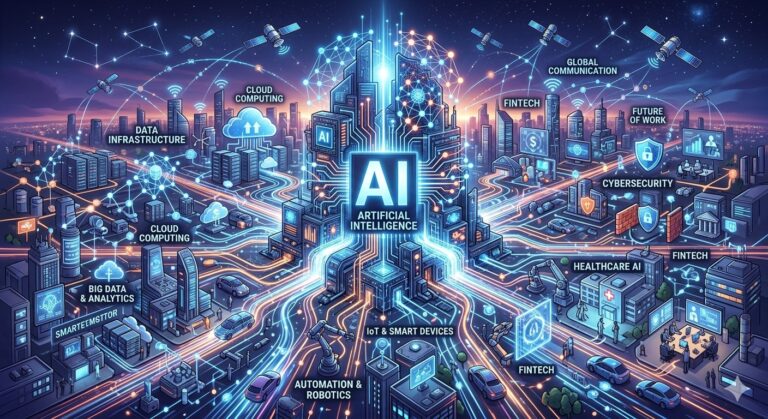
AI’s Place in the Current Digital Revolution
Businesses that want to remain competitive in the rapidly changing digital economy of today must prioritize digital transformation. In order to increase productivity, improve customer experiences, and seize new possibilities, businesses from all sectors are investing in new technology.
Artificial intelligence (AI) is at the core of this change. In 2026, AI will be essential in assisting businesses with data analysis, process automation, and the provision of more intelligent services. Companies that use AI-driven solutions may develop more quickly and respond to shifting consumer expectations more successfully.
Digital Transformation: What Is It?
The term “digital transformation” describes how digital technology are incorporated into every facet of a company. It entails utilizing technology to boost customer relations, optimize processes, and provide new value for clients.
Examples of digital transformation include:
- Automating manual processes
- Moving operations to cloud-based platforms
- Implementing data-driven decision-making
- Enhancing digital customer experiences
AI accelerates these initiatives by adding intelligence and automation to digital systems.
How AI Powers Digital Transformation
AI enhances digital transformation by enabling machines to analyze data, learn from patterns, and perform tasks that traditionally required human intelligence.
Businesses use AI to:
- Automate workflows and operations
- Improve customer engagement
- Predict market trends
- Optimize decision-making
- Personalize services at scale
By integrating AI into digital systems, companies can operate more efficiently and respond quickly to changes.
Automating Business Processes
Automation is one of the most significant benefits of AI in digital transformation. AI-powered automation reduces the need for manual work and minimizes errors.
AI can automate tasks such as:
- Customer support interactions
- Data processing and reporting
- Appointment scheduling
- Document management
- Workflow coordination
Automation allows teams to focus on strategic initiatives rather than repetitive tasks.
Enhancing Customer Experience
Customer experience has become a key competitive advantage. AI enables businesses to deliver faster, smarter, and more personalized interactions.
AI-driven tools can:
- Provide instant customer support
- Analyze customer behavior and preferences
- Deliver personalized recommendations
- Offer proactive assistance
Improved customer experiences lead to higher satisfaction, loyalty, and retention.
Enabling Data-Driven Decision Making
Modern businesses generate massive amounts of data. AI helps organizations analyze this data quickly and extract valuable insights.
With AI-powered analytics, businesses can:
- Identify trends and patterns
- Predict customer behavior
- Forecast demand
- Optimize marketing strategies
These insights enable leaders to make more informed decisions and drive better outcomes.
Improving Operational Efficiency
AI improves operational efficiency by streamlining workflows and identifying inefficiencies in business processes.
For example, AI systems can:
- Monitor system performance
- Detect operational bottlenecks
- Optimize resource allocation
- Improve supply chain management
These improvements help businesses reduce costs and increase productivity.
Supporting Innovation and Growth
Digital transformation is not only about improving existing processes—it also opens the door to innovation.
AI enables businesses to develop new products, services, and business models by:
- Analyzing market opportunities
- Identifying customer needs
- Testing new ideas quickly
- Enhancing product development
Companies that embrace AI-driven innovation can adapt to market changes more effectively.
Strengthening Competitive Advantage
Organizations that adopt AI as part of their digital transformation strategy gain a significant competitive edge.
AI helps businesses:
- Respond faster to customer needs
- Improve operational efficiency
- Deliver personalized experiences
- Scale operations without major cost increases
In competitive markets, these advantages can make a critical difference.
Why AI Is Essential for Digital Transformation in 2026
As technology continues to evolve, digital transformation has become a necessity rather than an option. AI plays a central role in this transformation by enabling businesses to operate smarter, faster, and more efficiently.
Platforms like SmileLineAI help businesses integrate AI-powered communication and automation tools that support modern digital transformation strategies.
Final Thoughts
AI is redefining digital transformation by bringing intelligence and automation to modern business systems. From improving customer experiences to optimizing operations and enabling data-driven decisions, AI empowers organizations to innovate and grow in a rapidly changing digital landscape.
In 2026 and beyond, businesses that successfully integrate AI into their digital transformation strategies will be better positioned for long-term success and competitive advantage.