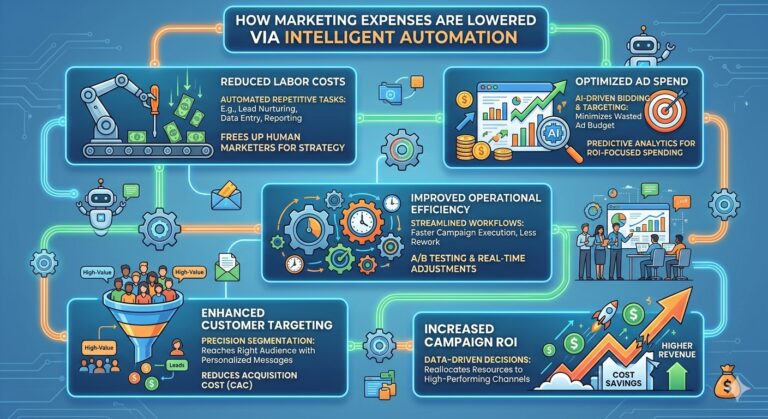
How Marketing Expenses Are Lowered via Intelligent Automation
Overview
Although it might be one of the most costly operational areas, marketing is crucial for the expansion of businesses. Marketing costs may mount up rapidly, from hiring experts and managing campaigns to creating content and evaluating results.
Businesses are finding a more effective strategy in 2026: intelligent automation. Businesses may drastically cut marketing expenses while increasing efficiency and effectiveness by incorporating automated marketing technologies and artificial intelligence into their operations.
Smart Marketing Automation: What Is It?
The use of digital platforms and AI-powered solutions to automate marketing processes and optimize campaigns is known as “smart marketing automation.” Smart systems, in contrast to conventional automation, examine data, identify trends, and make modifications on their own.
These systems can manage tasks such as:
- Email marketing campaigns
- Social media scheduling
- Ad campaign optimization
- Customer segmentation
- Analytics and reporting
By automating these activities, businesses can reduce manual work and operational expenses.
Reducing Labor Costs
One of the biggest expenses in marketing is human labor. Creating campaigns, monitoring performance, and managing customer interactions often require multiple team members.
Smart automation reduces labor costs by handling repetitive tasks automatically. Businesses can:
- Automate content publishing
- Schedule social media posts
- Send email campaigns automatically
- Generate performance reports
This allows smaller teams to manage large marketing operations without needing additional staff.
Improving Campaign Efficiency
Traditional marketing campaigns often rely on manual adjustments and delayed analysis. This can lead to wasted budgets on underperforming ads or ineffective strategies.
Smart automation tools analyze campaign performance in real time and optimize accordingly. They can:
- Pause low-performing ads
- Redirect budgets toward high-performing campaigns
- Adjust targeting parameters automatically
This ensures that marketing budgets are used more efficiently.
Minimizing Human Errors
Manual marketing processes are prone to errors such as incorrect targeting, scheduling mistakes, or inaccurate reporting.
Automation systems follow predefined rules and algorithms, reducing the likelihood of costly mistakes. By improving accuracy, businesses avoid unnecessary spending caused by human oversight.
Enhancing Customer Targeting
Marketing costs often increase when campaigns reach the wrong audience. Poor targeting results in wasted ad spending and low conversion rates.
Smart automation improves targeting through data analysis and customer behavior tracking. AI tools can:
- Identify ideal audience segments
- Predict customer interests
- Deliver personalized marketing messages
Better targeting leads to higher conversion rates and improved return on investment (ROI).
Reducing Content Production Costs
Content marketing is a major expense for many businesses. Writing blog posts, creating social media content, and producing marketing materials require time and resources.
Automation tools powered by AI can assist with:
- Generating content ideas
- Drafting marketing copy
- Optimizing content for SEO
- Repurposing existing content across platforms
These tools help businesses maintain consistent content production without dramatically increasing costs.
Automating Customer Engagement
Customer engagement is essential for building strong relationships and driving conversions. However, responding to inquiries and maintaining communication can be time-consuming.
Automation solutions such as chatbots and automated messaging systems provide instant responses to customers. This reduces the need for large support teams while maintaining high service quality.
Streamlining Marketing Workflows
Smart automation integrates various marketing processes into a single streamlined workflow. Instead of managing separate tools for different tasks, businesses can automate entire marketing sequences.
This improves efficiency by:
- Reducing tool complexity
- Eliminating redundant tasks
- Accelerating campaign execution
- Simplifying project management
Efficient workflows translate into lower operational costs.
Long-Term Financial Benefits of Marketing Automation
While implementing automation tools may require an initial investment, the long-term financial benefits are significant.
Businesses that adopt smart automation often experience:
- Lower operational costs
- Improved marketing ROI
- Faster campaign execution
- Better scalability
- Increased productivity
Over time, automation pays for itself by improving efficiency and reducing unnecessary spending.
Smart Automation and the Future of Marketing
As digital marketing continues to evolve, automation will become even more advanced. Artificial intelligence will enable deeper personalization, predictive analytics, and smarter campaign management.
Businesses that adopt automation early will be better positioned to compete in a technology-driven marketplace.
Smart automation is not just about saving money—it is about building a more efficient and scalable marketing system.
Conclusion
Smart automation is transforming the way businesses approach marketing. By reducing labor costs, improving targeting, minimizing errors, and optimizing campaigns, automation significantly lowers overall marketing expenses.
In 2026 and beyond, companies that leverage AI-powered marketing automation will operate more efficiently, achieve higher returns on investment, and scale their marketing efforts with greater ease.
For businesses looking to grow while controlling costs, smart automation is a powerful solution.