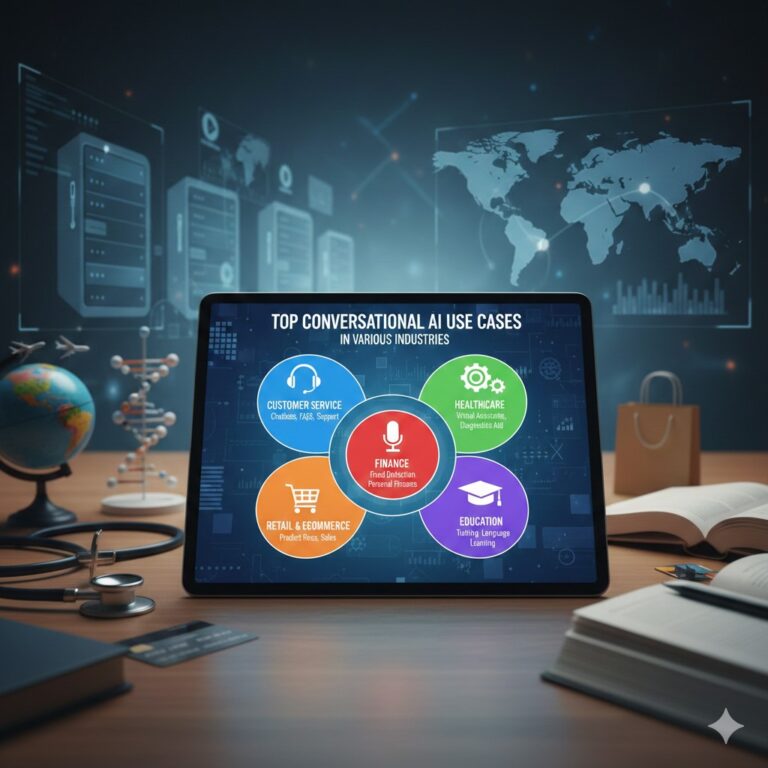
Top Conversational AI Use Cases in Various Industries
From basic automated chat tools to sophisticated intelligent systems that drive contemporary commercial communication, conversational AI has quickly advanced. Businesses in a variety of sectors are using conversational AI in 2026 to boost consumer interaction, cut expenses, and spur expansion.
Conversational AI is revolutionizing how businesses engage with their consumers and optimize internal procedures in a variety of industries, including retail, healthcare, finance, and education.
This article examines the most common applications of conversational AI in various industries and explains why it has emerged as a crucial tool for businesses.
Conversational AI, What Is It?
Conversational AI refers to technology that enables machines to simulate human-like conversations through text or voice. Powered by natural language processing (NLP), machine learning (ML), and intelligent automation, conversational AI understands user intent and delivers contextual responses in real time.
Unlike traditional scripted chatbots, conversational AI adapts, learns, and handles more complex interactions.
Retail & E-Commerce: Personalized Shopping Assistance
Retailers use conversational AI to create smarter, more engaging shopping experiences.
Key applications include:
- Product recommendations based on browsing behavior
- Real-time order tracking
- Cart abandonment reminders
- Automated returns and refund assistance
- Personalized promotional offers
Conversational AI enhances customer convenience, improves conversion rates, and increases customer retention in competitive online markets.
Healthcare: Patient Support and Appointment Management
Healthcare providers are adopting conversational AI to improve patient communication and operational efficiency.
Common use cases include:
- Appointment scheduling and reminders
- Answering common medical FAQs
- Pre-screening symptom assessments
- Providing medication reminders
- Post-treatment follow-ups
By automating routine interactions, healthcare professionals can focus on patient care while ensuring patients receive timely information.
Banking & Finance: Secure Customer Assistance
Financial institutions use conversational AI to provide secure, instant support for customers managing their accounts.
Examples include:
- Account balance inquiries
- Transaction history updates
- Fraud alerts and notifications
- Loan eligibility pre-checks
- Personalized financial product recommendations
Conversational AI improves response speed while maintaining strong security protocols.
Real Estate: Lead Qualification and Property Matching
In real estate, conversational AI helps agents manage inquiries efficiently.
Use cases include:
- Automated lead qualification
- Property recommendations based on preferences
- Virtual tour scheduling
- Instant answers to listing questions
This automation allows agents to focus on closing deals rather than handling repetitive inquiries.
Education: Student Engagement and Support
Educational institutions and online learning platforms leverage conversational AI to support students.
Applications include:
- Course recommendations
- Enrollment assistance
- Assignment reminders
- Technical support for online portals
- Instant responses to common questions
Conversational AI improves student experience and reduces administrative workload.
Travel & Hospitality: Seamless Booking and Support
The travel industry benefits greatly from conversational AI by delivering real-time assistance.
Key use cases:
- Flight and hotel booking support
- Reservation changes
- Travel itinerary updates
- Check-in assistance
- Handling cancellations or refunds
By providing 24/7 availability, businesses improve traveler satisfaction and reduce service bottlenecks.
SaaS & Technology Companies: Customer Support Automation
Software and tech companies use conversational AI to streamline customer support.
Common applications:
- Technical troubleshooting
- Knowledge base guidance
- Subscription management
- Onboarding assistance
- Proactive support alerts
Conversational AI reduces ticket volume and accelerates resolution times.
Human Resources: Recruitment and Employee Support
HR departments implement conversational AI for both hiring and internal communication.
Use cases include:
- Candidate pre-screening
- Interview scheduling
- Employee onboarding guidance
- HR policy inquiries
- Internal IT support requests
Automation enhances efficiency while improving employee experience.
Why Conversational AI Is Essential Across Industries
The widespread adoption of conversational AI is driven by its core benefits:
- 24/7 availability
- Faster response times
- Cost efficiency
- Scalability
- Personalized customer experiences
- Data-driven insights
Businesses across industries are recognizing that conversational AI is not just a support tool—it’s a strategic growth asset.
The Future of Conversational AI in 2026 and Beyond
As AI technology continues to evolve, conversational systems will become even more intuitive, proactive, and emotionally aware. Businesses that implement conversational AI today position themselves for stronger customer relationships and long-term competitive advantage.
Solutions like SmileLineAI help organizations deploy intelligent conversational systems that adapt to industry-specific needs and deliver measurable results.
Final Thoughts
Conversational AI is transforming industries by improving efficiency, enhancing engagement, and delivering smarter customer experiences. From retail and healthcare to finance and education, its applications continue to expand.
In 2026, businesses that embrace conversational AI are not just improving communication—they are redefining how they operate and grow.